Loading...
Contents
How to Prepare for a Software Engineer Interview
A Complete Guide (2026)
Jul 28, 202615 min readUpdated Sep 5, 2026
Preparing for a software engineer interview in 2026 means going beyond solving coding problems. Companies now evaluate computer science fundamentals, system design thinking, communication, and behavioral skills alongside coding ability. A structured plan, built around a realistic timeline and regular mock interviews, prepares you far better than random question practice.
Software engineering interviews look different than they did even a couple of years ago. Companies have gotten better at spotting candidates who memorized solutions without understanding them, so the process now weighs how you think, how you communicate, and how you handle a problem you haven't seen before, not just whether you can produce a correct answer.
Beyond coding, most interview loops now evaluate computer science fundamentals, system design reasoning for anyone beyond entry level, and behavioral signals like collaboration and ownership. A candidate who codes well but freezes when asked to explain a trade off out loud often loses out to someone with a slightly weaker solution but a clearer thought process.
This guide gives you a complete preparation framework, not just a list of things to study. You'll get a breakdown of the interview process itself, a 30 day preparation plan, practical checklists, and guidance on preparing for each round individually.
If you'd rather start rehearsing right away, you can practice with Mocklingo's AI mock interview, which simulates real interview pressure with follow up questions and instant feedback.
FREE TO USE
25K+ INTERVIEWS4.8★ RATING68% IMPROVEMENT
Crack Your Dream Job
Real Interviews. Real Pressure. Practice until it feels easy.
- Seamless Interview Experience
- Resume & JD Questions
- Instant Personalized Feedback
Understand the Software Engineer Interview Process
A typical software engineer interview process moves through resume screening, an online assessment, a technical interview, a coding round, system design for experienced roles, a behavioral interview, and a final round. Each stage tests something different, so preparation should be stage specific, not generic.
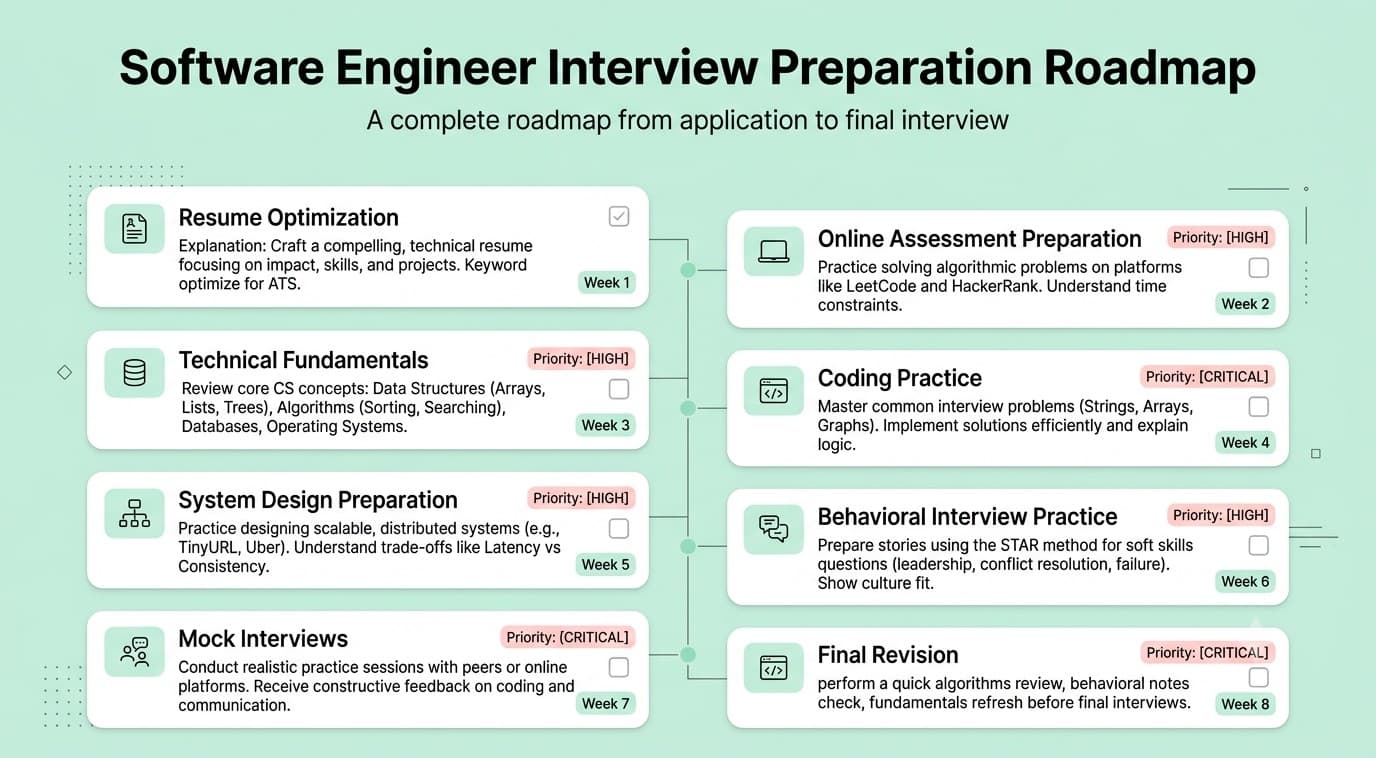
Resume Screening → Online Assessment → Technical Interview → Coding Round → System Design (if applicable) → Behavioral Interview → Final Interview
Resume Screening
Purpose: Filters candidates before any human conversation happens.
What recruiters evaluate: Relevant keywords, project quality, and whether your experience matches the role.
How to prepare: Tailor your resume to the specific job description and make sure your strongest, most quantifiable work is visible in the first few lines.
Online Assessment
Purpose: Tests baseline coding ability at scale before investing interviewer time.
What recruiters evaluate: Correctness, efficiency, and how you handle edge cases under a strict time limit.
How to prepare: Practice timed problems on the same platform format the company uses, since unfamiliar interfaces cost real time during the actual test.
Technical Interview
Purpose: Confirms your understanding of core computer science concepts beyond just coding syntax.
What recruiters evaluate: Depth of knowledge in areas like operating systems, databases, and networking, along with how clearly you explain them.
How to prepare: Revise fundamentals with real examples ready, not just definitions you can recite.
Coding Round
Purpose: Tests applied problem solving in real time, often with an interviewer watching your process.
What recruiters evaluate: Your approach, communication while coding, and ability to handle hints or pushback.
How to prepare: Practice explaining your reasoning out loud, not just solving problems silently.
System Design (if applicable)
Purpose: Evaluates your ability to design scalable, reliable systems, usually for mid level and senior roles.
What recruiters evaluate: How you handle trade offs, ambiguity, and scale in your architecture decisions.
How to prepare: Study common design patterns and practice narrating your design choices as you build them.
Behavioral Interview
Purpose: Assesses collaboration, ownership, and how you've handled real workplace situations.
What recruiters evaluate: Specificity and honesty in your answers, not just a polished delivery.
How to prepare: Prepare STAR formatted stories for common scenarios like conflict, failure, and leadership.
Final Interview
Purpose: Often a culture or leadership round to confirm overall fit before an offer.
What recruiters evaluate: Alignment with company values and your long term motivation for the role.
How to prepare: Research the team and product deeply enough to ask specific, informed questions.
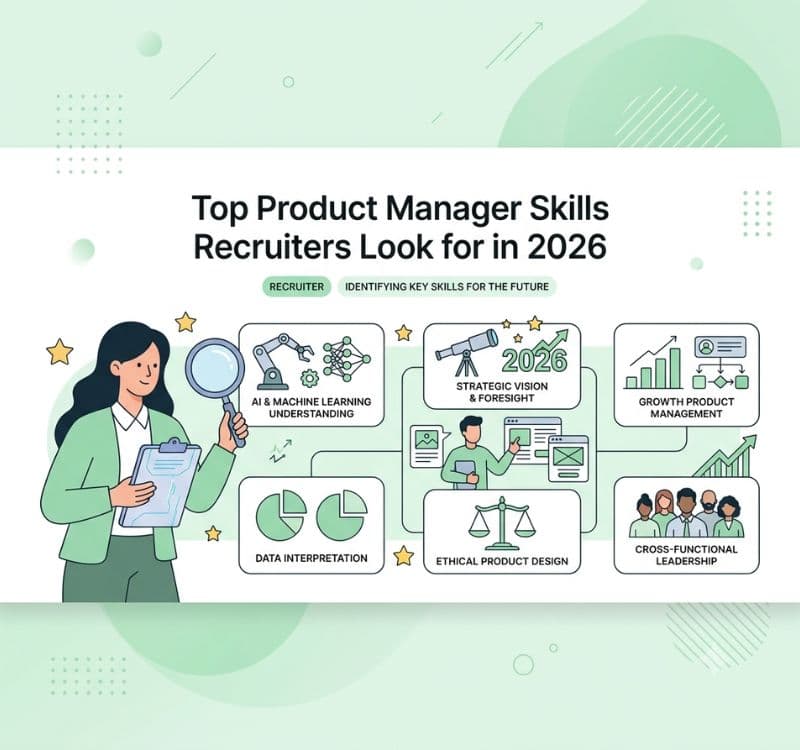
Know What Skills Companies Evaluate
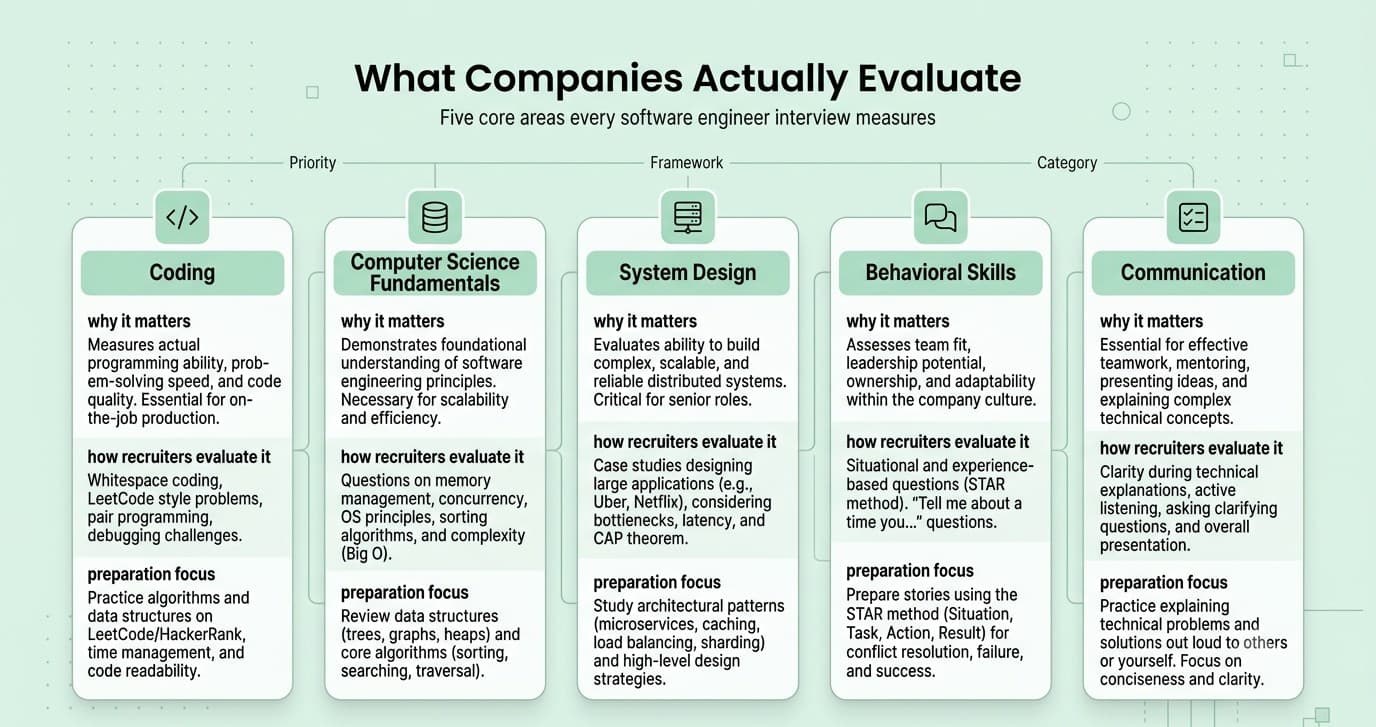
Companies evaluate five core areas in a software engineer interview: coding, computer science fundamentals, system design, behavioral skills, and communication. Each area needs a different kind of preparation, and skipping any one of them creates a visible gap in the interview.
| Area | Why It Matters | Preparation Focus |
|---|---|---|
| Coding | Tests your ability to solve problems efficiently under real constraints | Practice DSA daily |
| Computer Science Fundamentals | Confirms your technical understanding beyond memorized code | Review OS, DBMS, and networks |
| System Design | Assesses your ability to think about scalability and trade offs | Learn core architecture patterns |
| Behavioral Skills | Measures how well you collaborate and take ownership | Prepare STAR examples |
| Communication | Reveals how clearly you can explain your thought process | Practice explaining solutions out loud |
For a deeper breakdown of exactly which skills recruiters prioritize and how to demonstrate each one, see Software Engineer Skills Recruiters Look for in 2026.
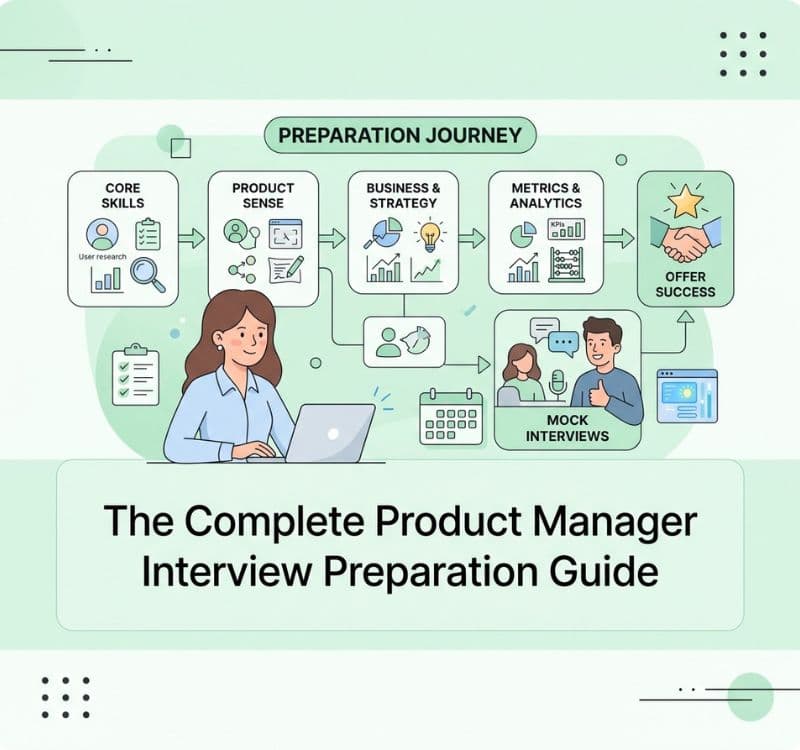
Create a 30 Day Interview Preparation Plan
A 30 day software engineer interview preparation plan works best when structured in four phases: fundamentals and resume review in week one, data structures and daily coding in week two, system design and mock interviews in week three, and company specific preparation with full mock interviews in week four.
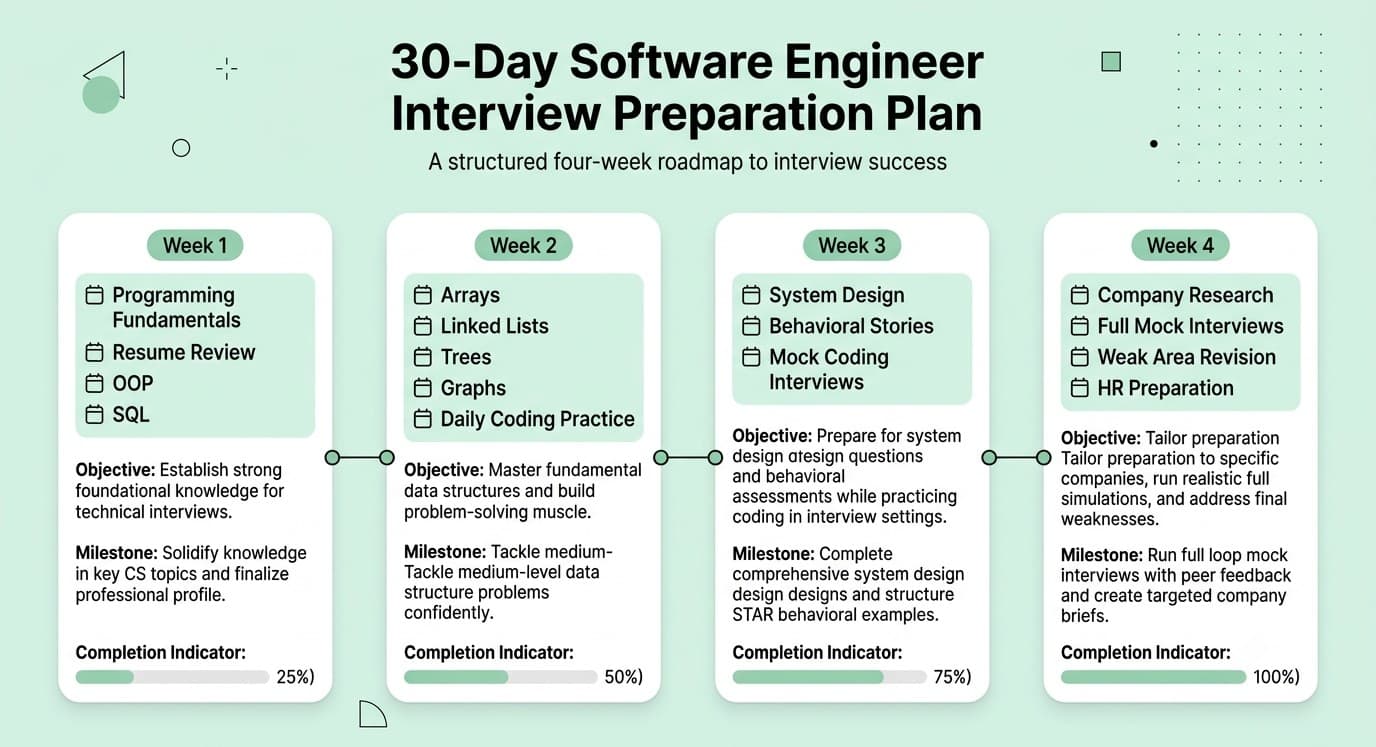
Week 1: Foundations
- Review programming fundamentals in your primary language
- Revisit object oriented programming concepts
- Refresh core SQL commands and query patterns
- Review and update your resume against target job descriptions
Week 2: Data Structures and Algorithms
- Study core data structures: arrays, linked lists, trees, graphs, and hash maps
- Practice algorithm patterns: sliding window, two pointers, recursion, and dynamic programming
- Solve at least one coding challenge daily, gradually increasing difficulty
Week 3: System Design and Behavioral Prep
- Learn system design fundamentals: scalability, caching, load balancing, and databases
- Draft STAR formatted answers for common behavioral questions
- Start taking mock coding interviews, ideally with a timer
Week 4: Final Preparation
- Research target companies and review their engineering blogs or known interview patterns
- Take full length mock interviews covering coding, technical, and behavioral rounds
- Revisit weak areas identified during mock sessions
- Prepare HR round answers, including salary expectations and questions to ask
Build a Practical Preparation Checklist
A practical preparation checklist covers three areas: technical readiness (language, DSA, SQL, APIs, Git, debugging), interview materials (resume, portfolio, GitHub, LinkedIn), and practice habits (timed coding, explaining solutions aloud, behavioral answers, and mock interviews).
A practical preparation checklist covers three areas: technical readiness (language, DSA, SQL, APIs, Git, debugging), interview materials (resume, portfolio, GitHub, LinkedIn), and practice habits (timed coding, explaining solutions aloud, behavioral answers, and mock interviews).
Technical
- Programming language fundamentals
- Data structures and algorithms
- SQL and database basics
- API concepts and usage
- Git and version control
- Debugging practice
Interview Materials
- Resume tailored to the role
- Portfolio with project write ups
- GitHub cleaned up and organized
- LinkedIn profile updated
Practice
- Timed coding practice
- Whiteboard or verbal problem explanation
- Behavioral answers rehearsed
- AI mock interview completed
FREE TO USE
8k+ SESSIONS92% FLUENCY4.9★ RATING
Speak With Confidence
Real Conversations. Real Scenarios. Speak until it feels natural.
- Real-Time Speaking Practice
- Guided Conversation Flows
- Instant AI Feedback
Best Resources to Prepare
Effective preparation draws from a mix of resource types: coding practice platforms for hands on problem solving, official documentation for accuracy, open source projects for real world code exposure, technical books for depth, engineering blogs for current practices, and mock interview platforms for realistic practice.
- Coding platforms: Structured problem sets that let you practice patterns repeatedly and track improvement over time.
- Official documentation: The most accurate source for language and framework specific details, especially useful when preparing for technical deep dives.
- Open source projects: Reading real, production level code exposes you to patterns and practices that textbooks rarely cover.
- Technical books: Useful for building depth in specific areas like system design or algorithms rather than surface level familiarity.
- Engineering blogs: Company engineering blogs often reveal the exact kind of problems and scale considerations their interviews are built around.
- Mock interview platforms: Realistic practice under pressure, ideally with structured feedback, closes the gap between knowing material and performing well live.
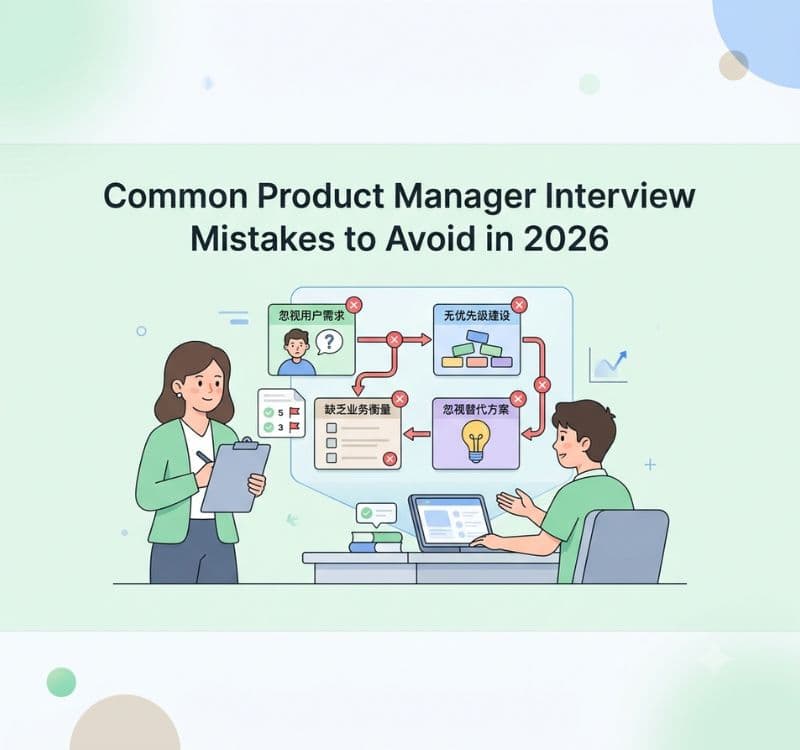
Common Preparation Mistakes
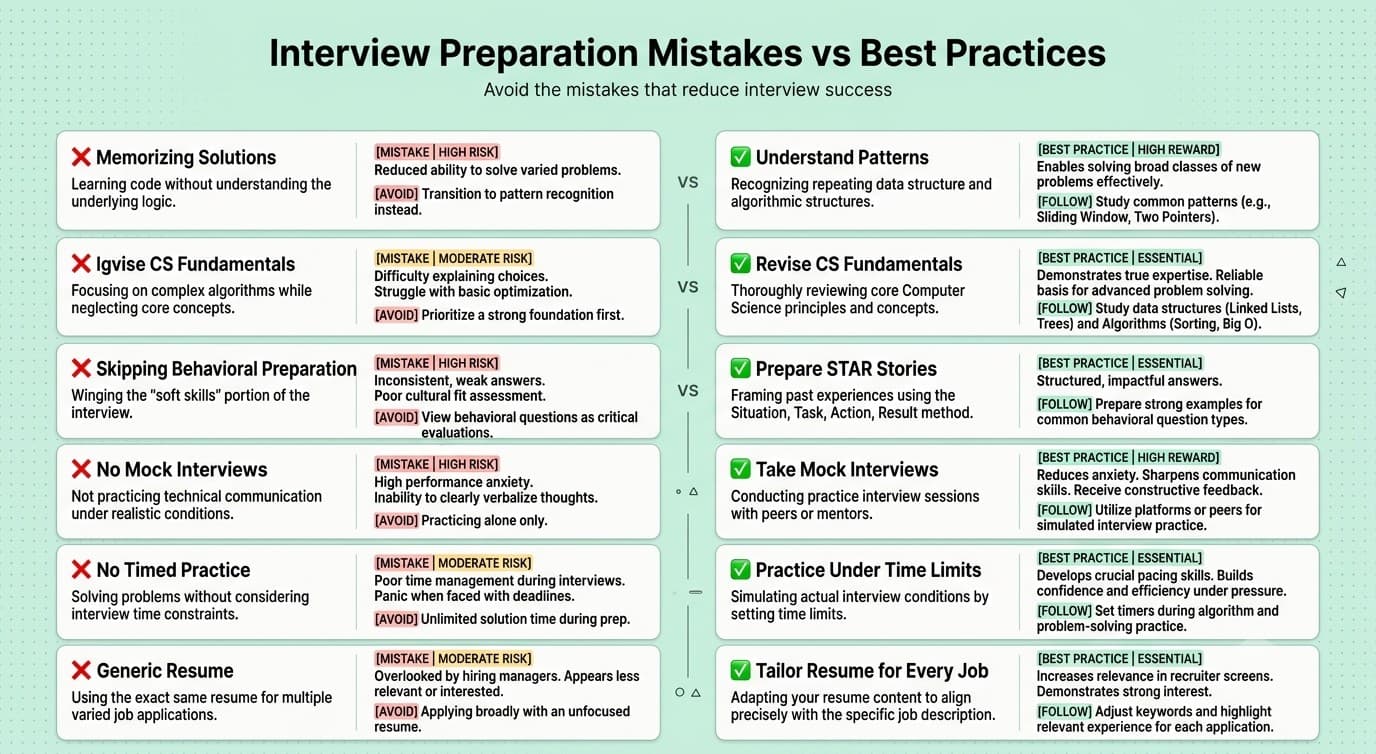
The most common software engineer interview preparation mistakes are memorizing solutions instead of understanding them, ignoring fundamentals, skipping behavioral preparation, avoiding mock interviews, never practicing under a timer, and neglecting resume review before applying.
- Memorizing solutions. Interviewers often change constraints mid question specifically to catch memorized answers. Fix this by practicing enough variations that you understand the underlying pattern, not just one specific problem.
- Ignoring fundamentals. Strong coding skills alone won't cover a technical round focused on core computer science concepts. Fix this by dedicating specific study time to fundamentals, not just coding practice.
- Skipping behavioral preparation. Many candidates prepare extensively for coding and then improvise behavioral answers on the spot. Fix this by writing out STAR stories in advance, even if you never read them word for word in the actual interview.
- No mock interviews. Practicing alone rarely reveals how you perform under real conversational pressure. Fix this by scheduling at least one full mock interview before the real one.
- Not timing practice. Solving problems without a timer builds false confidence, since real interviews always have time pressure. Fix this by practicing every problem with a strict, realistic time limit.
- Ignoring resume review. A resume that doesn't match the job description can filter you out before any interview happens. Fix this by tailoring your resume for each role rather than sending the same version everywhere.
READ MORE: common software engineer interview mistakes
Why Mock Interviews Improve Interview Performance
Mock interviews improve performance because they add real time pressure and structured feedback that solo studying can't replicate. AI mock interviews specifically offer unlimited repetitions and instant performance insights, compared to the limited, inconsistent feedback available through traditional self practice.
| Traditional Practice | AI Mock Interview |
|---|---|
| Self assessment | Instant structured feedback |
| Practice with friends, if available | Available anytime |
| Limited repetitions | Unlimited practice |
| General, subjective feedback | Detailed performance insights |
Practicing alone or with friends has real value, but it's inconsistent. Friends aren't always available, self assessment misses blind spots, and feedback tends to be general rather than specific. This is where Mocklingo's AI mock interview fits into a preparation plan. It simulates the actual pressure of a live interview, asks personalized follow up questions based on how you respond, and gives instant, structured feedback you can act on immediately, all without needing to schedule anyone else's time.
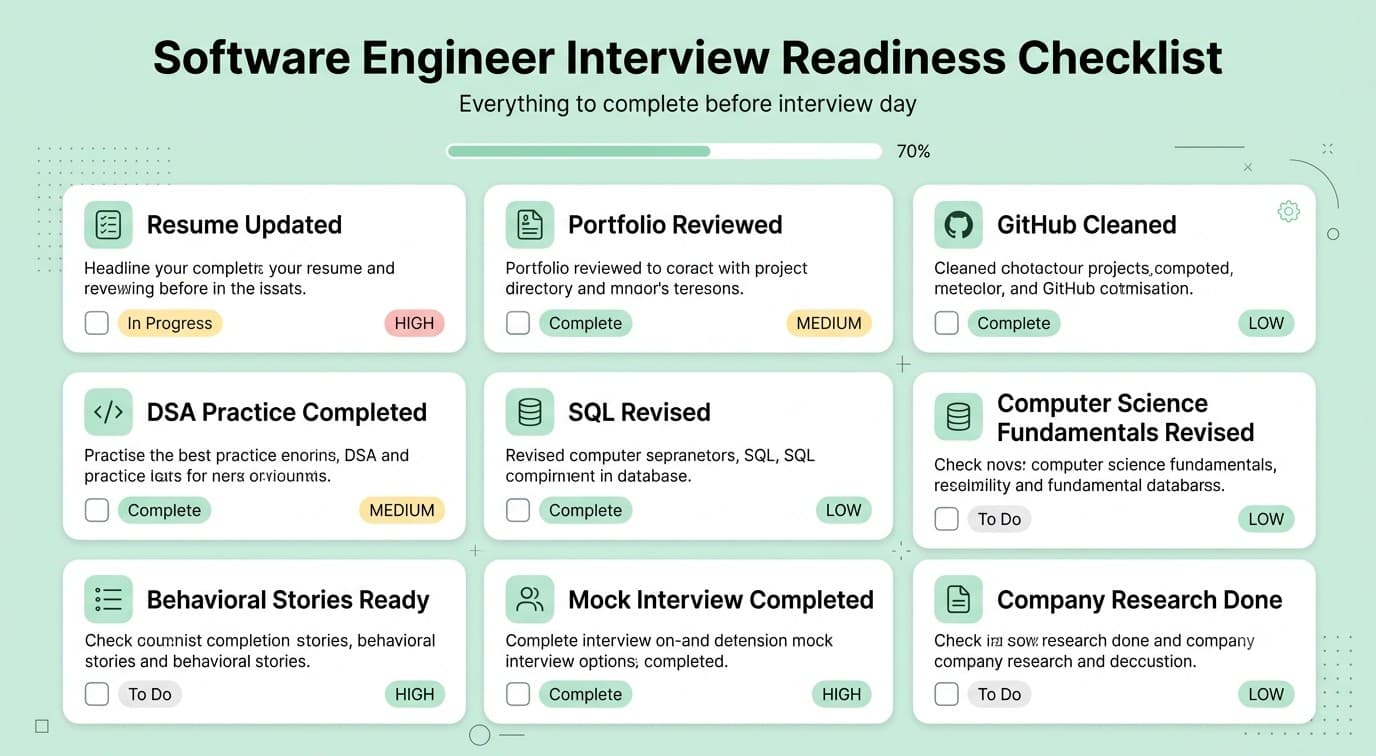
Software Engineer Interview Preparation Checklist
- Resume updated
- Portfolio reviewed
- GitHub cleaned up
- DSA practice completed
- SQL revised
- CS fundamentals revised
- Behavioral stories prepared
- Mock interview completed
- Company research done
Conclusion
Preparing for a software engineer interview in 2026 means treating it as a complete system, not a single skill to cram. Understanding the interview process, studying across all five evaluated areas, following a structured timeline, and practicing under real conditions puts you far ahead of candidates who only grind coding problems the week before.
Once your fundamentals and plan are in place, the next step is practice that mirrors the real thing. Continue your preparation with:
Start Your Free Software Engineer Mock Interview