Loading...
Contents
Top Python Developer Skills Recruiters Look for in 2026
Aug 13, 202650 min readUpdated Sep 23, 2026
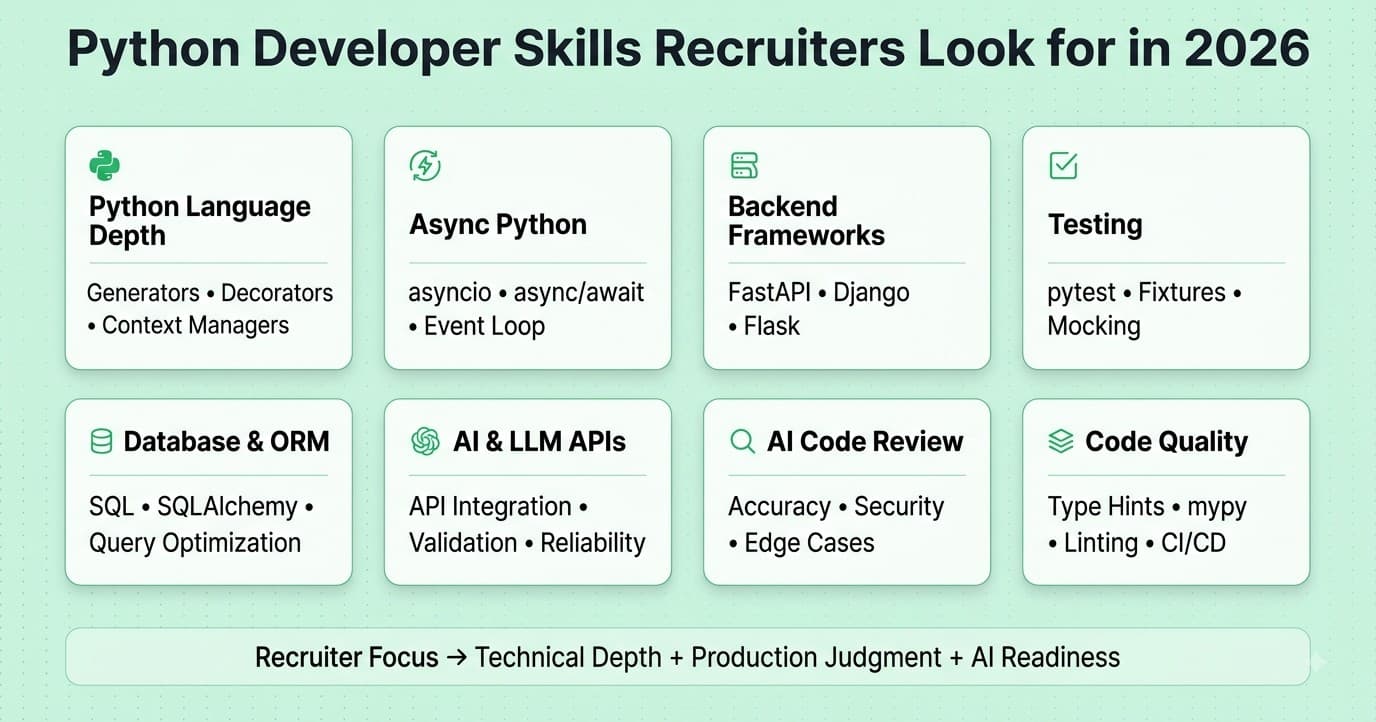
In 2026, recruiters hiring Python developers prioritize deep language fundamentals including generators, decorators, and async patterns, backend framework fluency in FastAPI or Django, test-driven development with pytest, database and ORM design judgment, and the ability to integrate and build on top of AI and LLM APIs. Python's role has expanded dramatically beyond web backends into AI engineering, data pipelines, and automation, so recruiters now evaluate candidates across a wider surface than they did even two years ago. Certifications matter far less than a project that runs in production and solves a real problem end to end.
If you have browsed Python developer job postings recently, you will have noticed something strange: the list of required skills has gotten longer and more varied, even as the core language has stayed consistent. A Python developer in 2026 might be hired to build a FastAPI backend, orchestrate an LLM pipeline, write data transformation scripts for an analytics team, or automate infrastructure provisioning. The same language, radically different contexts.
This is both an opportunity and an interview preparation challenge. Recruiters hiring Python developers are no longer evaluating a single, narrow profile. They are evaluating whether a candidate has the language depth to adapt across contexts, the judgment to choose the right tool within Python's sprawling ecosystem, and the presence of mind to work alongside AI coding tools without losing ownership of the quality and correctness of the code.
I have hired and evaluated Python developers across two decades, in startups building their first API and in engineering organizations maintaining systems at significant scale. The mistakes I see most often are not knowledge gaps. They are candidates who learned Python through a single framework's patterns without understanding the language beneath them, or who optimized their preparation for the wrong interview signals. This guide is built to fix that gap precisely.
FREE TO USE
25K+ INTERVIEWS4.8★ RATING68% IMPROVEMENT
Crack Your Dream Job
Real Interviews. Real Pressure. Practice until it feels easy.
- Seamless Interview Experience
- Resume & JD Questions
- Instant Personalized Feedback
How Hiring for Python Developers Has Changed Going Into 2026
The biggest shift is that Python is now the primary language of the AI engineering boom, meaning recruiters are seeing candidates from data science, automation, scripting, and traditional backend backgrounds all competing for the same roles. The ability to work fluently across these contexts, rather than deep specialization in just one, has become a meaningful differentiator alongside genuine language depth.
Several forces are reshaping what Python hiring looks like right now:
- AI engineering has merged with Python backend development. The skills needed to build an API that wraps and serves an LLM pipeline are now expected of Python backend developers at many companies, not just ML engineers. Candidates who can build with FastAPI, manage async I/O, and integrate external AI APIs are significantly more employable than those who treat these as separate disciplines.
- FastAPI has become the dominant framework signal for modern roles. Django fluency still matters, especially at companies with existing Django codebases, but FastAPI's async-first architecture and automatic documentation generation mean it now appears in more new greenfield role requirements than Flask or Django combined.
- Testing discipline has moved from a nice-to-have to a hiring signal. Recruiters have learned the hard way that candidates who do not write tests create expensive maintenance problems, and take-home assignments now routinely include test coverage as an explicit evaluation criterion.
- Async Python is no longer optional. asyncio, async def, and understanding the event loop were specialist knowledge two years ago. They are now expected competencies for any role involving I/O-heavy backend work, API integrations, or AI pipeline orchestration.
- AI copilot fluency is assumed, and review discipline is what gets tested. Most engineering teams now take for granted that candidates use AI tools. Interviews have shifted to testing whether a candidate can catch what the AI gets wrong, not whether they can write faster than the AI generates.
Core Fundamentals
Python Language Internals and Depth
Why Recruiters Prioritize This Skill
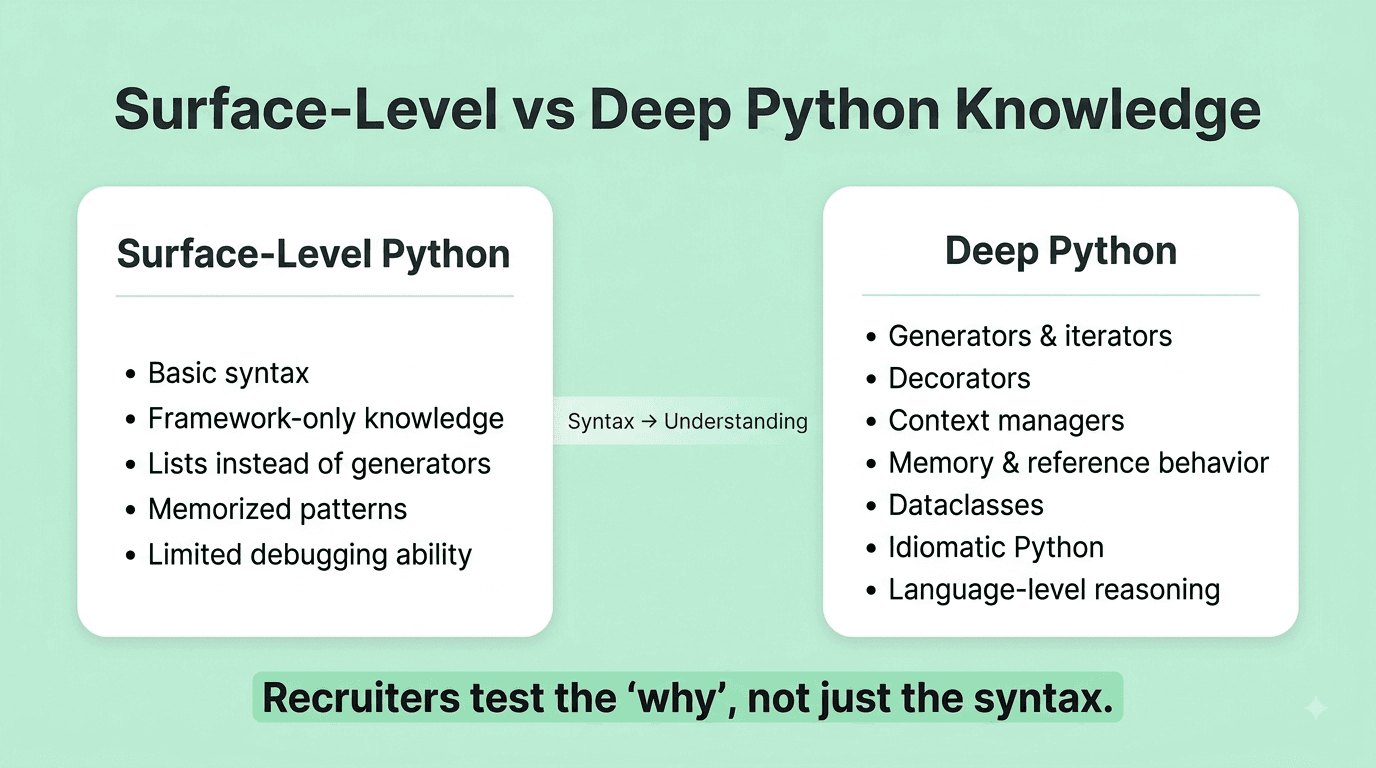
Python is unusually easy to write at a surface level, which means the gap between a candidate who "knows Python" and one who understands it deeply is invisible on a resume and very visible in an interview. Recruiters test language depth because it predicts whether a candidate will be confused by production bugs that fall outside a framework's happy path, unable to optimize code that is too slow, or dependent on Googling basic patterns under time pressure.
What Recruiters Actually Expect in 2026
Beyond basic syntax, recruiters now expect comfortable fluency with generators and the iterator protocol, decorators including those that take arguments, context managers using both the class and contextlib approaches, list and dict comprehensions including nested ones, and a working understanding of Python's memory model including mutable default arguments, shallow versus deep copy behavior, and reference semantics. Candidates are also expected to understand when to use a dataclass versus a regular class versus a named tuple, since these choices show up constantly in real Python codebases.
Interview Evaluation
Resume screening looks for evidence of Python use beyond tutorials, such as contributions to open-source Python projects, or descriptions of work that reference specific language features rather than just framework usage. Technical interviews include "what will this code output and why" questions designed specifically around tricky behaviors like mutable default arguments, late binding in closures, and generator exhaustion. Practical rounds may ask candidates to refactor an imperative loop into a generator-based approach, testing whether they can write idiomatic Python rather than translated Java or JavaScript.
Real Workplace Example
A backend function processes a large dataset row by row and builds a filtered result list. A developer with only surface Python knowledge builds this with a list comprehension that loads the entire dataset into memory before returning anything. A developer with generator fluency rewrites it as a generator function, allowing the caller to stream results without ever materializing the full list in memory, cutting the function's peak memory usage from gigabytes to kilobytes for large datasets.
Fresher Expectations
Understands list comprehensions, basic decorators, and the difference between mutable and immutable types. Can explain why a mutable default argument causes unexpected behavior when asked.
Mid-Level Expectations
Writes idiomatic Python instinctively, including generators for lazy evaluation, context managers for resource management, and dataclasses for structured data. Understands the GIL and why it matters for CPU-bound versus I/O-bound concurrency choices.
Senior-Level Expectations
Makes language-level architectural decisions for a team, such as whether to use slots for memory optimization on high-volume objects, when to prefer a protocol over an abstract base class for duck typing, and how to structure a large codebase's import hierarchy to avoid circular dependency problems.
Common Mistakes
Candidates frequently list Python on their resume but default to non-Pythonic patterns: using range and index to iterate when enumerate would be correct, building lists when generators are more appropriate, or writing class hierarchies that reflect Java thinking rather than Python's duck-typing idioms. These patterns are instantly recognizable to experienced reviewers.
How to Build This Skill
Read the Python documentation on the data model directly, not a blog post summarizing it, because the official documentation covers edge cases that tutorials skip. Then pick ten built-in functions you have never used in production and build a small project that uses each one deliberately. Write a module that implements a custom context manager, a custom iterator, and a decorator that takes arguments, and explain each to yourself aloud.
Example Interview Questions
"What will this code print, and why?" followed by a snippet with a mutable default argument accumulating state across calls. "What is the difference between a generator function and a generator expression, and when would you prefer each?" "Explain what the contextlib.contextmanager decorator actually does under the hood."
Strong Sample Answer Direction
A strong answer goes one layer deeper than the surface behavior: not just "mutable defaults are shared across calls" but "because default argument values are evaluated once when the function is defined and stored as part of the function object, not evaluated fresh each call." This level of explanation tells the interviewer the candidate understands the mechanism, not just the symptom.
Async Python and the asyncio Model
Why Recruiters Prioritize This Skill
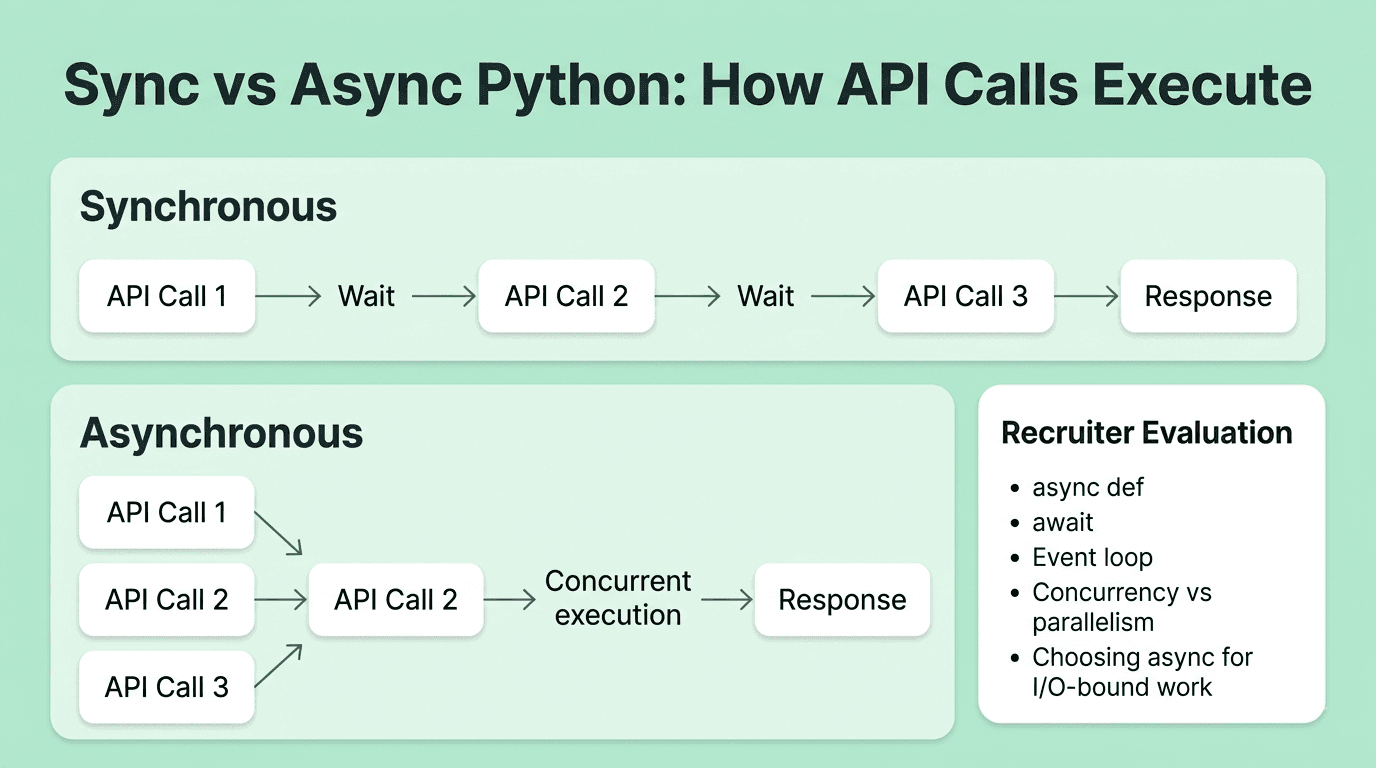
Modern Python backends, particularly those integrating with external APIs, databases, or LLM providers, spend the majority of their execution time waiting for I/O. Async Python allows a single thread to handle many of these waits concurrently without the overhead and complexity of multithreading. Recruiters prioritize this skill because I/O-heavy code written synchronously creates performance bottlenecks that are expensive and architecturally disruptive to fix later.
What Recruiters Actually Expect in 2026
The ability to write and reason about async def functions, understand what await actually does at the event loop level, use asyncio.gather for concurrent I/O, and explain why you cannot simply call an async function from a synchronous context without a runner. Candidates are also expected to know when async is the right choice versus where threading or multiprocessing would be more appropriate, since applying async to CPU-bound work is a common and consequential mistake.
Interview Evaluation
Live coding rounds increasingly include an async component: rewriting a synchronous function that makes multiple API calls so that the calls run concurrently rather than sequentially. The evaluation is as much on the explanation of what changed and why as on the working code itself.
Real Workplace Example
A data enrichment service needs to call three different external APIs for each record processed. Written synchronously, processing a batch of one hundred records takes the latency of all three calls multiplied by one hundred, sequentially. Written with asyncio.gather, the three calls per record run concurrently, and the total time collapses to roughly the latency of the slowest single call per record, a three times speedup without any additional infrastructure.
Fresher Expectations
Understands that async def and await are about concurrency for I/O-bound work, can write a simple async function that calls an external API, and knows that you cannot call an async function with a regular function call.
Mid-Level Expectations
Uses asyncio.gather and asyncio.create_task confidently, understands the difference between concurrency and parallelism, and knows when to use threading or multiprocessing for CPU-bound work instead of asyncio.
Senior-Level Expectations
Designs async architectures for services under real throughput requirements, understands backpressure and how to prevent a high-concurrency async application from overwhelming downstream dependencies, and mentors others on debugging async code, which requires different tooling and mental models than synchronous debugging.
Common Mistakes
The two most common mistakes are applying async/await to CPU-bound code where it provides no benefit and adds complexity, and writing async code that accidentally blocks the event loop by calling a synchronous blocking function from inside an async context, which defeats the entire purpose of the async architecture.
How to Build This Skill
Build a small project that makes concurrent HTTP requests to a public API, first synchronously and then with asyncio.gather, and measure the actual time difference. Then deliberately introduce a blocking call inside an async function and observe exactly how it impacts the event loop. The contrast between the two experiences is more educational than any tutorial.
Example Interview Questions
"What does the await keyword actually do at the event loop level?" "Why can't you call an async function directly from a synchronous function, and how do you bridge that boundary?" "When would you choose asyncio over threading for handling concurrent work?"
Strong Sample Answer Direction
A strong answer explains that await suspends the current coroutine and yields control back to the event loop, which can then run other coroutines that are ready, until the awaited object signals completion. This mechanism explanation is what separates a candidate who understands async Python from one who has memorized the syntax.
Technical Skills
Backend Framework Fluency: FastAPI, Django, and Flask
Why Recruiters Prioritize This Skill
Python backend frameworks are the surface area where most Python developers spend their actual work time, and framework fluency signals whether a candidate can be productive quickly on a real codebase rather than needing months of onboarding. Recruiters evaluate framework knowledge not to test memorization of specific APIs, but to assess whether a candidate understands the design philosophy behind the framework they claim to know.
What Recruiters Actually Expect in 2026
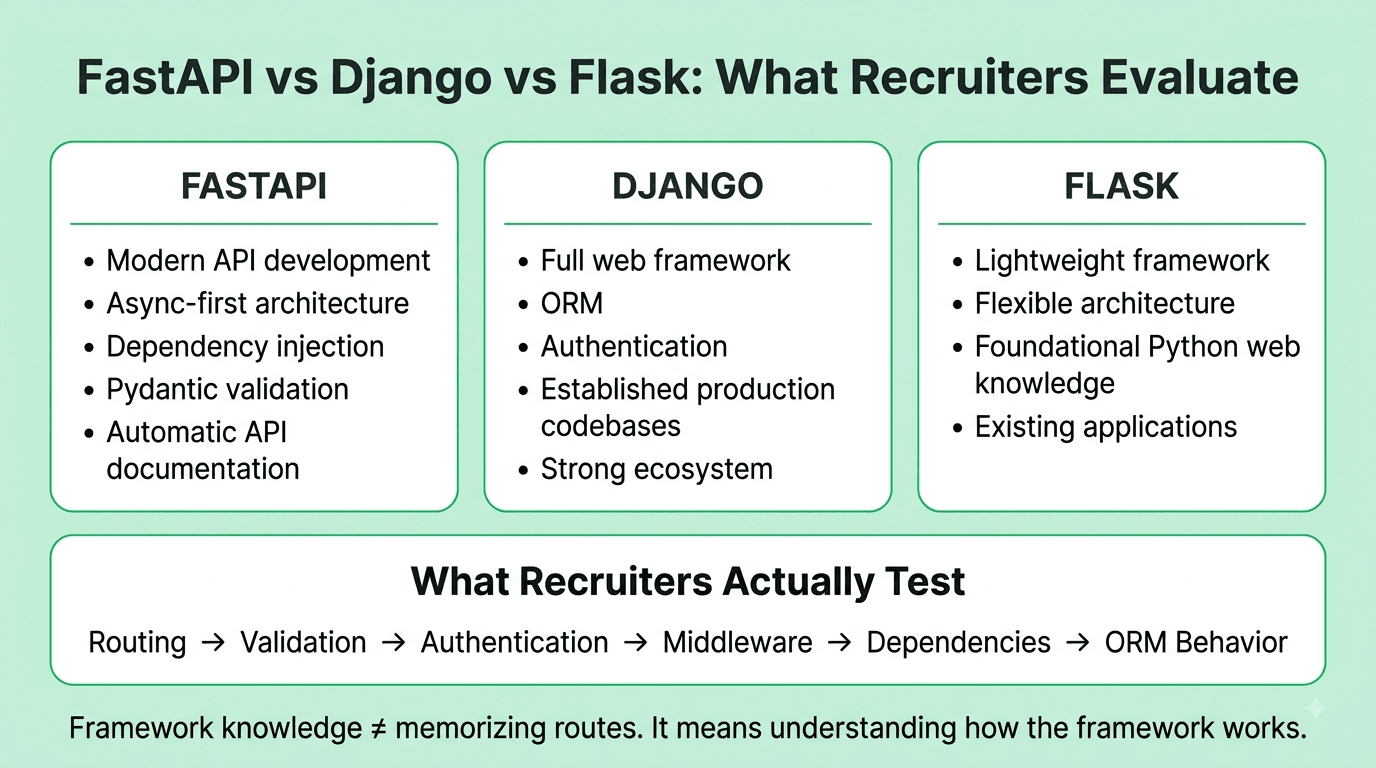
FastAPI has become the default expectation for new greenfield API projects because its async-first design, automatic OpenAPI documentation, and Pydantic-based validation model match modern Python API development patterns. Django is still expected and important for candidates targeting companies with established Django codebases, particularly in e-commerce, fintech, and media. Flask knowledge is increasingly viewed as foundational rather than current.
The key shift is that recruiters now expect framework knowledge to include understanding the framework's approach to dependency injection, middleware, validation, and authentication, not just knowing how to define a route. A FastAPI candidate who cannot explain how its dependency injection system works, or a Django candidate who cannot explain what the ORM actually does when it generates a query, will be evaluated as having surface rather than real framework knowledge.
Interview Evaluation
Resume screening looks for project descriptions that reference specific framework features rather than just framework names. Technical interviews include questions like "how does FastAPI's dependency injection system work, and why would you use it" or "explain what Django's ORM does when you call filter on a queryset." Practical rounds often involve building a small API endpoint with authentication and validation, evaluated on both correctness and whether the implementation follows framework idioms rather than reinventing patterns the framework already provides.
Real Workplace Example
A team needs to add rate limiting to all endpoints that handle user-submitted content. A developer with real FastAPI depth implements this as a dependency that gets injected at the router level, affecting all relevant endpoints automatically without touching each one individually. A developer with only surface FastAPI knowledge implements it as a duplicate block of code in every route function, creating a maintenance problem the moment the rate limiting logic needs to change.
Fresher Expectations
Can build a working CRUD API with basic authentication using their primary framework, understands the framework's routing model, and can read and follow existing codebase conventions without needing to ask how every pattern works.
Mid-Level Expectations
Understands the framework's internals deeply enough to debug unexpected behavior, writes reusable middleware and dependencies instead of duplicating logic, and makes deliberate choices about which framework to use for a given problem rather than defaulting to what they know.
Senior-Level Expectations
Selects and justifies framework choices for new systems based on team skill, performance requirements, and long-term maintainability. Designs framework-level conventions that other developers on the team follow without reinventing patterns, and identifies when the framework is being used against its own design philosophy.
Common Mistakes
Claiming Django expertise while only knowing how to use the admin panel and basic models, and claiming FastAPI expertise while not understanding Pydantic validation or dependency injection. Both reveal tutorial-level exposure rather than production depth.
How to Build This Skill
Build a complete, production-like API with your primary framework: authentication with token management, role-based authorization, pagination, input validation with meaningful error messages, and at least one async endpoint that calls an external service. Then add tests covering the main paths. The act of building this full surface area, not just a hello world route, is where real framework understanding develops.
Example Interview Questions
"How does FastAPI's dependency injection system work? When would you define a dependency versus just importing a function?" "What is the N+1 query problem in Django, and how does the ORM's behavior cause it? How do you fix it?" "How would you handle authentication across multiple FastAPI routers without duplicating code?"
Strong Sample Answer Direction
A strong FastAPI dependency injection answer explains that dependencies are callables that FastAPI resolves and injects before calling the route function, enabling shared logic like authentication, database session management, and rate limiting to be declared once and composed at the route or router level. A strong Django ORM answer explains what actually happens at the query level when you access a related object without prefetching it.
Testing With pytest and Test-Driven Thinking
Why Recruiters Prioritize This Skill
Untested code is a liability that accumulates silently. Recruiters have learned that candidates who do not write tests at interview time do not write tests on the job either, and the cost of that omission compounds over every feature added to a codebase without test coverage. Take-home assignments now routinely evaluate test coverage explicitly, and live rounds increasingly include a refactoring task where writing tests first is the cleanest approach.
What Recruiters Actually Expect in 2026
Beyond knowing that pytest exists, recruiters expect comfortable use of fixtures for test setup, parametrize for testing multiple input cases without code duplication, and monkeypatch or unittest.mock for isolating code from external dependencies. Candidates are also expected to understand the distinction between unit tests, integration tests, and end-to-end tests, and to make deliberate decisions about which level of testing is appropriate for which situation rather than treating all tests as equivalent.
Interview Evaluation
Take-home assignments are evaluated for test coverage, fixture design quality, and whether tests are testing behavior rather than implementation details. A candidate whose tests break every time a function is refactored, even when the behavior stays identical, reveals testing at the wrong level of abstraction. Live rounds sometimes include the task of writing tests for a function the interviewer provides, evaluated as much on what the candidate chooses to test as on the test syntax itself.
Real Workplace Example
A payment processing function that calls an external payment gateway needs to be tested without actually charging a card. A developer with real testing fluency writes a fixture that patches the external client with a mock, then uses parametrize to test success, card decline, and network timeout scenarios in a single clean test function. A developer without testing fluency either skips testing this function entirely or writes a manual test that calls the real payment gateway, which is both expensive and non-deterministic.
Fresher Expectations
Can write basic pytest test functions that cover the happy path and one or two error cases, and understands how to use monkeypatch or a simple mock to isolate a function from an external dependency.
Mid-Level Expectations
Designs fixture hierarchies that avoid duplication across a test suite, uses parametrize fluently, and makes deliberate choices about which code paths deserve unit tests versus integration tests. Can explain why a particular test structure makes the tests maintainable rather than brittle.
Senior-Level Expectations
Sets testing standards and coverage requirements for a team, designs a testing strategy across a multi-service codebase, and identifies when tests are being written at the wrong level of abstraction, catching the problem before it creates a maintenance burden.
Common Mistakes
Writing tests that test implementation details instead of behavior, meaning a test that asserts a specific internal function was called rather than that the observable output was correct. This makes tests brittle to refactoring and teaches the wrong mental model of what a test is for. Also common: not testing error paths at all, so the happy path is covered and every edge case is discovered in production.
How to Build This Skill
Take a function you already wrote and write tests for it in three stages: first without any mocking, then with mocking to isolate external dependencies, then using parametrize to cover multiple input cases in one test. This three-stage exercise builds the instinct for choosing the right testing approach for the situation rather than defaulting to a single pattern for everything.
Example Interview Questions
"How would you test a function that makes an external HTTP request without actually making the request?" "What is the difference between a mock and a patch in Python testing?" "Why might tests that pass individually fail when run together, and how would you investigate and fix that?"
Strong Sample Answer Direction
A strong answer on mocking explains the isolation goal first, that tests should be deterministic and fast, which means removing external dependencies that are non-deterministic or slow, and then explains the mechanism, patching the name where it is used rather than where it is defined. This explanation of the goal before the mechanism demonstrates genuine testing judgment, not just tool knowledge.
Database Interaction, ORM Design, and Query Fluency
Why Recruiters Prioritize This Skill
The database layer is where most performance problems in Python applications actually live, and yet it is the layer many developers interact with only through an ORM abstraction that hides what is actually happening. Recruiters test database knowledge because candidates who do not understand what their ORM is doing cannot debug slow queries, cannot design schemas that support their application's actual access patterns, and make expensive mistakes that are hard to migrate away from once real data exists.
What Recruiters Actually Expect in 2026
Comfort with SQLAlchemy for either or both its ORM and Core layers, understanding of when eager loading versus lazy loading is appropriate, and enough raw SQL fluency to read and evaluate the queries an ORM is generating. Recruiters also expect awareness of when a relational database is the right choice and when a document store, a cache layer, or a time-series database would serve the use case better.
Interview Evaluation
Schema design exercises given a feature description, followed by questions about how the schema supports common query patterns and what indexing strategy it needs. ORM questions that ask candidates to explain what SQLAlchemy does when they access a relationship attribute without having specified a loading strategy, revealing whether they understand lazy loading and its performance implications.
Real Workplace Example
An API endpoint returns a list of orders with each order's customer name and line item details. Written with default lazy loading, this endpoint issues one query for the orders, then one query per order for the customer, then one query per order for the line items, which at one hundred orders becomes over two hundred database roundtrips. A developer with real ORM depth uses joinedload or selectinload appropriately, collapsing this to two or three queries regardless of the number of orders returned.
Fresher Expectations
Can define SQLAlchemy models with relationships, write basic queries using the ORM, and explain what a foreign key does at the database level.
Mid-Level Expectations
Chooses appropriate loading strategies for relationships, can read the SQL an ORM generates and identify performance problems before they reach production, and designs schemas around the access patterns the application actually needs rather than the data's conceptual structure alone.
Senior-Level Expectations
Makes database technology selection decisions for new systems, designs migration strategies for schema changes on live databases without downtime, and builds patterns or utilities that make it easy for the rest of the team to write efficient queries by default rather than having to know all the ORM internals themselves.
Common Mistakes
Using the ORM without ever checking what SQL it generates, which creates invisible performance problems that only surface under real data volume. Also common: over-normalizing a schema based on theoretical correctness without considering how many joins will be needed to assemble the data for the most common queries.
How to Build This Skill
Enable SQLAlchemy query logging on an existing project and spend an hour reading every query that gets generated for your most common endpoints. Find the query that surprises you most, understand why it is being generated, and fix it. This single exercise will teach you more about ORM behavior than any tutorial.
Example Interview Questions
"What is the N+1 query problem, and how does it manifest with an ORM like SQLAlchemy?" "When would you use joinedload versus selectinload, and what is the database-level difference?" "How would you approach migrating a column type on a table with tens of millions of rows in a live database?"
Strong Sample Answer Direction
A strong N+1 answer explains the problem at the query level, one query to fetch the parent records and then one query per parent to fetch related records, then explains the specific ORM mechanism that prevents it, eager loading strategies specified at query time, and names a real case where it would actually matter versus cases where it is premature optimization.
AI and Automation Skills
Building With and On Top of AI and LLM APIs
Why Recruiters Prioritize This Skill
Python has become the primary language of the AI engineering layer, the code that sits between a raw LLM API and a production product. Recruiters hiring Python developers at companies of almost every size now expect at least familiarity with integrating external AI APIs, managing prompt construction and response parsing, and understanding the reliability and cost implications of LLM calls in a production context. This is a new expectation that did not exist in Python job descriptions two years ago and is now mainstream.
What Recruiters Actually Expect in 2026
Not ML research skills. What is expected is the ability to call an LLM API reliably, handle rate limits and retries, manage token costs through prompt design and response truncation, parse structured outputs from models reliably, and understand when a deterministic code solution is more appropriate than an LLM call. Candidates who have worked with orchestration libraries like LangChain or LlamaIndex, or with structured output libraries that constrain model responses to a validated schema, are noticeably more attractive to companies building AI-integrated products.
Interview Evaluation
Take-home assignments at AI-adjacent companies now sometimes include a component requiring candidates to build a small feature that integrates an external LLM API, evaluated on reliability (error handling, retries, rate limit handling), cost awareness (avoiding unnecessary API calls), and output validation (not assuming the model returns exactly the expected format).
Real Workplace Example
A product feature uses an LLM to classify support tickets into categories before routing them. A developer without AI integration experience writes a function that calls the model, assumes the response is always a valid category name, and crashes when the model occasionally returns a slightly different format. A developer with real AI integration experience defines the valid categories in the prompt explicitly, uses structured output mode or output validation to catch malformed responses, and falls back to a default category with a logged alert rather than raising an unhandled exception.
Fresher Expectations
Can call an LLM API, parse its response, and handle the most common error cases including rate limit errors. Understands that model output is probabilistic and must be validated rather than trusted unconditionally.
Mid-Level Expectations
Designs LLM integrations that are reliable under real traffic, manages prompt versioning as model behavior changes, monitors token costs and API latency, and chooses between synchronous and async LLM call patterns based on the use case.
Senior-Level Expectations
Makes architectural decisions about when LLM integration is the right approach versus rule-based or traditional ML approaches, designs evaluation pipelines for LLM-powered features rather than relying purely on manual spot-checking, and builds cost and latency monitoring into AI features from the start.
Common Mistakes
Treating LLM output as deterministic and structured without validation, which creates brittle integrations that fail unpredictably in production. Also common: making synchronous LLM API calls in a context where the latency significantly degrades user experience, when an async or background processing approach would be more appropriate.
How to Build This Skill
Build a small feature that uses an LLM API to do something genuinely useful, whether text classification, summarization, or structured data extraction, and specifically engineer it to handle the cases where the model returns unexpected output. Add token usage logging and observe the cost of different prompt lengths. This hands-on exercise surfaces the real reliability and cost considerations that tutorials do not cover.
Example Interview Questions
"How would you ensure that an LLM integration returns a valid response in one of five expected categories rather than free-form text?" "How would you handle rate limiting from an external LLM API in a high-throughput Python service?" "When would you choose not to use an LLM for a task that seems like an obvious fit?"
Strong Sample Answer Direction
A strong answer on output validation explains the layered approach: constrain the model's output through the prompt first, use structured output mode if the API supports it, validate the parsed output against an explicit schema, and implement a fallback for cases that still slip through. This shows a candidate who thinks about reliability from the beginning rather than optimistically assuming the model will cooperate.
Working Effectively With AI Coding Assistants
Why Recruiters Prioritize This Skill
By 2026, most Python teams assume daily use of AI coding tools. What recruiters test is whether a candidate uses these tools to accelerate their own judgment or to substitute for judgment they do not have. The distinction matters because substitution creates code that looks correct but contains subtle bugs, security issues, or architectural choices the developer cannot explain or defend.
What Recruiters Actually Expect in 2026
The ability to direct an AI tool precisely enough to get useful starting code, and the code review discipline to evaluate that output critically before using it, including checking for correctness on edge cases, security implications, and whether the approach fits the existing codebase's patterns. Some interviews now include a round where candidates are shown AI-generated Python code and asked to review it for bugs, anti-patterns, or security issues.
Interview Evaluation
Live rounds increasingly permit AI tool use while observing whether the candidate reads and validates the output, narrates their review process, and modifies the generated code rather than accepting it verbatim.
Real Workplace Example
An AI tool generates a utility function that reads credentials from an environment variable and falls back to a hardcoded default for "development convenience." A developer with strong review discipline catches immediately that hardcoded credentials in source code are a security vulnerability regardless of the justification, and removes the fallback. A developer without that discipline ships the fallback and creates a vulnerability that persists quietly until a security audit.
Fresher Expectations
Uses AI tools to speed up boilerplate and routine patterns, tests generated code before trusting it, and asks clarifying follow-up prompts when the first output is not quite right rather than accepting a partial solution.
Mid-Level Expectations
Reviews AI-generated code with the same critical eye as a teammate's pull request, catches performance issues and anti-patterns the tool introduced, and is aware of which categories of task the tools handle reliably versus where they commonly introduce subtle errors.
Senior-Level Expectations
Sets team norms for responsible AI tool usage, balancing development velocity against code quality and security risk. Identifies patterns in where AI tools commonly go wrong in Python-specific contexts, such as incorrect async patterns or subtle ORM misuse, and builds those into team review checklists.
Common Mistakes
Accepting AI-generated Python code that is syntactically correct but uses an anti-pattern, such as a mutable default argument, an asyncio.run call nested inside an already-async context, or a database session that never gets closed. These mistakes pass a quick visual scan and only reveal themselves under real conditions.
How to Build This Skill
Ask an AI tool to generate a Python function for a task you already know well, then review it as if you were the code reviewer, specifically looking for the five Python-specific anti-patterns most common in AI output: mutable defaults, blocking calls in async context, unreleased resources, missing error handling, and overly broad exception catching.
Example Interview Questions
"Here is a piece of AI-generated Python code. What issues do you see?" "How do you decide when to use an AI coding tool versus writing something by hand?" "Tell me about a time an AI tool gave you incorrect Python code. How did you catch it?"
Strong Sample Answer Direction
A strong answer names specific categories of Python-specific error they look for in AI-generated code rather than speaking generically about "reviewing carefully," because specificity proves the review habit is real rather than performed for the interview.
FREE TO USE
8k+ SESSIONS92% FLUENCY4.9★ RATING
Speak With Confidence
Real Conversations. Real Scenarios. Speak until it feels natural.
- Real-Time Speaking Practice
- Guided Conversation Flows
- Instant AI Feedback
Business and Collaboration Skills
Code Quality, Clean Code, and Review Culture
Why Recruiters Prioritize This Skill
Python code that works today and cannot be maintained tomorrow is a liability. Recruiters test code quality because production Python codebases live for years, get extended by developers who did not write the original code, and accumulate technical debt faster than most languages because Python's permissiveness makes it easy to write code that works but is difficult to understand or extend.
What Recruiters Actually Expect in 2026
Comfort with tools like black for formatting, ruff or flake8 for linting, mypy for type checking, and pre-commit hooks to enforce these automatically. Candidates are also expected to understand the reasoning behind type annotations, not just how to add them, because typed Python is now standard in any codebase maintained by more than one person.
Interview Evaluation
GitHub portfolio reviews where recruiters look at code style, type annotation consistency, and whether a candidate's personal projects have the same discipline as their professional work. Code review rounds where candidates annotate a pull request with feedback that is specific, reasoned, and prioritized by severity rather than volume.
Real Workplace Example
A function is added to process incoming data with no type annotations. Six months later, a new developer calls it with a value of a different type and gets a runtime error deep in the call stack that takes an hour to trace back to the original function's unvalidated input. The same function with proper type annotations and a mypy check in the CI pipeline would have caught this at the point of the new call, immediately.
Fresher Expectations
Writes consistently formatted Python following PEP 8 conventions, adds type annotations to function signatures, and can explain why type annotations make code easier to maintain and review.
Mid-Level Expectations
Sets up and maintains linting and type checking in a project, writes meaningful docstrings for public functions, and gives pull request feedback that distinguishes between style preferences, correctness issues, and architecture concerns.
Senior-Level Expectations
Sets code quality standards for a team and builds the tooling to enforce them automatically, reducing the burden on individual reviewers and ensuring consistency without requiring manual enforcement.
Common Mistakes
Adding type annotations but annotating everything as Any, which satisfies the letter of a type checking requirement while providing none of its value. Also common: writing docstrings that only restate the function's name rather than explaining what the function assumes about its inputs and what it guarantees about its output.
How to Build This Skill
Run mypy on a personal project you have never typed before and work through the errors until it passes strict mode. This exercise will surface every place you made an implicit assumption about a variable's type, building the habit of making types explicit going forward.
Example Interview Questions
"What is the difference between Any and Union in Python's type system, and when would you use each?" "How would you add type checking to an existing project that has no annotations without breaking it immediately?" "What feedback would you leave on a pull request where the code works correctly but has no type annotations or tests?"
Strong Sample Answer Direction
A strong answer on type annotations explains the progressive typing approach, starting with the public interface and the most error-prone functions rather than trying to annotate an entire codebase at once, since this is the practical approach that works in real codebases.
Skills Recruiters Value More Than Certifications
Certifications in Python or its associated frameworks signal that you completed a structured course. A deployed project with real constraints signals that you can actually solve a real problem with Python. Most hiring managers weight a modest but real project, one that handles actual data, has tests, and has been deployed somewhere, far above a certification, because building and shipping a real project surfaces problems a course never forces you to face.
Certifications have a narrow but real use case: for career switchers with no professional Python experience, they provide signal to get past automated resume screening. For anyone with two or more years of professional experience, the certification adds almost nothing that a well-documented GitHub project and a clear resume description of real work would not do more effectively.
Python-specific certifications are notably weaker signals than in other domains because Python is the language where the gap between passing a certification exam and being able to do real work is widest. The language is easy to learn at the surface. It takes deliberate, production-like practice to develop the depth that actually matters in interviews.
Skills That Are Becoming Less Important
AI Is Changing Python Development
AI Is Changing Python Development
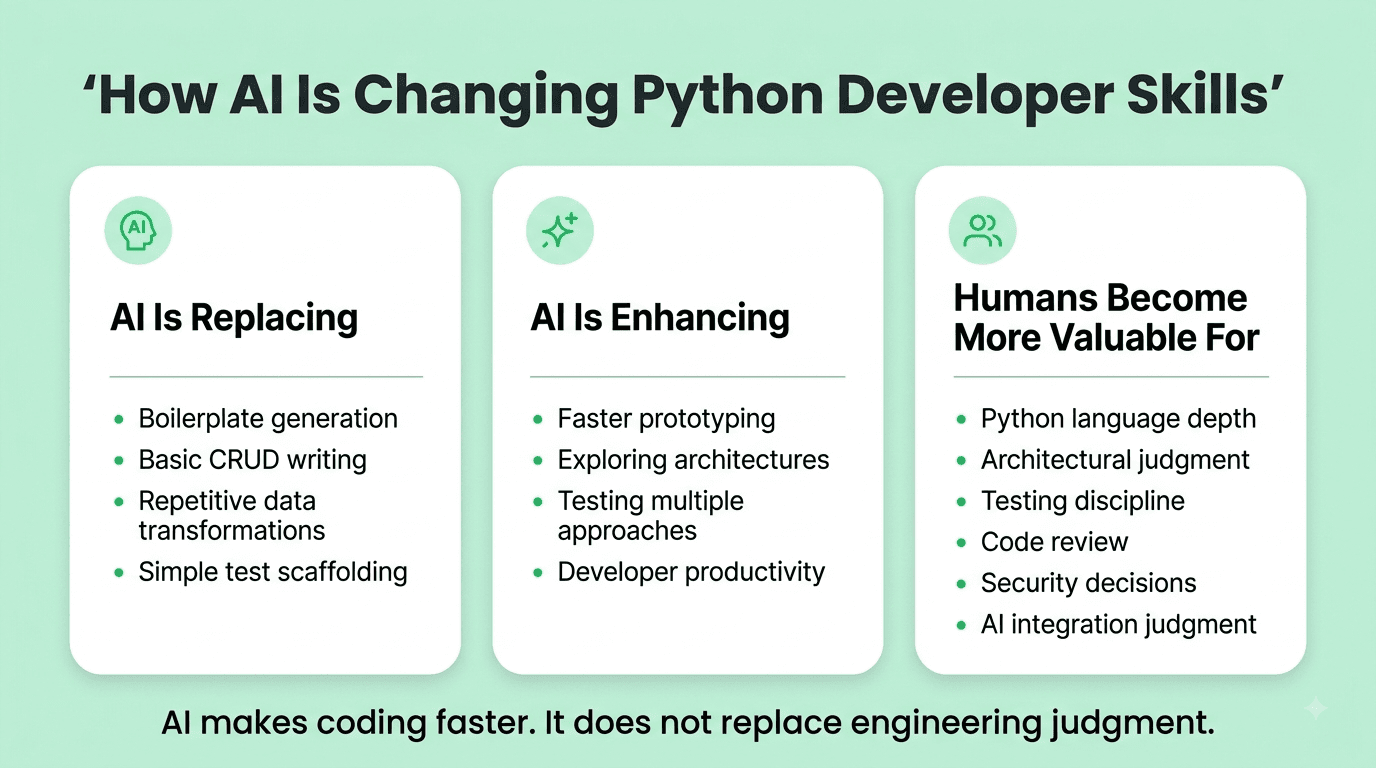
Which skills AI is replacing: Boilerplate generation, basic CRUD function writing, repetitive data transformation scripts, and simple test scaffolding are increasingly produced by AI tools faster than a developer can type them.
Which skills AI is enhancing: Python developers with strong fundamentals can now explore multiple architectural approaches in the time it used to take to implement one, because AI accelerates the distance between a design decision and working code. This means developers with better judgment are getting more leverage from the tools, while developers with weak fundamentals are getting faster at producing code they still do not fully understand.
Which human skills are becoming more valuable: Language depth that allows catching AI-generated anti-patterns, architectural judgment about when async is appropriate, testing discipline that catches what AI tools miss in edge cases, and the ability to integrate and build on AI APIs are all becoming sharper differentiators as the mechanical coding layer gets automated.
How professionals should adapt: Treat AI tools as a fast but imprecise collaborator. Use them to reduce the time from design to working code, but invest that saved time into the work AI cannot do: choosing the right approach before writing any code, reviewing the generated code with genuine depth, and building the test coverage that makes future changes safe.
Skills That Instantly Differentiate Candidates
Common Skill Gaps Recruiters Notice
- Candidates who write Python fluently by feel but cannot explain why a specific behavior occurs, such as why a generator is exhausted after being iterated once, or why a mutable default accumulates state.
- Candidates who claim async experience but have never debugged an async application, making them unable to reason about what happens when a blocking call sneaks into an async context.
- Candidates who have never set up a linting or type-checking pipeline and have no instinct for why it matters for a maintained codebase.
- Candidates with no real testing experience who claim to test their code but whose take-home assignment has no test file at all.
- Candidates who list "machine learning" on a Python resume but cannot describe a practical LLM integration project, since the gap between theoretical ML knowledge and practical AI engineering capability is one of the widest gaps recruiters are currently seeing.
Learning Roadmap
For Freshers
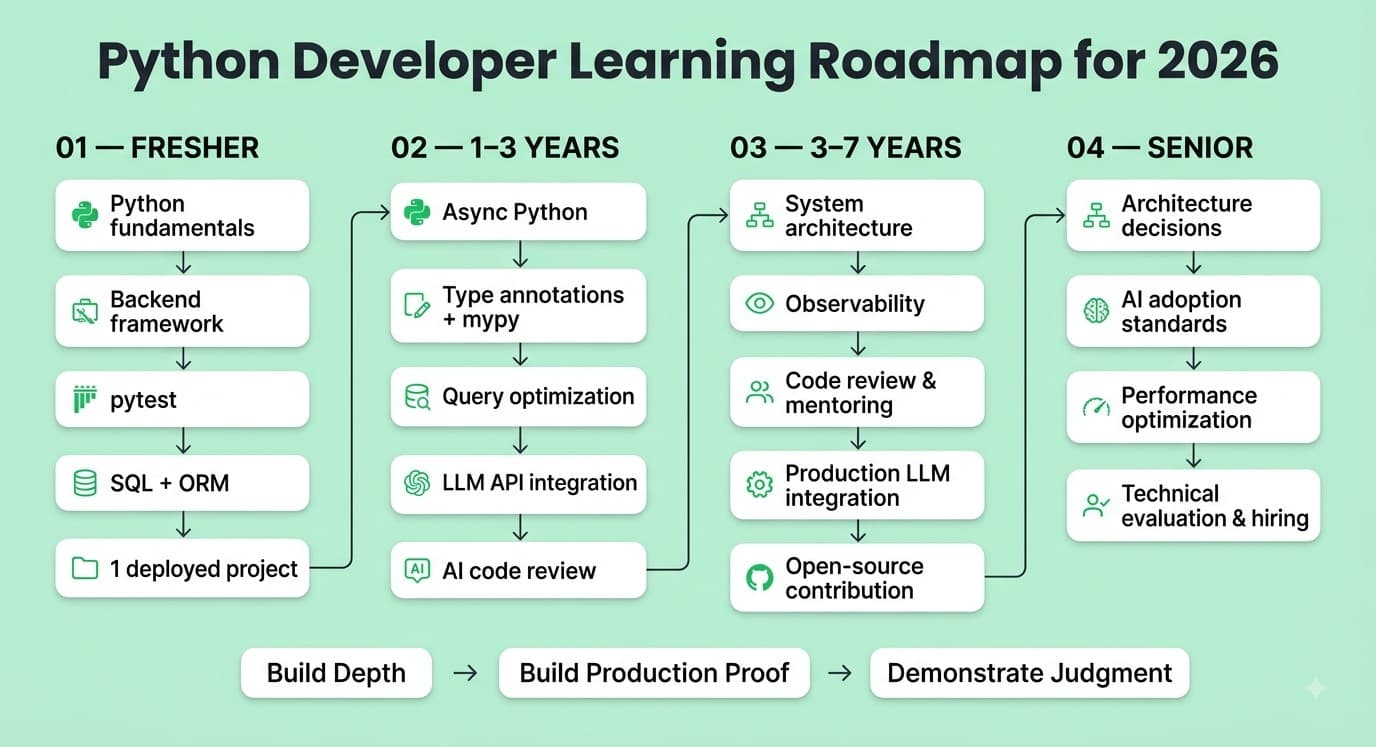
- Python fundamentals through the language data model: closures, generators, decorators, and context managers before picking a framework.
- One backend framework built past the tutorial level: build a complete API with authentication, validation, and error handling.
- pytest basics: write tests that mock external dependencies and cover at least the main success and failure paths.
- Basic SQL and one ORM: write raw SQL alongside ORM queries and compare what gets generated.
- One deployed project with a real README and basic test coverage.
For Professionals With 1 to 3 Years of Experience
- Async Python through asyncio: rewrite a synchronous API you have already built using async endpoints and measure the difference.
- Type annotations and mypy: progressively type an existing project to strict mode.
- Database query optimization: enable query logging and review the queries your ORM generates for your most-used endpoints.
- AI API integration: build one small, real feature using an external LLM API with proper error handling and output validation.
- AI coding assistant review discipline: build the habit of reviewing generated code with a named checklist before using it.
For Professionals With 3 to 7 Years of Experience
- System architecture for Python services: design a feature from API contract to database schema to async background processing, and document the tradeoffs.
- Observability: add structured logging, metrics, and error tracking to a production service.
- Mentoring through code review: lead a team's testing standards and code quality tooling.
- LLM integration at production scale: build a feature with token cost monitoring, output validation, retry logic, and a fallback path.
- Contribution to an open-source Python library, even a small one, to build the skill of reading and navigating a codebase you did not write.
For Senior Professionals
- Technical decision making at the architectural level: framework selection, database technology selection, and async versus synchronous service design.
- Team-wide AI tool adoption standards, balancing velocity against quality and security risk.
- Performance profiling and optimization across the Python stack: from hotspot analysis in pure Python code to database query plans to API response time bottlenecks.
- Hiring and evaluating other Python developers using the judgment-based standards described in this guide.
Self-Assessment Checklist
- I can explain what happens when Python evaluates a mutable default argument, and why, without looking it up.
- I can explain what await does at the event loop level, not just that it "waits" for something.
- I can build a FastAPI or Django endpoint with dependency injection, validation, and authentication from memory.
- I can write a pytest test that mocks an external HTTP call and covers at least one error case.
- I can explain what SQL an ORM query generates and identify if it has an N+1 problem.
- I have a project with type annotations that passes mypy without Any shortcuts.
- I have called an external LLM API and handled the case where the model's output was not in the expected format.
- I can review AI-generated Python code and name at least three specific categories of error I am looking for.
- I have at least one deployed Python project I can walk through end to end, from database to API, with test coverage.
If fewer than six of these are checked, the learning roadmap above is your actual prep plan, not a suggestion.
Portfolio or Resume Proof
| Skill | Resume | Portfolio or GitHub | Interview Talking Point | |
|---|---|---|---|---|
| Python language depth | Reference specific features used, not just "Python" as a language | Share a post explaining a non-obvious Python behavior with a real example | Publish a utility module using generators, decorators, and context managers with explanations | Explain the mechanism, not just the syntax |
| Async Python | Mention async endpoints or concurrent API calls and the throughput improvement | Share a before/after performance comparison of sync versus async | Publish a project with async endpoints and documented latency measurements | Explain what the event loop is actually doing |
| FastAPI or Django depth | Name the framework and the specific complexity handled, such as async background tasks or custom middleware | Share a post on a framework design decision and why it was made | Publish a complete API project with authentication, tests, and documentation | Explain the framework's design philosophy, not just its syntax |
| Testing with pytest | Mention test coverage percentage or testing approach for a major project | Share a post on a specific testing pattern, such as parametrize or fixture scoping | Publish test files alongside project code with comments explaining fixture design choices | Explain what you chose to test and why |
| Database and ORM | Mention a specific performance improvement from query optimization | Share a query optimization story with before/after query counts | Include schema diagrams and ORM configuration in project documentation | Explain the SQL the ORM generates and the loading strategy used |
| AI and LLM integration | Describe a specific AI-powered feature and how you ensured reliability | Share a project story including cost or reliability challenges | Publish a small AI integration project with output validation and retry logic | Explain your approach to validating model output before trusting it |
| Code quality tooling | Mention linting, type checking, and CI/CD setup on a project | Share a post on setting up mypy strict mode progressively | Show pre-commit configuration and CI pipeline configuration in GitHub | Explain why each tool is in your pipeline and what it catches |
Conclusion
Python's breadth in 2026 is both its opportunity and its interview preparation challenge. The language now touches web backends, AI pipelines, data engineering, automation, and developer tooling, and the candidate who can speak fluently about language fundamentals, demonstrate real async understanding, and show genuine experience building with AI APIs occupies a position in the market that was not well-defined even two years ago.
None of the skills above require rare talent. They require deliberate practice past the tutorial level, honest assessment of where your understanding is surface versus deep, and the specific habit of explaining your reasoning out loud, since Python interviews increasingly test judgment, not syntax recall. That last habit, reasoning clearly under the pressure of a follow-up question about why you made a specific choice, is exactly the skill that structured mock interview practice is designed to build. It is also the one that is hardest to develop alone and easiest to develop with realistic pressure and specific feedback, which is where tools like Mocklingo's AI mock interview practice make the most difference.
Practice mock interview for python developer