Loading...
Contents
Will AI Replace Business Analysts in 2026?
What Every BA Needs to Know
Jun 6, 202612 min readUpdated Oct 23, 2026
Every month, a new article appears with headlines such as "AI will replace Business Analysts " or "ChatGPT is coming for BA jobs."
Not surprisingly, many aspiring Business Analysts, students, and working professionals begin questioning their career choices. They wonder whether the profession they invested years learning is becoming less relevant. They question whether requirements gathering, stakeholder management, business process analysis, and documentation will still matter in a world increasingly influenced by artificial intelligence.
The reality is more nuanced.
AI is already handling some Business Analyst tasks faster than humans in many organisations. Ignoring that shift would be a mistake. However, the idea that AI will eliminate the Business Analyst role altogether is not supported by current hiring trends, enterprise adoption patterns, or the way AI systems actually operate.
Understanding where AI adds value and where it still depends on human expertise is the key to understanding the future of the profession.
This article explores how AI is affecting Business Analyst roles today, what responsibilities are becoming automated.
FREE TO USE
25K+ INTERVIEWS4.8★ RATING68% IMPROVEMENT
Crack Your Dream Job
Real Interviews. Real Pressure. Practice until it feels easy.
- Seamless Interview Experience
- Resume & JD Questions
- Instant Personalized Feedback
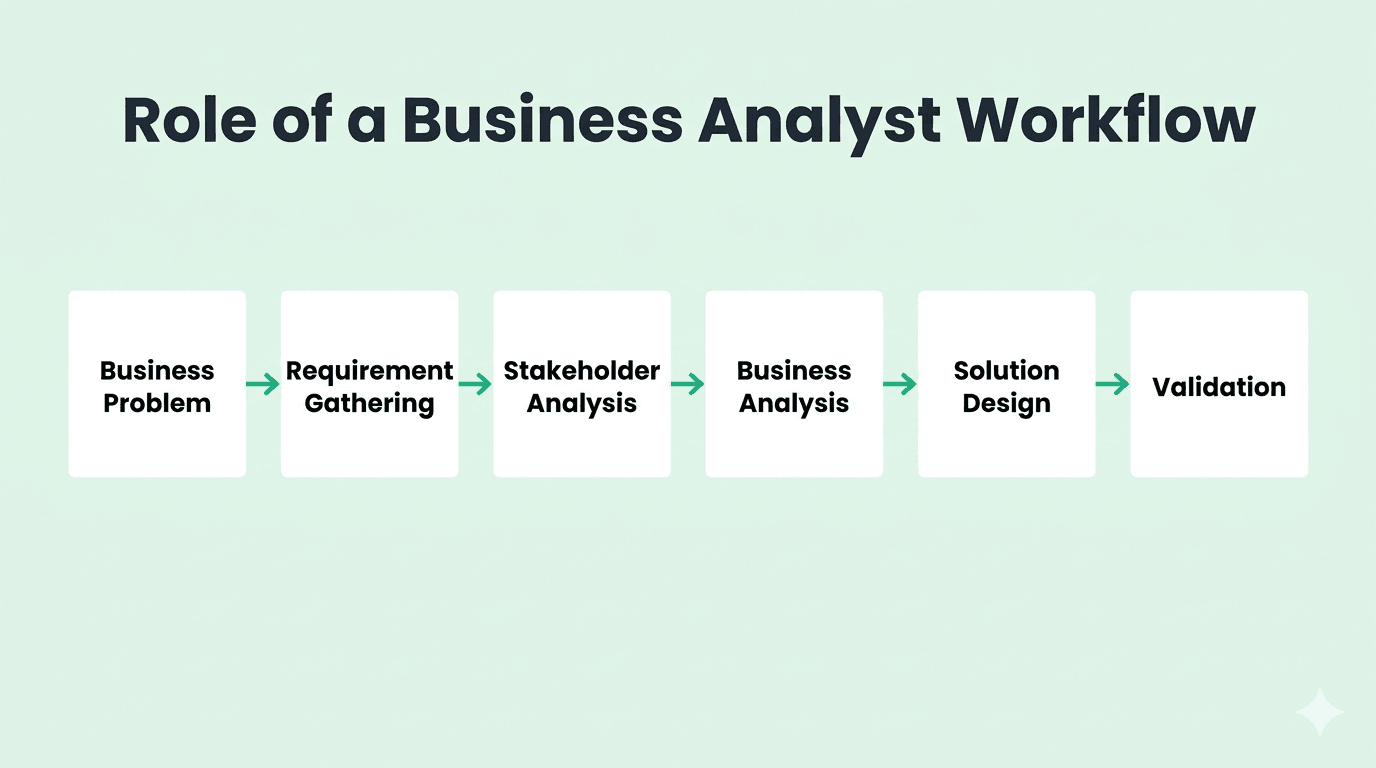
What Business Analysts Actually Do
Before discussing whether AI can replace Business Analysts, it is important to understand what the role actually involves.
A common misconception is that Business Analysts primarily create reports, write documentation, or work with spreadsheets. While these activities are part of the job, they represent only a fraction of the responsibilities that Business Analysts handle in real-world organisations.
At its core, Business Analysis is about understanding business problems and helping organisations make better decisions.
Business Analysts work with stakeholders to identify challenges, uncover requirements, evaluate potential solutions, and ensure that projects deliver meaningful business outcomes. They often act as the bridge between business teams and technical teams, translating business needs into actionable requirements that developers, product teams, and decision-makers can work with.
A typical Business Analyst may be responsible for:
• Gathering and analysing business requirements
• Facilitating workshops and stakeholder discussions
• Documenting business processes and workflows
• Identifying operational inefficiencies
• Evaluating technology solutions
• Managing stakeholder expectations
• Supporting change management initiatives
• Validating whether implemented solutions solve the intended problem
• Using data to guide decision-making
The complexity of the role becomes more apparent when working on large projects.
Requirements are rarely handed over in a structured format. Stakeholders often disagree with one another. Business priorities change midway through projects. Departments may have conflicting goals. Some problems are clearly visible, while others require extensive investigation before the root cause becomes apparent.
A skilled Business Analyst must navigate all of this while maintaining alignment between business objectives and project outcomes. This is why discussions about AI replacing Business Analysts require more nuance than many headlines suggest.
What AI Can Actually Do in the Business Analyst's World
Rather than discussing AI in broad terms, it is more useful to examine the areas where it is already changing day-to-day Business Analyst work.
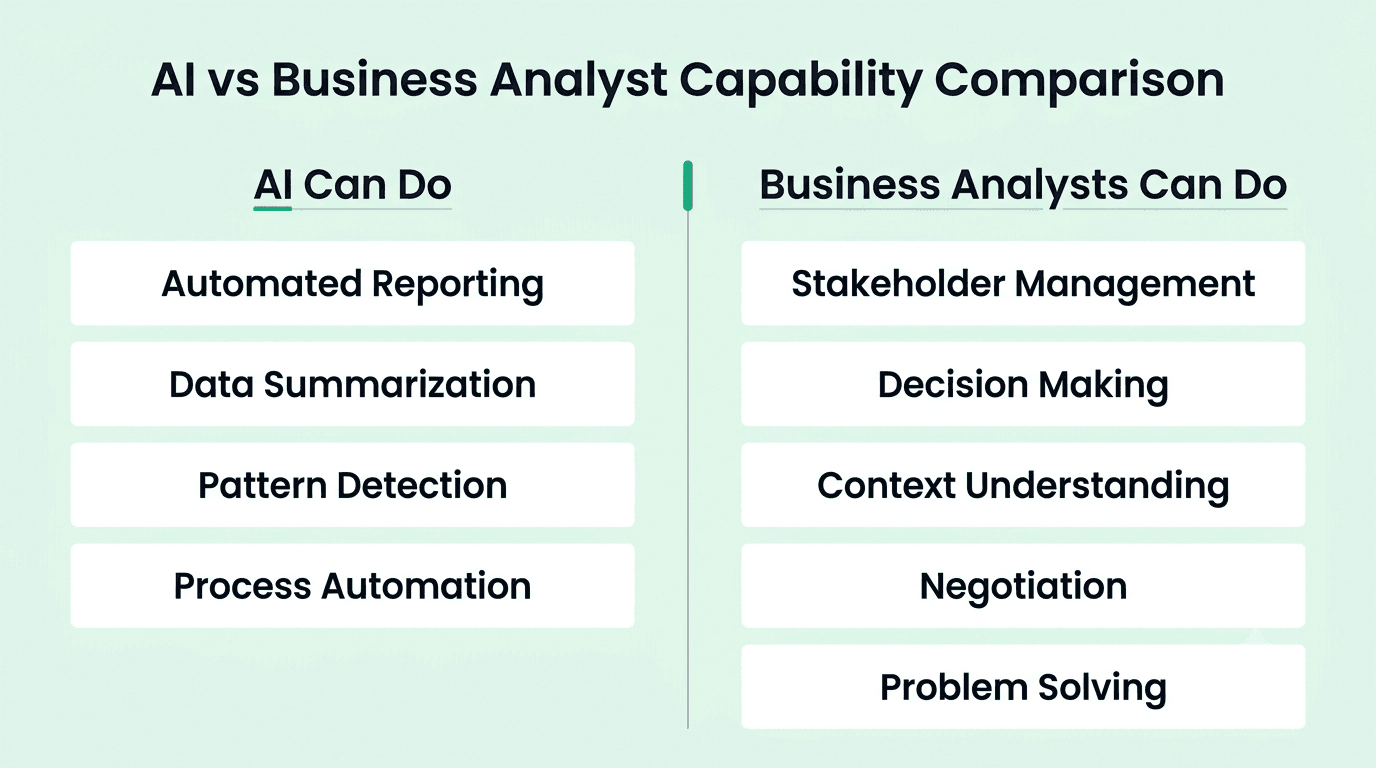
Generating First-Draft Documents
AI tools such as ChatGPT, Claude, and Microsoft Copilot can create initial drafts of Business Requirements Documents, User Stories, acceptance criteria, and process descriptions when provided with sufficient context.
Tasks that once required hours of manual effort can now be completed in minutes.
This does not eliminate the need for Business Analysts, but it does reduce the amount of time spent creating documentation from scratch.
Analysing Structured Data Faster
AI-powered analytics tools can review large datasets, identify trends, highlight anomalies, and surface insights much faster than traditional manual analysis.
Platforms such as Power BI Copilot, Tableau AI, and AWS QuickSight allow analysts to interact with data using natural language, reducing the effort required to perform exploratory analysis and generate reports.
Summarising Large Volumes of Information
Business Analysts frequently work with meeting transcripts, policy documents, customer feedback, research reports, and stakeholder interviews.
AI can process large amounts of information and produce summaries, key themes, and action points within minutes. This significantly accelerates research, discovery, and analysis activities.
Automating Repetitive Reporting
Recurring reports, dashboard updates, KPI summaries, and status updates can increasingly be automated through AI-enabled reporting systems.
As a result, Business Analysts can spend less time compiling information and more time interpreting it.
Generating Process Diagrams
Several AI tools can transform written process descriptions into flowcharts, BPMN diagrams, and workflow visualisations.
While these outputs still require validation and refinement, they reduce the effort needed to create a useful starting framework.
The impact of these capabilities is real. Many organisations are already incorporating AI into their business analysis workflows to improve efficiency and reduce time spent on repetitive tasks.
However, efficiency gains should not be confused with full job replacement. The tasks that AI performs most effectively tend to be structured, repeatable, and process-driven. Much of the strategic value provided by Business Analysts exists outside those categories.
What AI Cannot Do in the Business Analyst's World
While AI can automate and accelerate many operational tasks, several responsibilities remain heavily dependent on human judgment, context, and relationship management.
Understand Organisational Politics
Requirements gathering rarely happens in a purely objective environment.
Stakeholders often have competing priorities, hidden concerns, and political considerations that influence their decisions. A department head may publicly support a project while privately worrying about budget reductions. Two teams may request conflicting features because they are measured against different business goals. Senior leaders may have strategic preferences that are not immediately visible to project teams.
Experienced Business Analysts learn how to identify these dynamics and navigate them effectively.
AI lacks the situational awareness, interpersonal understanding, and organisational context required to operate in these environments. It cannot read the room, identify unspoken concerns, or understand the political implications of a business decision.
Ask the Right Questions in Context
Strong Business Analysts do more than document answers.
They challenge assumptions, identify gaps, uncover hidden requirements, and ask questions that reveal risks before they become costly problems.
This ability develops through experience, domain expertise, and exposure to previous projects. Skilled BAs recognise patterns and know where initiatives are most likely to fail because they have seen similar situations before.
AI can respond to prompts and generate suggestions, but it cannot independently recognise every critical question that has not yet been asked.
Manage Stakeholder Relationships
Business Analysts often spend months or years working with the same stakeholders, learning how they communicate, what their priorities are, and how decisions are made within the organisation.
Those relationships become valuable assets. They enable difficult conversations, accelerate decision-making, and improve collaboration across departments.
AI can assist with communication, but it cannot build credibility, establish trust, or maintain professional relationships over time.
Take Accountability for Decisions
When requirements are approved, budgets are committed, or solutions are implemented, organisations need individuals who are accountable for outcomes.
This becomes even more important in regulated industries such as banking, healthcare, insurance, and government, where compliance requirements demand clear ownership and responsibility.
AI can generate recommendations and draft content, but it cannot accept accountability for business outcomes. Responsibility remains with people.
Handle Ambiguous Problems
Many business challenges begin without a clearly defined problem statement.
An organisation may notice declining customer retention, increasing operational costs, or poor employee productivity without fully understanding why those issues exist.
The process of moving from uncertainty to clarity requires investigation, facilitation, critical thinking, and structured problem-solving.
AI performs best when the problem is already defined and the objective is clear. The work of defining the problem itself remains one of the most valuable contributions a Business Analyst can make.
AI vs Business Analyst: What the Data Actually Shows
If AI were truly replacing Business Analysts, we would expect to see declining demand for BA roles across industries. Current hiring trends suggest otherwise.
According to the US Bureau of Labor Statistics, Management Analyst and Business Analyst-related occupations are projected to grow faster than the average rate for all occupations during the coming decade.
In India, demand for Business Analysts continues to increase across technology, consulting, financial services, healthcare, and digital transformation initiatives.
Many organizations implementing AI and automation projects actively hire Business Analysts to help define requirements, manage stakeholders, and ensure technology investments align with business goals.
LinkedIn hiring trends have consistently shown strong demand for professionals with business analysis, data analysis, process improvement, and digital transformation skills.
What is changing is not the existence of the role but the expectations attached to it. Many modern Business Analyst job descriptions now include:
• Familiarity with AI-powered productivity tools
• Understanding of AI and automation workflows
• Experience using tools such as ChatGPT, Copilot, or AI-enabled analytics platforms
• Ability to evaluate AI-generated outputs critically
The role is evolving, not disappearing.
FREE TO USE
8k+ SESSIONS92% FLUENCY4.9★ RATING
Speak With Confidence
Real Conversations. Real Scenarios. Speak until it feels natural.
- Real-Time Speaking Practice
- Guided Conversation Flows
- Instant AI Feedback
Is Business Analyst a Good Career in the AI Era?
For many professionals, this is the question that matters most.
The answer remains yes. In fact, organisations adopting AI often increase their need for business analysis capabilities.
Every AI implementation requires someone to define business objectives, understand stakeholder requirements, identify success criteria, evaluate risks, and manage organisational change.
Those responsibilities align closely with the traditional strengths of Business Analysts. There is also an increasing need for human oversight.
AI-generated recommendations, reports, and insights must be reviewed to ensure they are accurate, relevant, and appropriate for a specific business context.
Someone needs to verify whether the output actually solves the problem it was intended to solve.
Business Analysts are well positioned to perform that role because they understand both the business context and the operational realities behind the data.
Rather than reducing the need for Business Analysts, AI is creating new opportunities for professionals who can combine analytical thinking with AI-enabled productivity.
Are Business Analysts Still in Demand in 2026?
Yes, and the demand continues to evolve.
Many of the organisations actively hiring Business Analysts today are also investing heavily in AI, automation, and digital transformation.
Examples include:
• Technology companies developing AI-powered products
• Financial institutions modernising legacy systems
• Healthcare providers implementing digital health solutions
• Consulting firms leading transformation projects
• Government agencies upgrading public-sector technology infrastructure
• Large enterprises adopting automation and intelligent workflows
These initiatives create additional complexity, which often increases the need for skilled Business Analysts.
What employers increasingly look for is a combination of traditional BA expertise and practical AI literacy.
Candidates who understand both business processes and AI-enabled workflows are generally better positioned than those who rely solely on traditional methods.
Business Analyst Career Future: What You Should Do Right Now
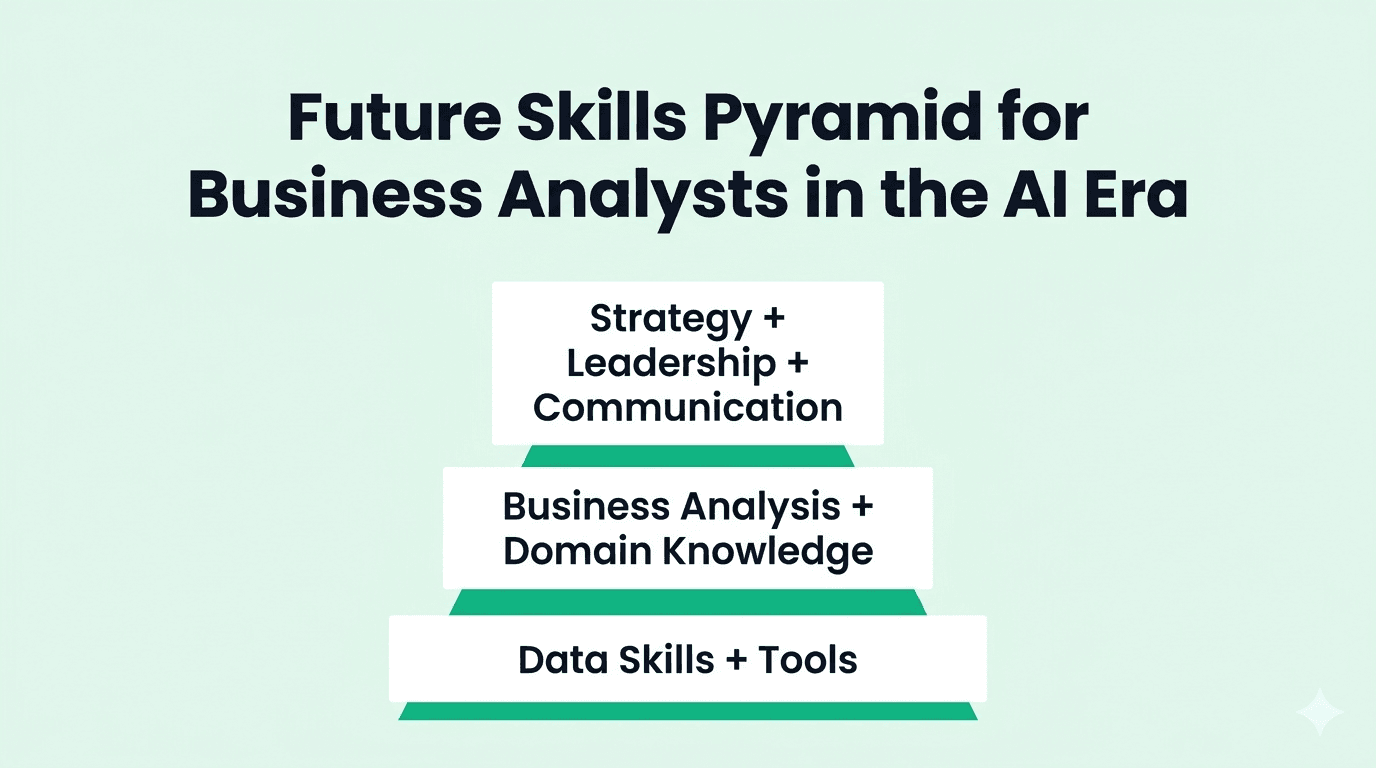
Whether you are an experienced Business Analyst, a career changer, or a student considering the profession, the most productive response is adaptation.
Learn AI Tools as Part of Your Workflow
Use tools such as ChatGPT, Claude, Copilot, Power BI AI features, and workflow automation platforms in your daily work.
Understanding how these tools improve productivity is becoming a practical business skill.
Invest in Skills AI Cannot Easily Replicate
Focus on:
• Stakeholder management
• Facilitation
• Strategic thinking
• Negotiation
• Change management
• Communication
• Decision-making under uncertainty
These capabilities remain difficult to automate and continue to differentiate high-performing Business Analysts.
Develop Domain Expertise
Industry knowledge creates a significant competitive advantage.
Business Analysts with deep expertise in healthcare, banking, insurance, logistics, manufacturing, retail, or e-commerce provide context that generic AI systems cannot easily replicate.
Build AI Literacy
You do not need to become a machine learning engineer.
However, understanding how AI systems work, where they perform well, where they fail, and how to evaluate their outputs is increasingly important.
Stay Visible in the Market
Keep your professional profiles updated, showcase AI-related projects, and share insights about your experience adapting to new technologies.
The market increasingly rewards professionals who demonstrate both business expertise and technological adaptability.
The Verdict on AI vs Business Analyst
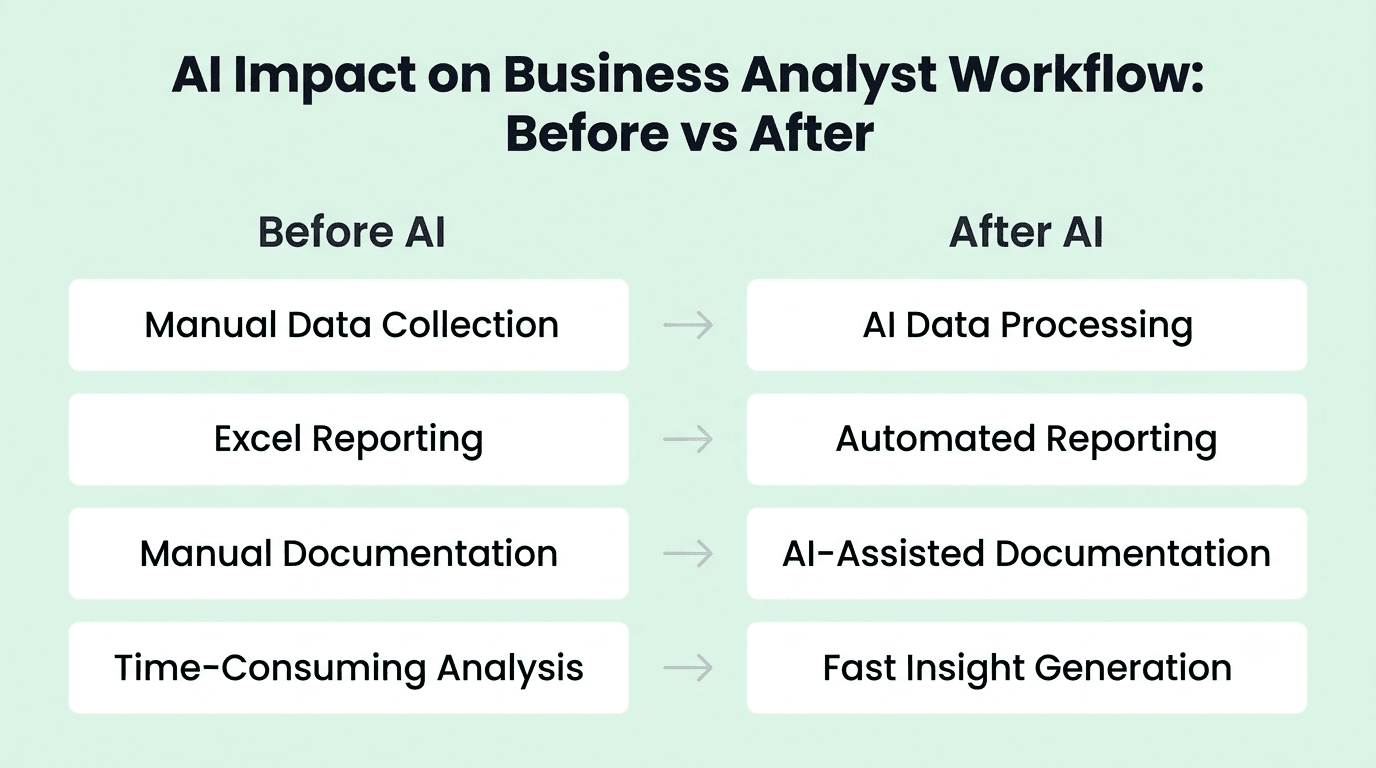
The discussion around AI and Business Analysis is often framed in extremes either AI will fully replace Business Analysts or it will have minimal impact. In reality, neither view is accurate. AI is already taking over repetitive tasks like drafting documents, summarising reports, and basic data analysis, improving efficiency across teams.
At the same time, core responsibilities such as problem understanding, stakeholder alignment, decision-making in ambiguity, and managing change still depend on human judgment.
The role is shifting toward interpretation, communication, and strategic thinking rather than disappearing. Business Analysts who adapt to AI tools are not becoming less relevant, they are becoming more effective.
Conclusion
AI is changing how Business Analysts work, but it is not removing the need for them. The role is shifting from repetitive tasks to more thinking, interpretation, and decision support.
Business Analysts who adapt by using AI tools and strengthening core skills like communication, problem-solving, and domain knowledge will remain relevant. The role is not ending, it is evolving.
FAQs
More Blogs


Oct 22, 2026
UI/UX Designer Interview Preparation Guide: A Complete Roadmap for 2026
38 min read

