Loading...
Contents
Data Analyst Interview Preparation Guide
A Complete Roadmap for 2026
Aug 5, 202614 min readUpdated Sep 19, 2026
To prepare for a data analyst interview, focus on four pillars: SQL and Excel fluency, statistics fundamentals, a portfolio of two or three real projects, and structured communication using frameworks like STAR for behavioral questions. Most interview loops include a resume screen, a technical or SQL round, a case study or business problem round, and a final culture fit round with the hiring manager. Candidates who practice explaining their thinking out loud, not just solving problems silently, consistently outperform those who only study concepts in isolation.
If you are preparing for a data analyst interview, you already know the field has gotten more competitive. Companies are no longer just testing whether you can write a SQL query. They want to see how you think, how you communicate insights to non-technical stakeholders, and how you handle ambiguity when a business question does not come with clean instructions. This guide breaks down everything you need, whether you are a fresher applying for your first analyst role or an experienced professional moving into a senior or lead position.
FREE TO USE
25K+ INTERVIEWS4.8★ RATING68% IMPROVEMENT
Crack Your Dream Job
Real Interviews. Real Pressure. Practice until it feels easy.
- Seamless Interview Experience
- Resume & JD Questions
- Instant Personalized Feedback
Introduction to the Data Analyst Interview Process
Data analyst interviews typically test three things at once: technical competence, analytical thinking, and communication. A candidate who can write a perfect SQL query but cannot explain what the result means to a marketing manager will struggle just as much as someone who tells a great business story but cannot back it up with correct numbers.
Most interview loops run through three to five rounds and take anywhere from two to five weeks. Larger companies tend to have more structured, multi-stage processes with dedicated technical and case study rounds. Startups often combine everything into one or two conversations, sometimes including a live take-home assignment.
What changes by experience level is not the topic list, it is the depth expected.
- Freshers are tested on fundamentals: SQL joins, Excel formulas, basic statistics, and clear communication.
- Intermediate candidates (two to five years) are expected to design their own analysis from a vague business question, choose the right metrics, and defend their approach.
- Experienced professionals are evaluated on strategic thinking, stakeholder management, mentoring ability, and how they have influenced business decisions with data in the past.
What Recruiters and Hiring Managers Look For
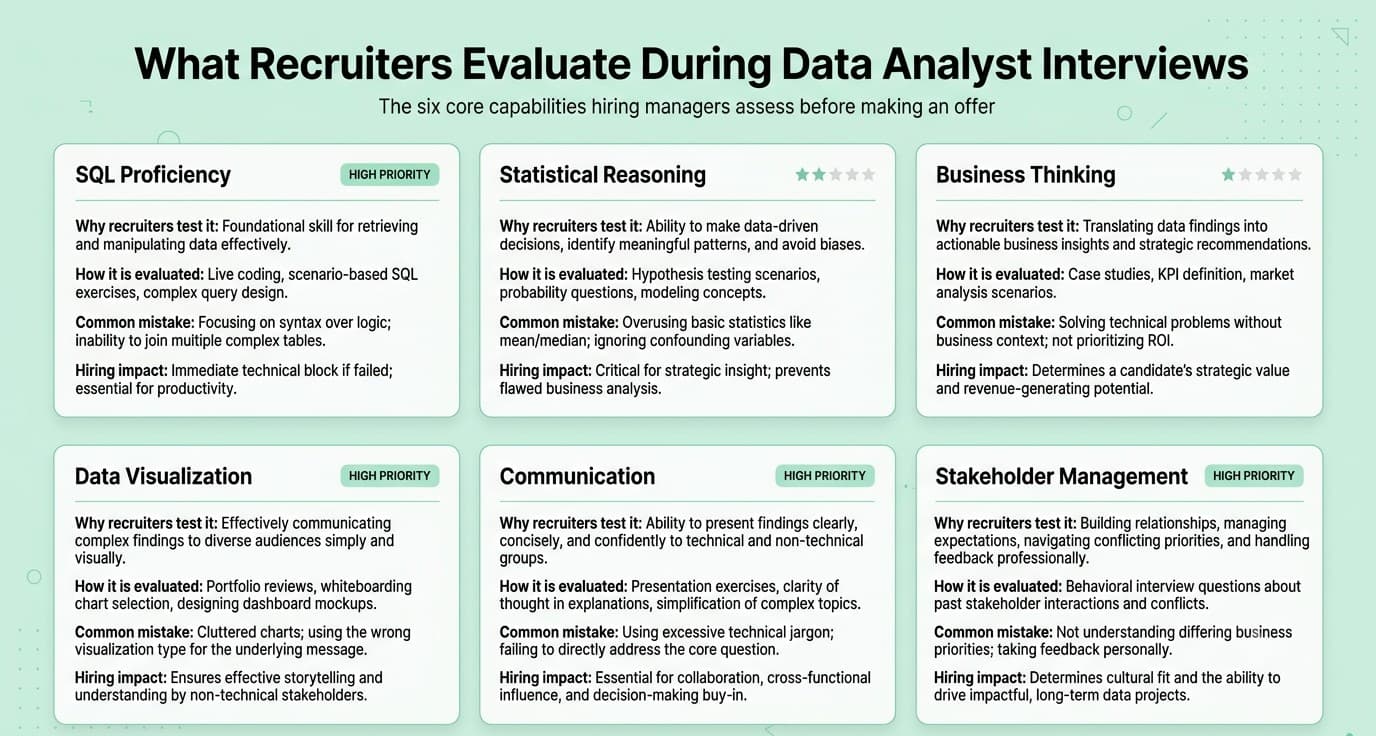
Recruiters are not just checking boxes on a skills list. They are trying to predict how you will perform once you are on the team, under a real deadline, with real stakeholders asking real questions.
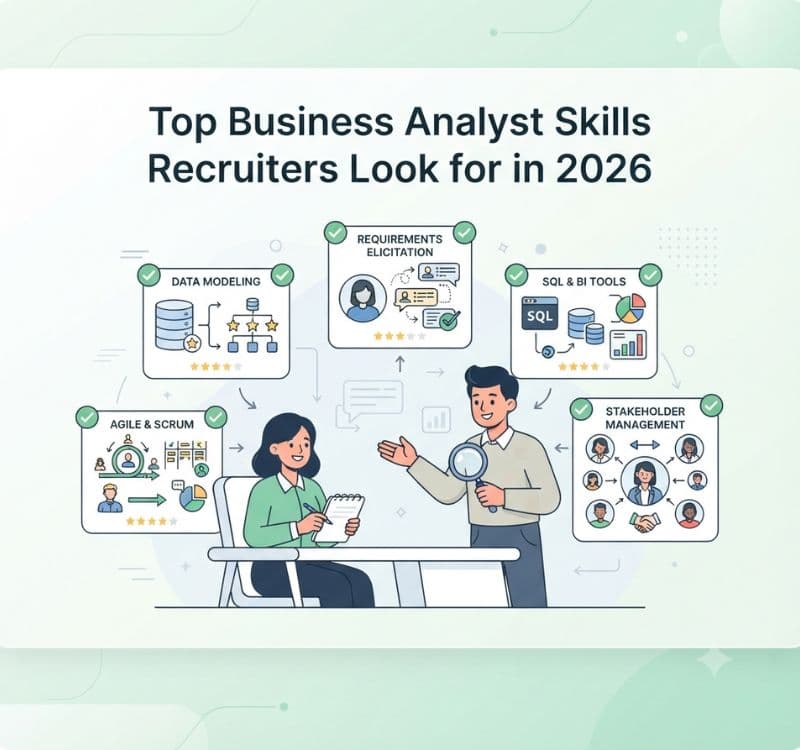
Core skills recruiters expect:
- SQL proficiency. This is nearly universal. You should be comfortable with joins, subqueries, window functions, aggregations, and query optimization.
- Spreadsheet fluency. Excel or Google Sheets skills like pivot tables, VLOOKUP or XLOOKUP, and conditional formatting still come up often, especially at smaller companies.
- Statistical reasoning. Understanding of mean, median, standard deviation, correlation versus causation, hypothesis testing, and sampling bias.
- Data visualization. Ability to build clear dashboards in tools like Tableau, Power BI, or Looker, and to know when a chart is misleading.
- Business acumen. The ability to connect a number to a decision. Recruiters want to hear you say things like "this metric matters because it affects retention" rather than just reciting the calculation.
- Communication. Especially for candidates who are not native English speakers, clear and confident verbal communication during the interview itself is often weighted just as heavily as technical accuracy.
Hiring managers also quietly evaluate soft signals: Do you ask clarifying questions before diving into a problem? Do you stay calm when you get something wrong? Do you show curiosity about the company's actual data challenges?
Also Read: Top Data Analyst Skills Recruiters Look for in 2026
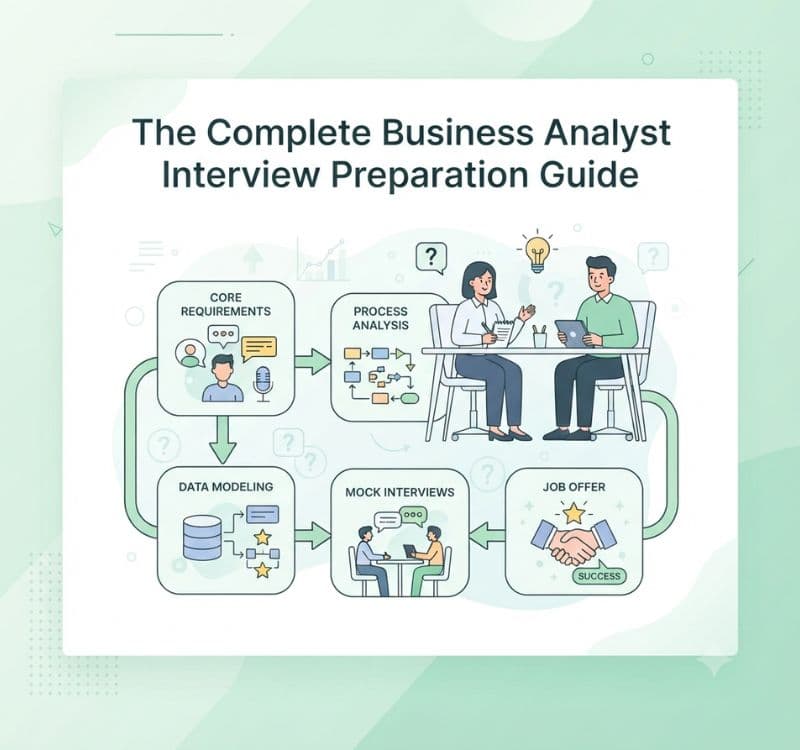
How to Prepare, A Step-by-Step Roadmap
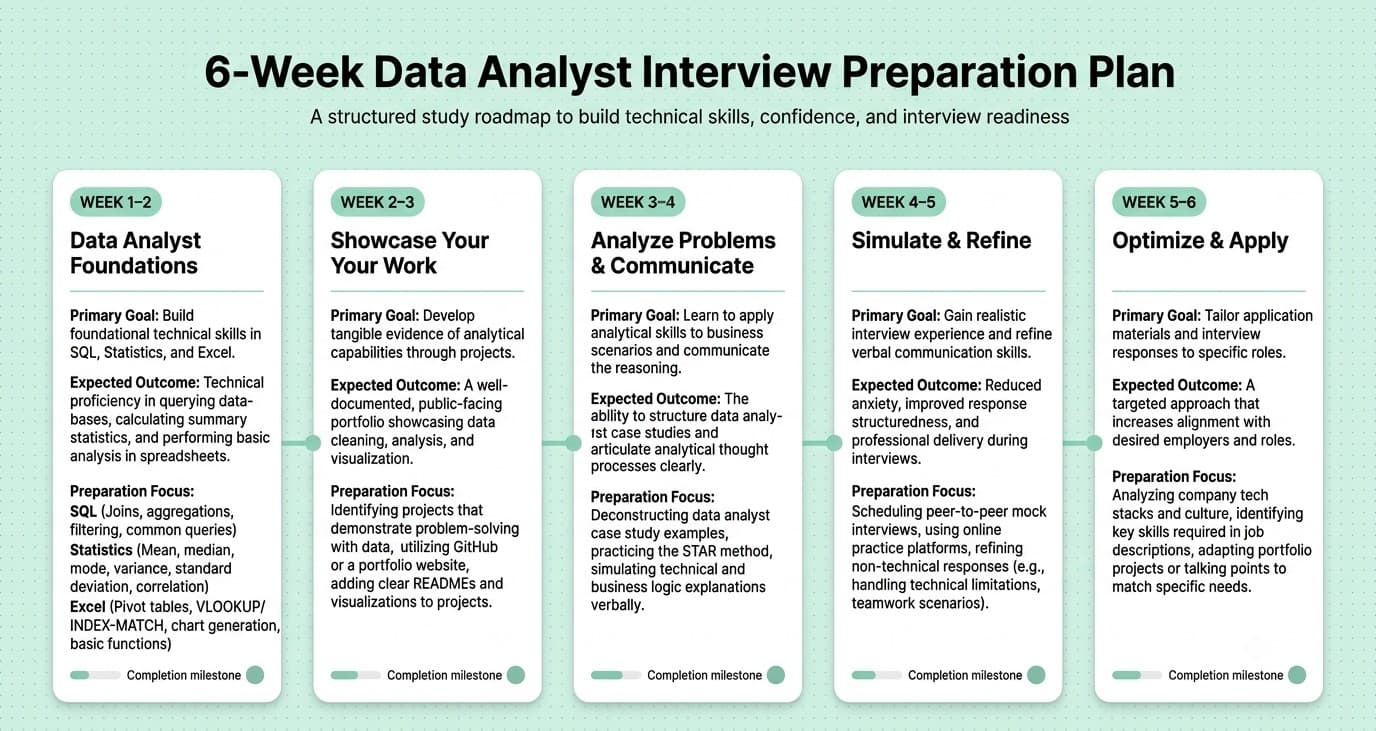
Rather than studying everything at once, follow this sequence over four to six weeks.
Week 1 to 2: Rebuild your fundamentals Go back to SQL basics and statistics basics even if you think you know them. Interviewers often ask simple questions in unusual phrasing, and shaky fundamentals show up fast under pressure.
Week 2 to 3: Build or refresh your portfolio Pick two or three projects that show a full analysis cycle: a business question, your approach, the data cleaning steps, the analysis, and a clear recommendation. Quality matters far more than quantity.
Week 3 to 4: Practice case studies out loud Data analyst case interviews are conversational. Practice narrating your thought process, not just arriving at the right answer silently. This is one of the most underrated preparation steps.
Week 4 to 5: Mock interviews Simulate the real pressure of an interview, including the parts that make people nervous: explaining a wrong answer, handling a follow-up question you did not expect, or being asked to defend an assumption. A structured platform like Mocklingo can help you rehearse this exact scenario with realistic follow-up questions and feedback on both your technical answers and your delivery.
Week 5 to 6: Company-specific research Study the company's product, business model, and recent news. Many case study rounds are built directly around the company's actual metrics or challenges.
Core Topics to Study, Ranked by Interview Importance
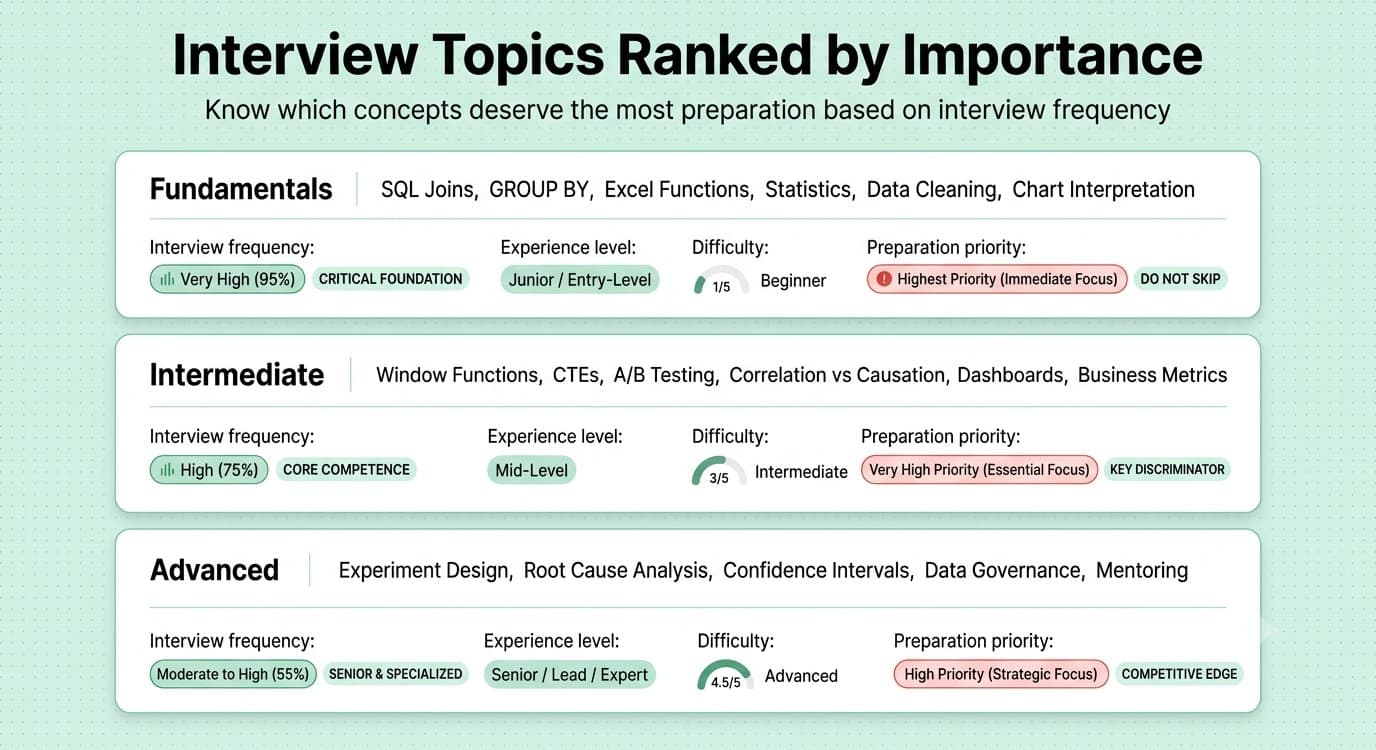
Fundamental Concepts (asked in almost every interview)
- SQL joins (inner, left, right, full outer) and when to use each
- GROUP BY, HAVING, and aggregate functions
- Basic Excel formulas: VLOOKUP, XLOOKUP, SUMIF, COUNTIF
- Descriptive statistics: mean, median, mode, standard deviation
- Data cleaning: handling nulls, duplicates, and outliers
- Reading and interpreting a simple chart or dashboard
Intermediate Concepts (common at two to five years experience)
- Window functions: RANK, ROW_NUMBER, LAG, LEAD
- Subqueries versus CTEs, and when each is more readable
- A/B testing fundamentals: control groups, sample size, statistical significance
- Correlation versus causation, and confounding variables
- Building a dashboard that answers a specific business question, not just displaying numbers
- Metric definition: how to choose a north star metric and avoid vanity metrics
Advanced Concepts (senior and lead roles)
- Designing an experimentation framework across multiple teams
- Diagnosing metric anomalies and root cause analysis under time pressure
- Communicating uncertainty and confidence intervals to non-technical executives
- Data governance and ensuring consistent metric definitions across an organization
- Mentoring junior analysts and reviewing their analysis for logical gaps
Scenario Based Preparation Tips
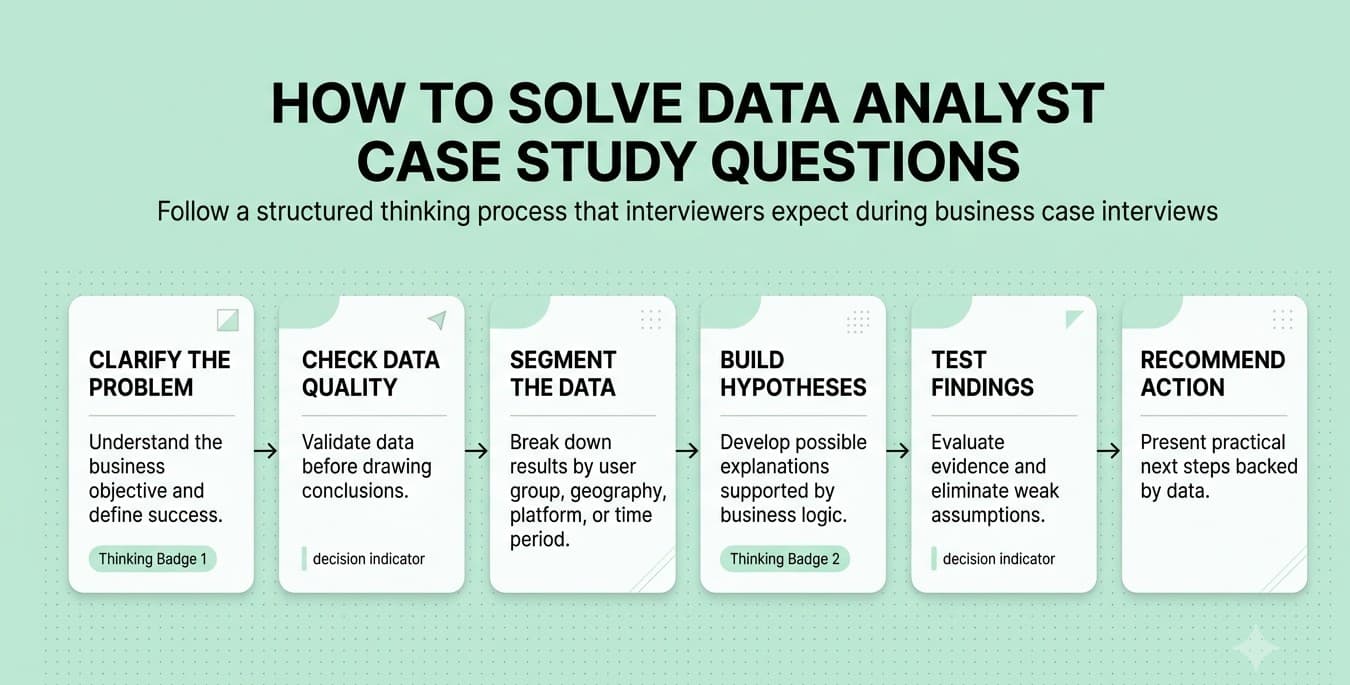
Interviewers love questions like "our weekly active users dropped ten percent last week, how would you investigate this." Practice a repeatable framework for these:
- Clarify the metric definition and the time window.
- Check for data quality issues first, such as a tracking bug or a reporting delay.
- Segment the drop by platform, geography, or user cohort to isolate where it is happening.
- Form two or three hypotheses and explain how you would test each one.
- State what you would recommend next, even if you do not have a final answer yet.
This structure shows the interviewer how you think, which matters more than getting the "correct" root cause.
Practical Preparation Exercises
- Rebuild a public dataset analysis from scratch, such as a retail sales dataset, and write a one page summary of your findings as if presenting to a manager.
- Time yourself solving five SQL problems in under thirty minutes total to build speed under pressure.
- Record yourself explaining a project in ninety seconds, then listen back for filler words and unclear structure.
- Practice explaining a technical concept, like p-values, to someone with no statistics background in under a minute.
FREE TO USE
8k+ SESSIONS92% FLUENCY4.9★ RATING
Speak With Confidence
Real Conversations. Real Scenarios. Speak until it feels natural.
- Real-Time Speaking Practice
- Guided Conversation Flows
- Instant AI Feedback
Common Interview Rounds
Resume and application screen Recruiters scan for relevant tools, quantifiable impact, and clear project descriptions. Numbers matter here. "Improved reporting efficiency" is weaker than "reduced weekly reporting time from six hours to ninety minutes by automating a Python script."
HR or recruiter round Focused on background, motivation, salary expectations, and basic communication. Short and conversational, but it filters out a surprising number of candidates who cannot clearly explain their own resume.
Technical or SQL round Live coding or a shared screen exercise involving SQL queries, sometimes combined with a short Excel or Python task. Interviewers are watching your problem-solving process as much as your final query.
Case study or business problem round You are given a business scenario and asked to walk through how you would analyze it. This is often the round that determines the offer, since it tests judgment rather than memorized syntax.
Hiring manager or team round Focused on culture fit, collaboration style, and how you have handled disagreement or ambiguity in past roles. Behavioral questions dominate here.
Final round or leadership round For senior roles, this may include a presentation of a past project to a panel, testing both technical depth and executive communication.
How to Answer Confidently
Confidence in an interview is less about personality and more about preparation and structure. A few techniques that consistently help:
- Think out loud. Silence makes interviewers nervous. Narrate your reasoning even when you are unsure.
- Use the STAR method for behavioral questions. Situation, Task, Action, Result. Keep each answer under two minutes.
- Pause before answering technical questions. A two second pause to organize your thoughts reads as confidence, not hesitation.
- Ask clarifying questions. For any case study, asking one or two smart clarifying questions before diving in signals real analytical maturity.
- Practice speaking, not just solving. Many strong analysts lose points not because they lack knowledge but because their spoken explanation is disorganized. Rehearsing answers out loud, ideally with realistic follow up questions, closes this gap faster than silent study. This is exactly the kind of practice a mock interview session on Mocklingo's AI mock interview tool is built for, since it gives you a live back and forth rather than a static question list.
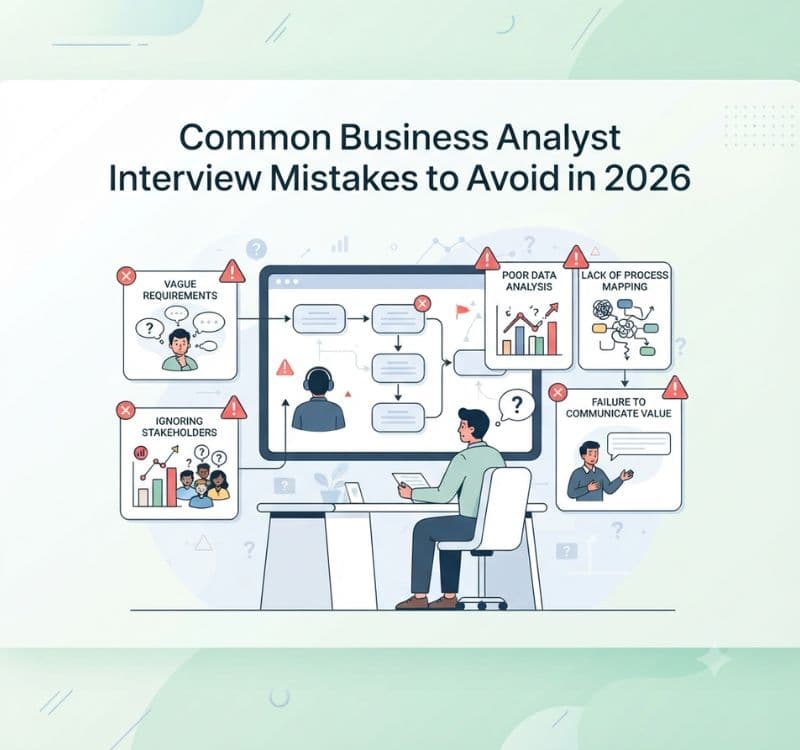
Common Mistakes to Avoid
- Jumping into a query or answer without clarifying the question. This is the single most common mistake in technical and case rounds.
- Memorizing SQL syntax without understanding the underlying logic. Interviewers change the phrasing specifically to catch this.
- Talking only about tools, not impact. Saying "I know Tableau" is far weaker than describing a decision your dashboard influenced.
- Rambling in behavioral answers. Long, unstructured stories lose the interviewer's attention. Stick to STAR.
- Ignoring communication practice. Especially for candidates preparing in a second language, under-practicing spoken delivery is a bigger risk than under-practicing SQL.
- Not preparing questions for the interviewer. Having no questions at the end can read as low genuine interest in the role.
- Overloading the portfolio with too many shallow projects. Two or three deep, well-explained projects beat six rushed ones.
Best Practices
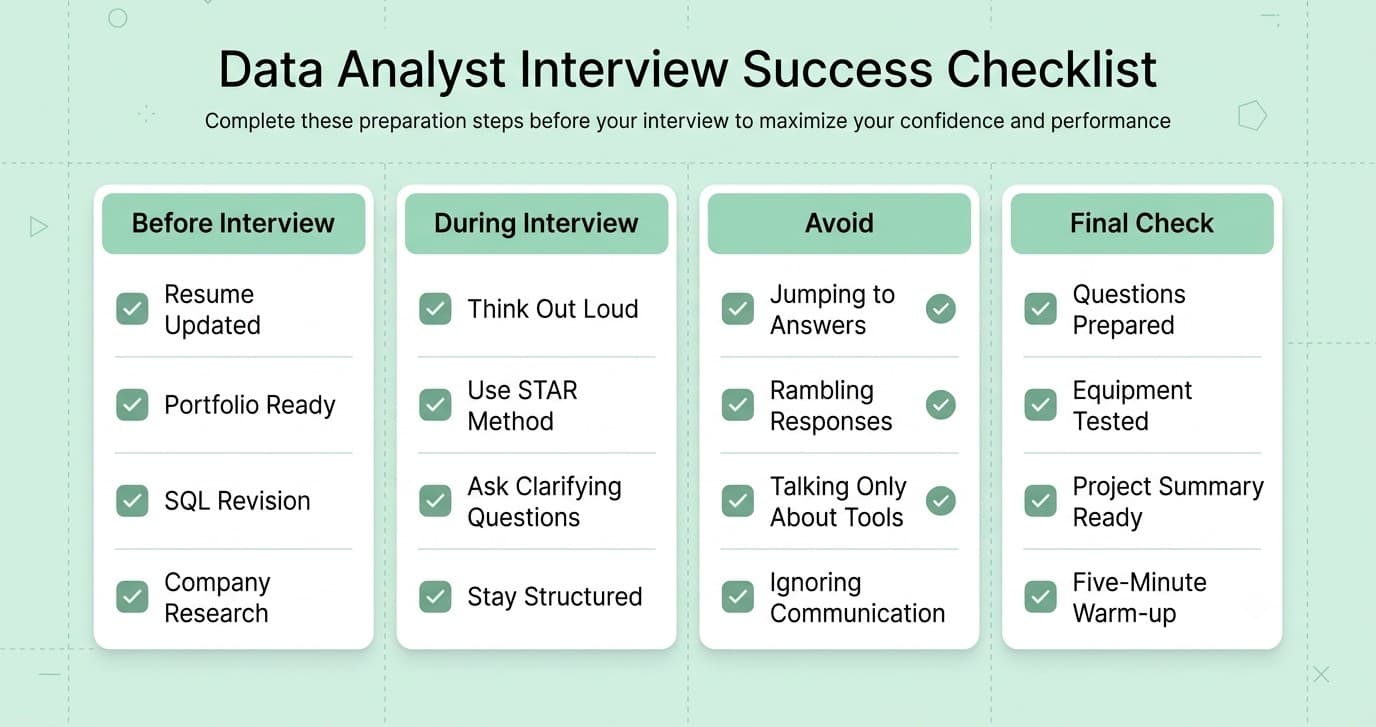
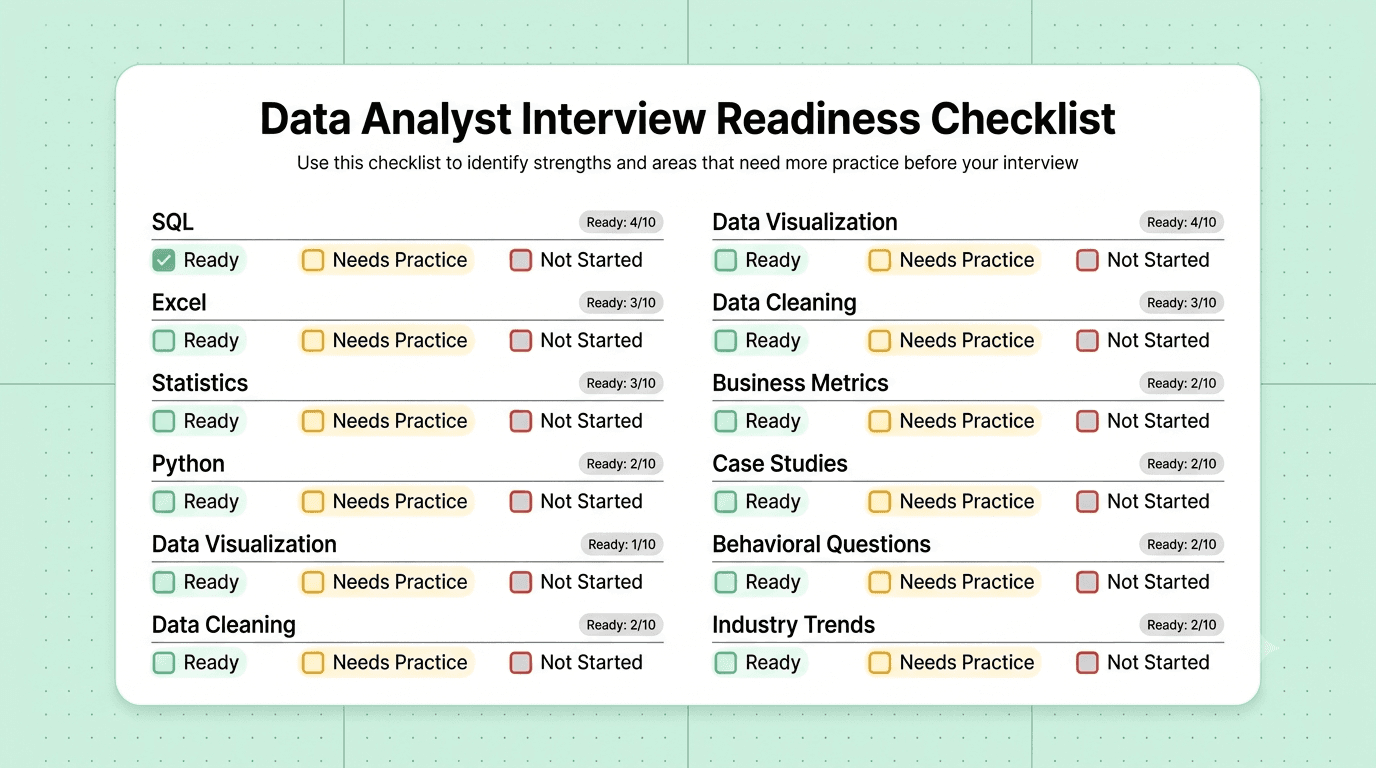
Final Interview Day Checklist
- Final Interview Day Checklist Review your two or three portfolio projects and be ready to explain each in under two minutes.
- Refresh core SQL syntax: joins, window functions, GROUP BY.
- Re-read the job description and note two or three specific skills to emphasize.
- Prepare three to five thoughtful questions for the interviewer.
- Test your camera, microphone, and internet connection if the interview is remote.
- Have a notepad ready for case study rounds to jot down assumptions and structure.
- Do a five minute warm-up: explain one project out loud before the call starts.