Loading...
Contents
Top Data Analyst Skills Recruiters Look for in 2026
Aug 5, 202634 min readUpdated Sep 22, 2026
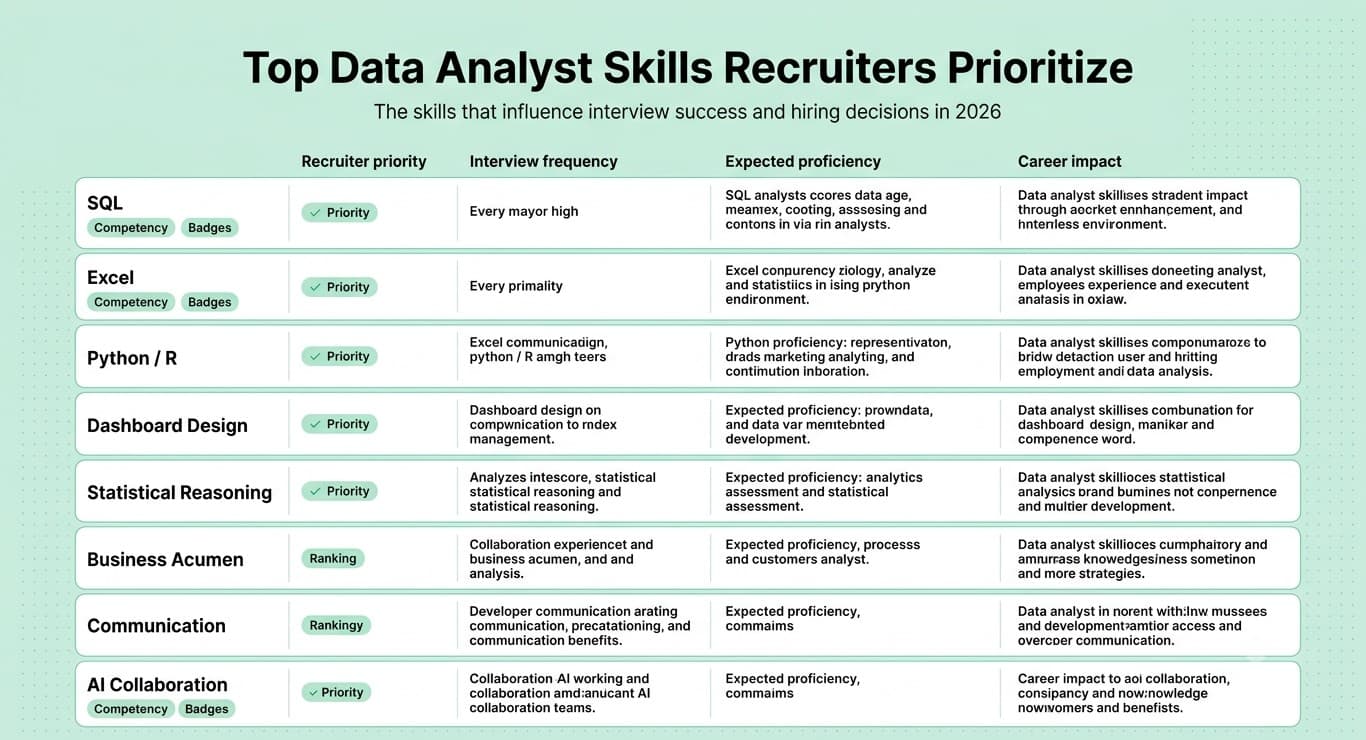
In 2026, recruiters hiring data analysts prioritize SQL fluency, business storytelling with data, Python or R for automation, dashboard design in tools like Power BI or Tableau, statistical reasoning, and the ability to work alongside AI copilots without losing critical judgment. Certifications matter less than a portfolio that proves you can turn messy data into a decision someone actually acted on. Fresher expectations center on clean SQL and clear communication. Senior expectations center on framing the right business question before touching a single row of data.
If you have spent any time scrolling job boards, you already know the job description for "Data Analyst" looks almost identical at every company. SQL. Excel. A BI tool. "Strong communication skills." What that list does not tell you is which of those skills actually gets you shortlisted, which ones get tested in the interview, and which ones separate a candidate who gets an offer from one who gets a polite rejection email.
I have sat on the hiring side of data analyst interviews for over two decades, across startups building their first analytics function and enterprises running mature data teams. The honest answer is that most candidates are not rejected because they lack skills. They are rejected because they cannot demonstrate the skills they actually have, or because they have optimized for the wrong things. This guide exists to fix that gap.
We will go deep on the skills that matter most in 2026, not the ones that mattered in 2019. AI has quietly rewritten a large part of the data analyst job description, and recruiters have adjusted their evaluation criteria accordingly, even if the job postings have not caught up yet.
FREE TO USE
25K+ INTERVIEWS4.8★ RATING68% IMPROVEMENT
Crack Your Dream Job
Real Interviews. Real Pressure. Practice until it feels easy.
- Seamless Interview Experience
- Resume & JD Questions
- Instant Personalized Feedback
How Hiring for Data Analysts Has Changed Going Into 2026
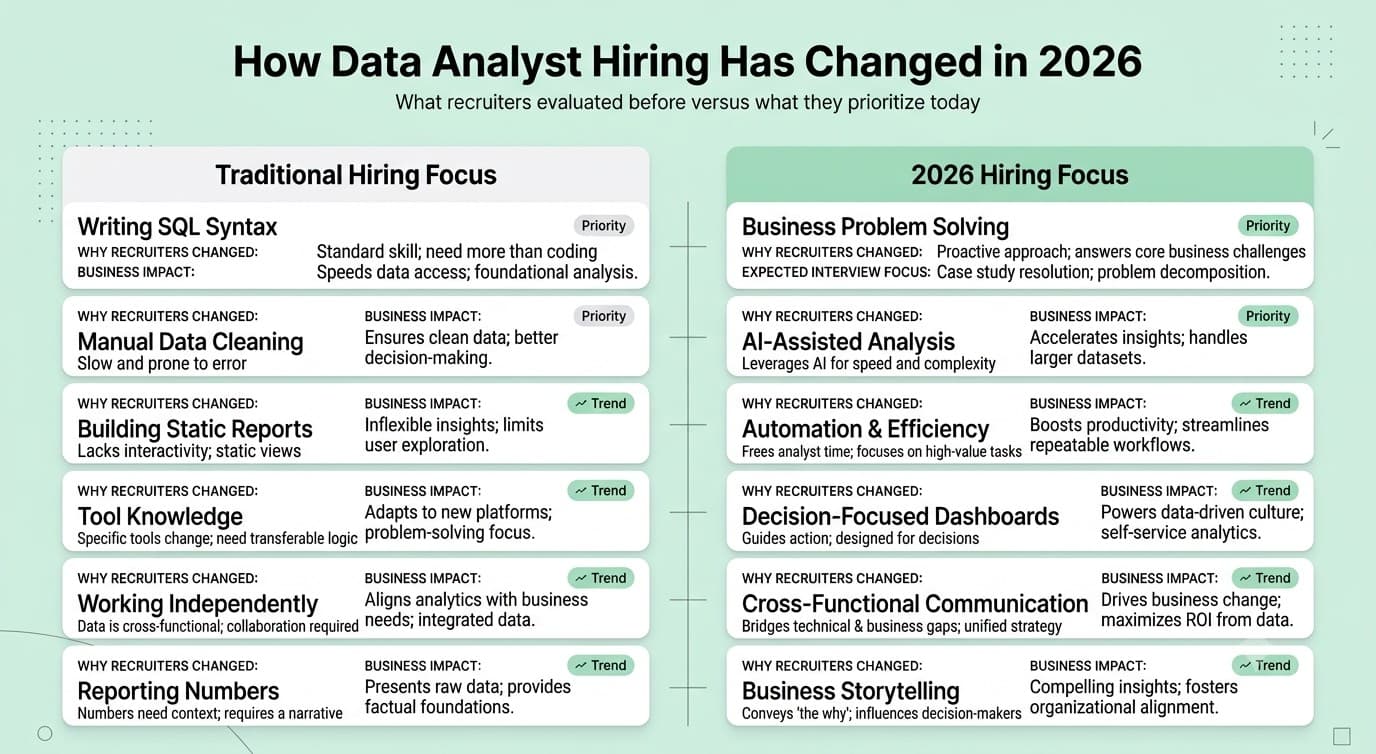
The biggest shift is that AI tools now write basic SQL queries and clean simple datasets, so recruiters spend less time testing whether you can write code and more time testing whether you know what question to ask, how to sanity check AI output, and how to explain a finding to someone who does not care about your methodology.
A few things are shaping hiring decisions this year:
- AI copilots have absorbed the mechanical parts of the job. Writing a basic SQL join, cleaning a CSV, or generating a first-draft chart takes minutes with tools like Copilot, ChatGPT, or built-in AI features in Power BI and Tableau. Recruiters know this, so testing "can you write a SQL query" in isolation tells them less than it used to.
- Business context has become the real differentiator. When the mechanical work gets faster, the bottleneck moves to judgment: knowing which metric actually matters, spotting a flawed assumption in a dashboard, or explaining why a number moved.
- Hiring budgets are tighter, so teams want fewer, more versatile analysts. A candidate who can go from a stakeholder request to a finished, defensible dashboard without four handoffs is worth more than one who is excellent at just one step.
- Remote and hybrid hiring means communication skill is tested earlier. Many first rounds are now asynchronous or over video, so how you explain your thinking carries as much weight as the thinking itself.
None of this means technical skill stopped mattering. It means technical skill is now table stakes, and the skills layered on top of it decide who gets hired.
Core Fundamentals
SQL
Why Recruiters Prioritize This Skill
SQL is still the closest thing the data world has to a universal language. Almost every company, regardless of its stack, stores structured data in a relational database or a warehouse that speaks SQL. A recruiter who sees weak SQL skills on a data analyst candidate treats it as a disqualifying signal, because it suggests the person has not actually worked with real, messy company data.
What Recruiters Actually Expect in 2026
Basic SELECT and WHERE clauses are assumed, not tested in isolation anymore. What gets tested now is your ability to write multi-table joins, window functions, and subqueries under time pressure, and to reason about query performance on large tables. Recruiters also increasingly ask candidates to review and correct an AI-generated query, because that mirrors how SQL actually gets written on the job now.
Interview Evaluation
- Resume screening: recruiters look for specific SQL functions mentioned (window functions, CTEs, indexing) rather than the generic phrase "proficient in SQL."
- Technical interviews: a live or take-home SQL test using a sample schema, usually involving joins across three or more tables.
- Practical rounds: debugging a broken or slow query, which tests real experience rather than memorized syntax.
Real Workplace Example
A marketing team asks why signups dropped last week. The raw answer requires joining a signups table, a marketing spend table, and a campaign metadata table, then filtering out bot traffic using a flag buried in a fourth table nobody mentioned. This is what "SQL skill" actually means on the job, not writing a clean query against a single, tidy table.
Fresher Expectations
Comfortable with joins, aggregations, GROUP BY, and basic window functions like ROW_NUMBER or RANK. Able to write a query from a plain-English business question without hand holding.
Mid-Level Expectations
Can optimize slow queries, understands indexing at a conceptual level, and can write CTEs and nested subqueries confidently. Can spot when a query is technically correct but semantically wrong, for example double counting rows after a join.
Senior-Level Expectations
Designs the data model or schema decisions that make future queries easier for the whole team, not just their own. Reviews junior analysts' SQL for logic errors, not just syntax.
Common Mistakes
Candidates often memorize syntax without understanding what a join actually does to row counts, which shows up immediately when asked to explain their own query out loud. Another common mistake is ignoring NULL handling, which quietly breaks aggregate calculations.
How to Build This Skill
Practice on real, messy public datasets rather than tutorial datasets that are already clean. Sites with realistic e-commerce or sports data work better than toy examples. Recreate reports you have seen at work using only SQL, then verify the numbers against the original report.
Example Interview Questions
"Write a query to find the second highest salary in each department." "Given these two tables, why might a simple join double count some rows, and how would you fix it?"
Read More: Top 100 Data Analyst Interview Questions
Strong Sample Answer Direction
A strong answer explains the reasoning before writing the query: what grain the data is at, what the join key is, and what could go wrong. Reciting syntax without that reasoning reads as memorized rather than understood.
Excel and Spreadsheet Fluency
Why Recruiters Prioritize This Skill
Despite the rise of BI tools, Excel remains the fastest way for non-technical stakeholders to receive and manipulate data. Recruiters know that even at companies with sophisticated data stacks, a huge share of ad hoc requests still get answered in a spreadsheet.
What Recruiters Actually Expect in 2026
Pivot tables and VLOOKUP are assumed baseline knowledge. What differentiates candidates now is fluency with dynamic arrays, Power Query for data transformation, and the discipline to build a spreadsheet that someone else can audit six months later without asking you what a formula means.
Interview Evaluation
Take-home exercises where candidates are given a messy export and asked to produce a clean summary. Recruiters look at formula structure, not just the final numbers, because a fragile spreadsheet full of hardcoded values is a red flag.
Real Workplace Example
A finance team needs a quick reconciliation between two systems before a board meeting in two hours. There is no time to build a pipeline. Excel with Power Query and well-structured formulas is the only realistic tool for that turnaround.
Fresher Expectations
Pivot tables, lookup functions, basic charting, and clean formatting that does not require explanation.
Mid-Level Expectations
Power Query for repeatable data cleaning, dynamic arrays, and building templates other people can reuse without breaking them.
Senior-Level Expectations
Knows when Excel is the wrong tool and pushes back on requests that should be automated in SQL or Python instead, protecting the team from spreadsheet sprawl.
Common Mistakes
Hardcoding values instead of using formulas, and building spreadsheets so complex that only the original author can maintain them.
How to Build This Skill
Rebuild a report you currently get manually as a Power Query driven template that refreshes with one click. Practice explaining a spreadsheet's logic out loud to someone unfamiliar with it.
Example Interview Questions
"How would you flag duplicate entries across two large lists without using VLOOKUP?" "Walk me through how you would audit a spreadsheet you inherited from someone who left the company."
Strong Sample Answer Direction
Strong answers show restraint, choosing the simplest reliable method over the most impressive looking formula.
Technical Skills
Python or R for Analysis and Automation
Why Recruiters Prioritize This Skill
Recruiters increasingly expect data analysts to automate repetitive reporting rather than rebuild the same spreadsheet every Monday. Python, in particular, has become the bridge skill between analyst and analytics engineer roles, and companies like hiring analysts who can grow into that bridge without a full role change.
What Recruiters Actually Expect in 2026
Not software engineering. Recruiters expect pandas fluency, basic scripting to automate a recurring report, and enough comfort with libraries to use AI coding assistants effectively rather than being replaced by them. Candidates who can direct an AI tool to write a script, then catch its mistakes, are valued more than candidates who write everything from scratch slowly.
Interview Evaluation
Take-home data cleaning tasks in a Jupyter notebook, or live coding sessions focused on pandas operations like grouping, merging, and handling missing data.
Real Workplace Example
A weekly sales report currently takes three hours to assemble by hand from four different exports. An analyst who scripts this in Python turns three hours into five minutes, freeing time for actual analysis instead of data assembly.
Fresher Expectations
Comfortable reading and modifying existing scripts, basic pandas operations, and simple visualizations using matplotlib or seaborn.
Mid-Level Expectations
Writes scripts from scratch to automate recurring workflows, understands how to structure reusable functions instead of copy pasting code.
Senior-Level Expectations
Builds lightweight internal tools or automated pipelines that other analysts rely on, and makes calls about when a task deserves proper automation versus when it is a one time analysis.
Common Mistakes
Trying to prove coding skill with unnecessarily complex code, when the job usually rewards simple, readable scripts that a teammate could maintain.
How to Build This Skill
Pick one recurring manual report in your current job or a public dataset and automate it end to end. Practice explaining your code to a non-technical person in one sentence per step.
Example Interview Questions
"Given this messy CSV, write a script to clean and summarize it." "How would you handle a dataset with 15 percent missing values in a key column?"
Strong Sample Answer Direction
A strong answer discusses tradeoffs around missing data (drop, impute, or flag) rather than jumping straight to code, since the reasoning behind the choice matters more than the syntax.
Dashboarding and BI Tools (Power BI, Tableau, Looker)
Why Recruiters Prioritize This Skill
Dashboards are how most of an organization actually consumes data. A brilliant analysis that lives in a notebook nobody else opens has zero business impact. Recruiters test this skill because it is where analytical work meets real stakeholder usage.
What Recruiters Actually Expect in 2026
Beyond knowing the software, recruiters expect design judgment: knowing which chart type fits which question, avoiding dashboards with 20 metrics nobody looks at, and building for the specific audience rather than a generic "everything" view.
Interview Evaluation
Portfolio reviews of past dashboards, often followed by "walk me through why you made this design choice" rather than "what does this button do."
Real Workplace Example
A sales leader needs a dashboard that answers one question at a glance every morning: are we on pace for the quarter. A cluttered dashboard with 12 charts fails this job even if every number on it is technically correct.
Fresher Expectations
Can build a functional dashboard from a clean dataset with appropriate chart choices and clear labeling.
Mid-Level Expectations
Designs dashboards around a specific decision or audience, uses filters and drill downs thoughtfully, and manages performance on larger datasets.
Senior-Level Expectations
Sets dashboard standards for a team, decides what should and should not become a permanent dashboard versus a one time report, and pushes back on stakeholder requests for vanity metrics.
Common Mistakes
Building for visual impressiveness instead of decision usefulness, and including every available metric instead of the two or three that actually drive a decision.
How to Build This Skill
Rebuild a dashboard you have seen at work or online, but redesign it around a single clear question instead of copying the original layout.
Example Interview Questions
"Show me a dashboard you built and tell me one thing you would change if you rebuilt it today." "How would you design a dashboard for a CEO who has 30 seconds to look at it each morning?"
Strong Sample Answer Direction
Strong candidates critique their own past work honestly instead of presenting it as perfect, which signals real design maturity.
Analytical and Problem-Solving Skills
Statistical Reasoning
Why Recruiters Prioritize This Skill
Anyone can compute an average. Recruiters want analysts who know when an average is misleading, when a sample size is too small to trust, and when a correlation is being mistaken for causation. This is the skill that prevents a company from making a bad decision based on a confident but wrong chart.
What Recruiters Actually Expect in 2026
Not a statistics degree. Practical fluency: understanding variance, confidence, sample size, and the difference between statistical and practical significance, applied to real business scenarios rather than textbook problems.
Interview Evaluation
Case study questions like "conversion rate went from 2 percent to 2.3 percent after a change, is that meaningful," which test judgment rather than formula recall.
Real Workplace Example
An A/B test shows a new checkout flow "increased" conversion, but the sample only ran for two days over a weekend, a low traffic period. A statistically literate analyst catches this before the change gets rolled out company wide.
Fresher Expectations
Understands mean, median, standard deviation, and basic hypothesis testing at a conceptual level.
Mid-Level Expectations
Designs and evaluates A/B tests properly, understands statistical significance versus business significance, and can explain both to a non-technical stakeholder.
Senior-Level Expectations
Sets experimentation standards for the company, catches flawed test designs before they run, and trains other analysts to think statistically by default.
Common Mistakes
Reporting a percentage change without mentioning sample size, and treating correlation in a dashboard as proof of causation without further investigation.
How to Build This Skill
Take a public dataset and deliberately try to find a misleading correlation, then explain why it is misleading. This builds the skeptical instinct recruiters are testing for.
Example Interview Questions
"How would you determine if a 5 percent lift in an A/B test is real or noise?" "What is the difference between correlation and causation, with a business example?"
Strong Sample Answer Direction
A strong answer always circles back to what decision the business is trying to make, since statistical rigor without business context is just trivia.
1 / 2
FREE TO USE
8k+ SESSIONS92% FLUENCY4.9★ RATING
Speak With Confidence
Real Conversations. Real Scenarios. Speak until it feels natural.
- Real-Time Speaking Practice
- Guided Conversation Flows
- Instant AI Feedback
Business Acumen and Framing the Right Question
Why Recruiters Prioritize This Skill
This is consistently the skill that separates a data analyst from a "query writer." Recruiters have learned that technically skilled analysts who cannot connect their work to business outcomes create dashboards nobody uses and analyses that answer the wrong question well.
What Recruiters Actually Expect in 2026
The ability to take a vague stakeholder request like "sales are down, can you look into it" and turn it into a specific, answerable question before writing a single line of code.
Interview Evaluation
Case interviews and behavioral questions asking candidates to walk through a real ambiguous request they received and how they clarified it.
Real Workplace Example
A stakeholder says "our churn is too high." A business acute analyst does not immediately pull churn numbers. They ask: churn of which segment, over what time period, and compared to what benchmark, before any data gets touched.
Fresher Expectations
Asks clarifying questions before diving into analysis, rather than guessing at what the requester meant.
Mid-Level Expectations
Proactively identifies the real business problem behind a request, sometimes different from what was originally asked.
Senior-Level Expectations
Shapes what questions the business should be asking in the first place, often before a formal request even comes in.
Common Mistakes
Jumping straight into analysis without confirming the actual question, which wastes hours producing an answer nobody needed.
How to Build This Skill
Read your company's or industry's business model closely enough to explain, in one paragraph, how the business makes money and what the key levers are.
Example Interview Questions
"A stakeholder asks you to analyze why revenue dropped. What questions do you ask before starting?" "Tell me about a time you were given a vague request and how you clarified it."
Strong Sample Answer Direction
Strong answers show the clarifying questions asked, not just the final analysis, because the questions reveal the thinking.
Communication Skills
Data Storytelling
Why Recruiters Prioritize This Skill
An accurate finding that nobody understands or acts on has zero business value. Recruiters test storytelling because it is the final, and often weakest, link in the analytics chain.
What Recruiters Actually Expect in 2026
The ability to lead with the "so what" instead of the methodology, tailored to the audience. A finding presented to an executive should sound different from the same finding presented to a fellow analyst.
Interview Evaluation
Presentation rounds where candidates walk through a past analysis to a mock stakeholder, evaluated on clarity and structure, not just accuracy.
Real Workplace Example
Instead of opening with "I ran a cohort analysis segmented by acquisition channel," a strong analyst opens with "customers acquired through paid social churn twice as fast as organic, here is what I think is causing it."
Fresher Expectations
Can summarize a finding in two or three plain sentences before diving into detail.
Mid-Level Expectations
Adjusts explanation depth and vocabulary based on the audience, and anticipates the first follow up question.
Senior-Level Expectations
Uses data storytelling to influence decisions at the leadership level, framing findings around business risk and opportunity rather than statistics.
Common Mistakes
Leading with methodology, or including every chart from the analysis instead of the one or two that actually support the recommendation.
How to Build This Skill
Practice explaining any analysis in exactly three sentences: what you found, why it matters, and what you recommend. This is also excellent practice for interview settings where time is limited, similar to how structured mock interview practice on platforms like Mocklingo helps candidates get comfortable compressing complex answers under time pressure.
Example Interview Questions
"Walk me through a data project you worked on, in under two minutes." "How would you explain a statistically significant but small effect to someone who is not data literate?"
Strong Sample Answer Direction
Strong answers are short by design, not because the analysis lacked depth, but because the candidate chose what to leave out.
Stakeholder Communication and Pushback
Stakeholder Communication and Pushback
Why Recruiters Prioritize This Skill
Analysts regularly receive requests that are unclear, contradictory, or based on a flawed assumption. Recruiters want to know a candidate can push back respectfully rather than silently building something they know is wrong.
What Recruiters Actually Expect in 2026
Confidence to say "that metric will be misleading, here is why" without sounding combative, especially important as more junior stakeholders now ask analysts to validate AI generated claims.
Interview Evaluation
Behavioral questions and sometimes live roleplay where the interviewer plays a difficult stakeholder.
Real Workplace Example
A manager asks for a dashboard tracking "engagement" without defining it. Instead of guessing, a strong analyst proposes two or three concrete definitions and asks the manager to pick one, avoiding wasted rework later.
Fresher Expectations
Comfortable asking questions and voicing a small disagreement respectfully in a one on one setting.
Mid-Level Expectations
Pushes back in group settings, including with more senior stakeholders, when a request would produce misleading results.
Senior-Level Expectations
Trusted to represent the data team's judgment in leadership meetings, sometimes overriding a request entirely with a better alternative.
Common Mistakes
Either silently complying with a flawed request, or pushing back too bluntly in a way that damages the working relationship.
How to Build This Skill
Practice reframing disagreement as a question rather than a correction, for example "what would you think if the number moved this way for a different reason" instead of "that's wrong."
Example Interview Questions
"Tell me about a time a stakeholder asked for something you disagreed with. What did you do?" "How would you handle a request for a metric you know can be manipulated?"
Strong Sample Answer Direction
Strong answers show a resolution, not just the disagreement, proving the pushback led somewhere productive.
AI and Automation Skills
Working Effectively With AI Copilots
Why Recruiters Prioritize This Skill
By 2026, most data teams assume candidates already use AI tools daily. What recruiters are actually testing is whether a candidate can direct AI well and catch its mistakes, rather than blindly trusting its output.
What Recruiters Actually Expect in 2026
Ability to write a precise prompt for a data task, and more importantly, to independently verify the AI's output against the actual data rather than assuming it is correct.
Interview Evaluation
Some interviews now include an exercise where candidates are given AI generated code or an AI generated chart and asked to find what is wrong with it.
Real Workplace Example
An AI tool suggests a query to calculate customer lifetime value, but silently excludes refunded orders. An analyst who does not verify the logic ships a number that overstates revenue, which is caught only after a leadership meeting.
Fresher Expectations
Uses AI tools to speed up routine tasks but double checks output against a small manual sample.
Mid-Level Expectations
Knows which tasks are safe to delegate to AI entirely and which require human judgment, and can spot subtle logic errors in AI generated code.
Senior-Level Expectations
Sets team norms for how and when AI tools should be used, balancing speed against the risk of unverified automation.
Common Mistakes
Treating AI output as automatically correct, or refusing to use AI tools at all out of pride, both of which recruiters view as red flags now.
How to Build This Skill
Deliberately ask an AI tool to solve a data problem you already know the answer to, then compare its output line by line to spot where it goes wrong.
Example Interview Questions
"How do you decide when to trust AI generated code versus writing it yourself?" "Tell me about a time an AI tool gave you a wrong or misleading answer."
Strong Sample Answer Direction
Strong answers show specific verification habits, not general enthusiasm or general skepticism about AI.
Skills Recruiters Value More Than Certifications
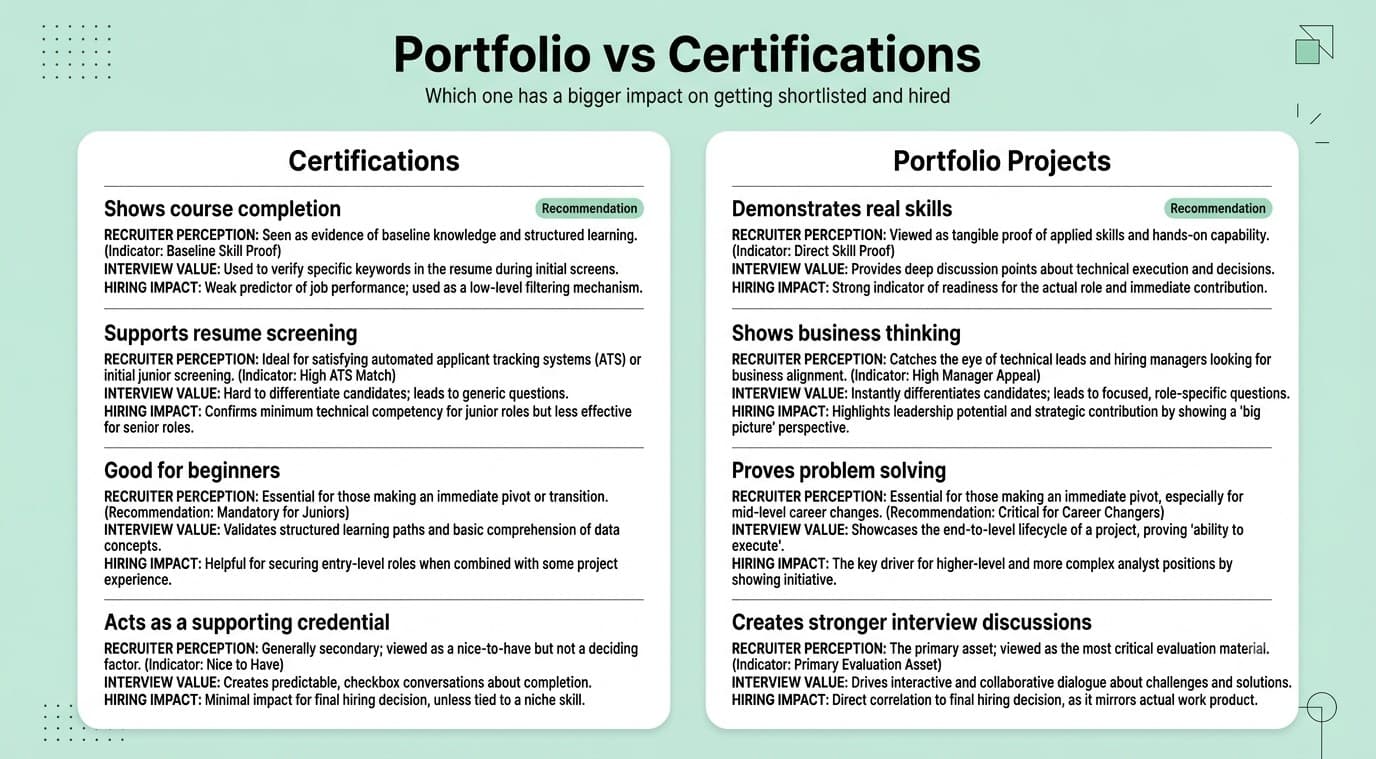
Certifications signal that you completed a course. Portfolios signal that you can do the job. Most hiring managers weight a real project, even a small one built on public data, higher than a certification badge, because a certification proves knowledge exposure while a project proves applied judgment.
Certifications still have a place, mainly as a tiebreaker between two similarly strong candidates, or as a signal for career switchers with no other proof of skill. But recruiters consistently report that candidates lean too heavily on a stack of certificates while having no project they can speak about in detail for more than two minutes. If you have to choose where to spend your next twenty hours, a well documented project will outperform another certificate almost every time.
Skills That Are Becoming Less Important
- Manual, repetitive Excel work without automation. Being fast at manual pivot tables is no longer impressive when Power Query and Python can do the same work reliably.
- Memorized SQL syntax without reasoning. AI tools can generate syntax instantly, so reciting a query from memory carries less weight than explaining why it is structured that way.
- Tool specific certifications as a primary credential. Knowing one specific BI tool deeply matters less than being able to transfer dashboard design judgment across tools.
- Static, one time reports as a core skill. The market increasingly values analysts who build repeatable, automated reporting over analysts who excel at one off manual reports.
None of these skills are useless. They are simply no longer differentiators on their own.
AI Is Changing Data Analytics
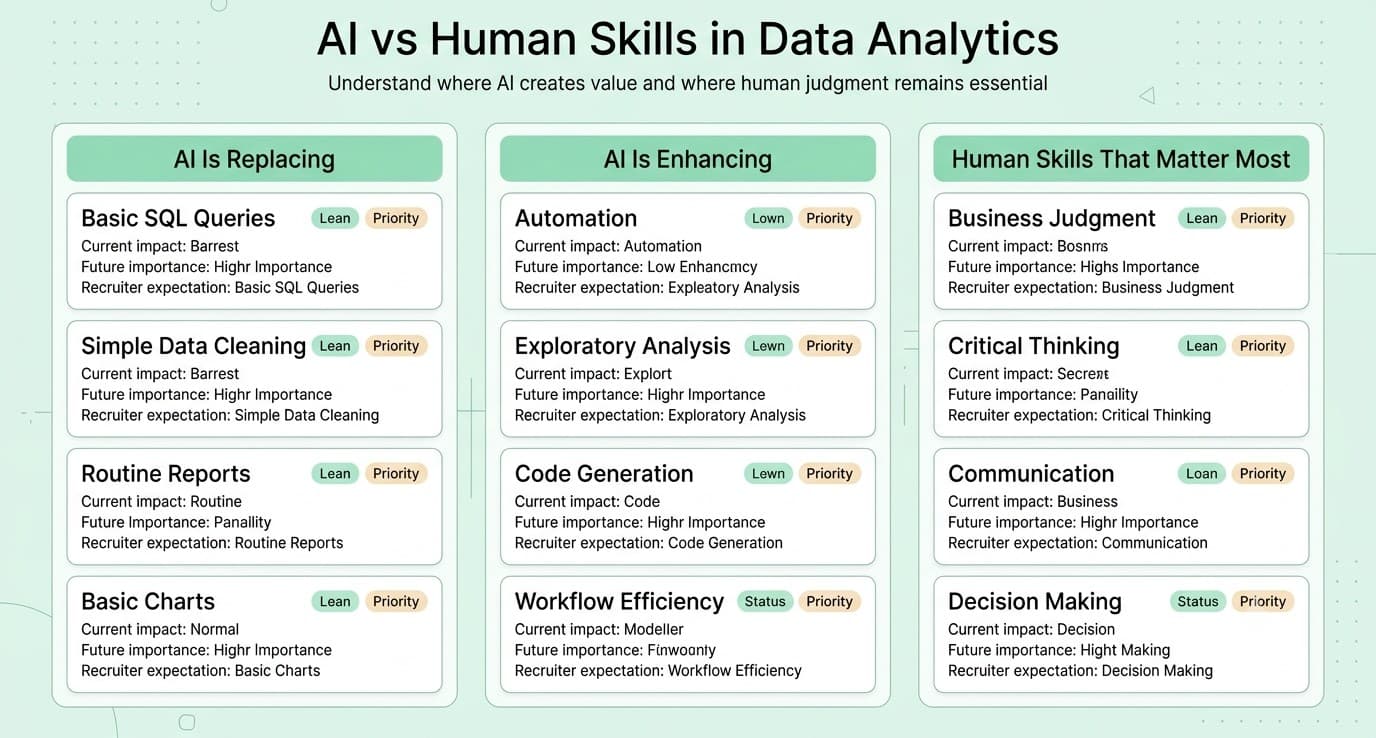
Which skills AI is replacing: Basic query writing, first draft chart generation, simple data cleaning, and repetitive report assembly are increasingly automated. Analysts who define their value purely by these tasks face real pressure.
Which skills AI is enhancing: Analysts who already know how to ask good questions can now explore ten hypotheses in the time it used to take to explore one, because AI accelerates the mechanical steps between question and answer.
Which human skills are becoming more valuable: Judgment about which question matters, skepticism toward confident sounding but wrong output, and the ability to translate a finding into a business decision. These skills are hard to automate because they require context AI does not have.
How professionals should adapt: Treat AI as a fast, occasionally wrong junior analyst working for you. Direct it clearly, verify its output, and spend the time you save on the parts of the job that actually require your judgment: framing questions, interpreting nuance, and communicating with stakeholders.
This is a balanced shift, not a threat. Analysts who adapt tend to become more valuable, not less, because they can now cover more ground per week than before.
Read More : Will AI replace data analyst
Skills That Instantly Differentiate Candidates
- A portfolio project with a real, specific business question, not a generic "analyzed a dataset" project.
- Evidence of pushing back on a stakeholder request, showing judgment rather than pure compliance.
- A dashboard rebuild story, showing the ability to critique and improve existing work rather than only building from scratch.
- Fluent, specific answers about tradeoffs, for example explaining why they chose a median over a mean in a particular analysis.
- Comfort saying "I don't know, but here is how I would find out" instead of guessing under pressure.
Common Skill Gaps Recruiters Notice
- Candidates who can write SQL but cannot explain what their query actually does to the underlying data.
- Candidates who build technically correct dashboards that do not answer any specific business question.
- Candidates who cite p-values and confidence intervals without being able to explain what they mean in plain language.
- Candidates who cannot describe a time they were wrong about a finding and how they caught it.
- Candidates who treat every AI suggestion as correct without independent verification.
Learning Roadmap
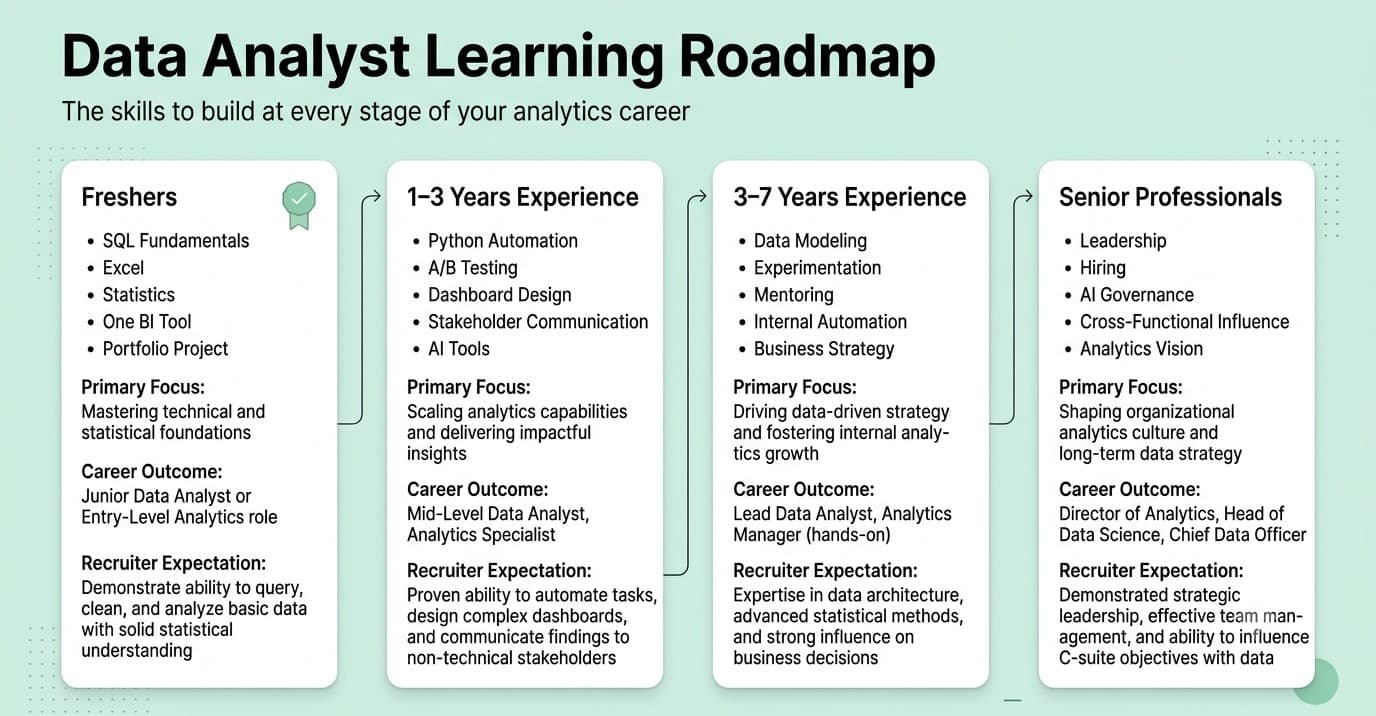
For Freshers
- SQL fundamentals through joins and window functions.
- Excel with pivot tables and basic Power Query.
- One BI tool, built deep rather than wide.
- Basic statistics: mean, median, standard deviation, and simple hypothesis testing.
- One portfolio project answering a specific business question end to end.
For Professionals With 1 to 3 Years of Experience
- Python or R for automating a recurring report.
- A/B testing design and evaluation.
- Dashboard design principles, not just tool mechanics.
- Stakeholder communication practice, including how to push back respectfully.
- Verified, hands on use of AI coding assistants for real tasks.
For Professionals With 3 to 7 Years of Experience
- Data modeling and schema design judgment.
- Leading experimentation standards for a team.
- Mentoring junior analysts on both technical and communication skills.
- Building lightweight internal tools or pipelines.
- Translating analytical findings into business strategy conversations.
For Senior Professionals
- Setting team wide standards for tooling, experimentation, and AI usage.
- Shaping which business questions get asked, not just answering them.
- Cross functional influence, including presenting to leadership and driving decisions.
- Hiring and evaluating other analysts using the same judgment based standards outlined in this guide.
Conclusion
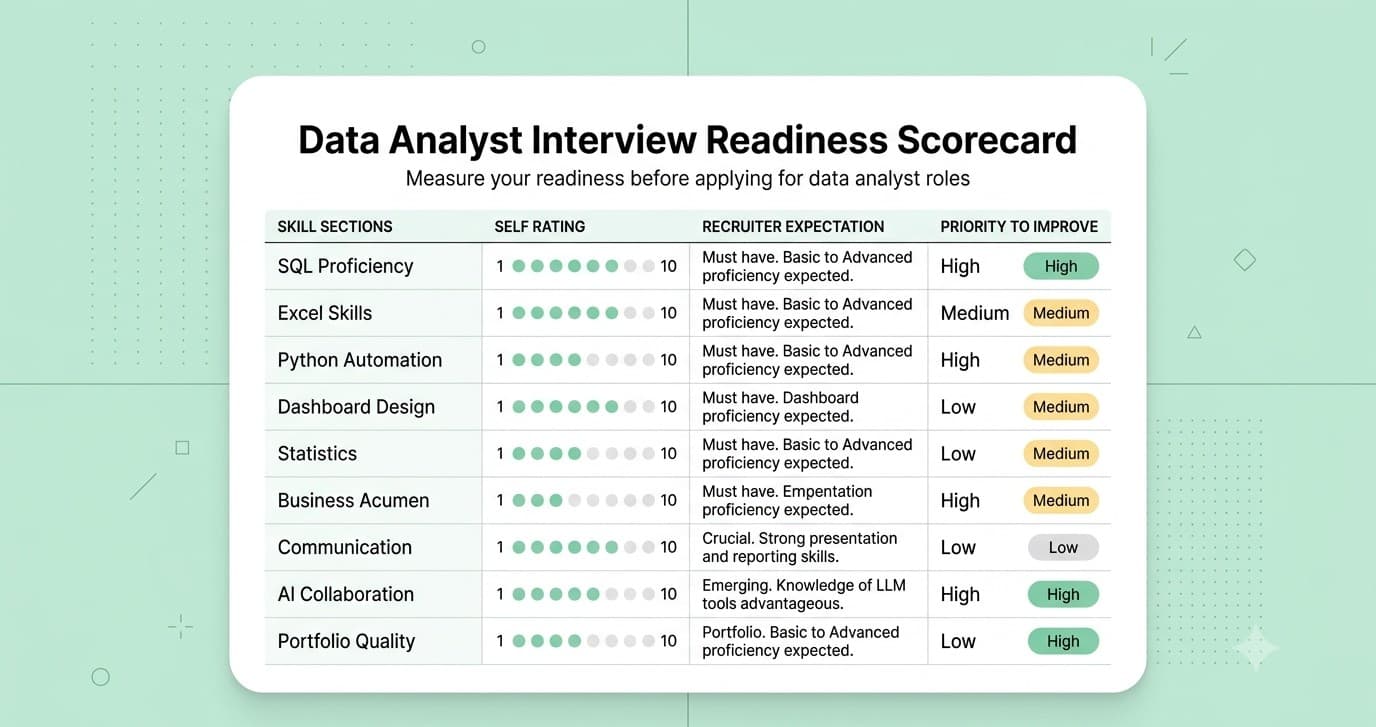
The data analyst role in 2026 rewards a specific combination: technical fluency that is fast rather than flashy, business judgment that shows up before the analysis starts, and communication that respects the listener's time. None of these skills require rare talent. They require deliberate practice, and honest feedback on where your explanations are unclear or your reasoning has gaps.
If communication under pressure is your weak point, practicing how you explain a finding out loud, in a timed setting, closes that gap faster than reading another article. That kind of structured practice, explaining your reasoning clearly within a time limit the way a real interview or stakeholder meeting demands, is exactly what tools like Mocklingo's AI mock interview practice are built for.
Practice for Data Analyst Interview with Mocklingo