Loading...
Contents
Digital Marketing Interview Preparation: Complete Step by Step Guide (2026)
Jul 24, 202623 min readUpdated Oct 22, 2026
Digital marketing interview preparation in 2026 means going beyond memorizing definitions. Recruiters now test practical skills, analytics literacy, problem solving under pressure, and clear communication. Effective preparation combines studying core concepts (SEO, PPC, GA4), building real project examples, and rehearsing answers out loud through mock interviews before the real one.
Digital marketing interviews have changed. A few years ago, knowing the textbook definition of SEO or PPC was often enough to get through a screening round. That's no longer true. Recruiters today are checking whether you can actually read a GA4 dashboard, explain why a campaign underperformed, and hold a conversation about business impact not just recite terminology.
This guide walks through exactly how to prepare, step by step: what to study, how to structure your answers, a day by day roadmap, checklists you can use the night before, and how preparation differs for freshers versus experienced professionals. By the end, you'll have a complete, repeatable system for walking into any digital marketing interview ready.
FREE TO USE
25K+ INTERVIEWS4.8★ RATING68% IMPROVEMENT
Crack Your Dream Job
Real Interviews. Real Pressure. Practice until it feels easy.
- Seamless Interview Experience
- Resume & JD Questions
- Instant Personalized Feedback
How to Prepare for a Digital Marketing Interview
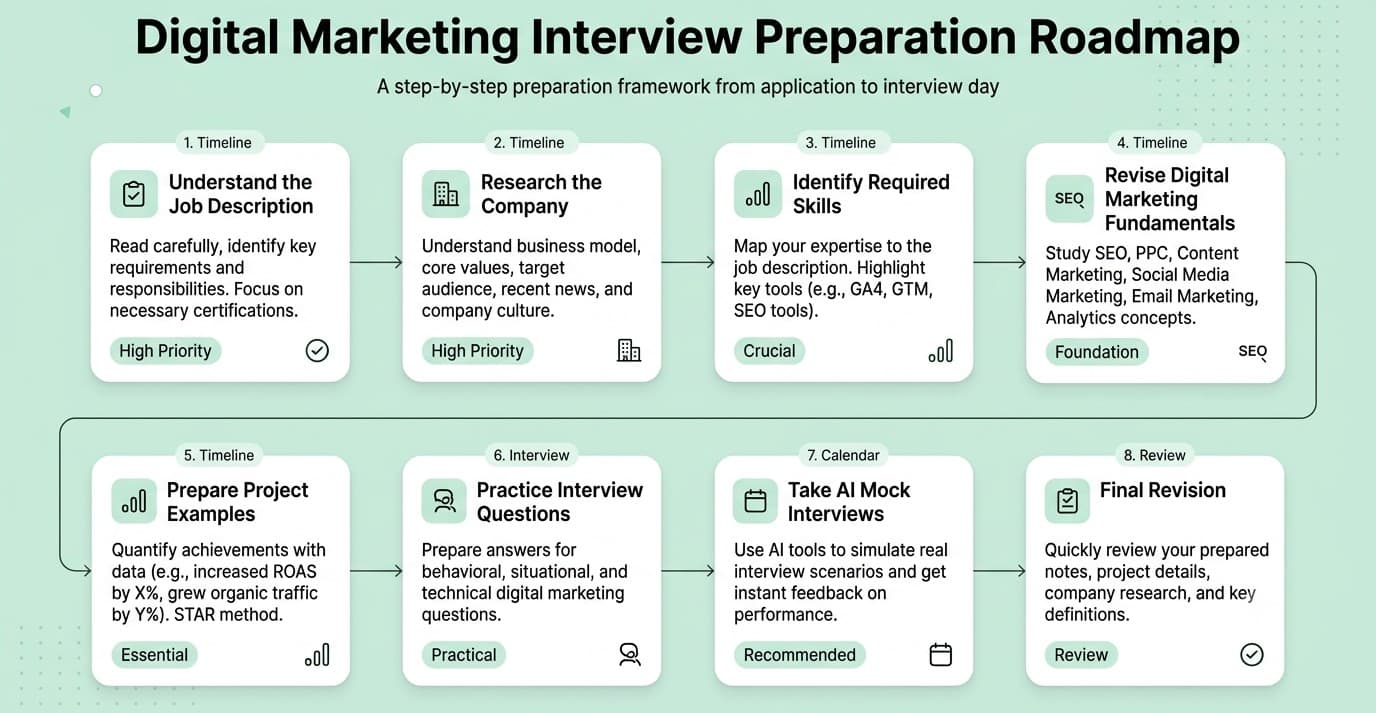
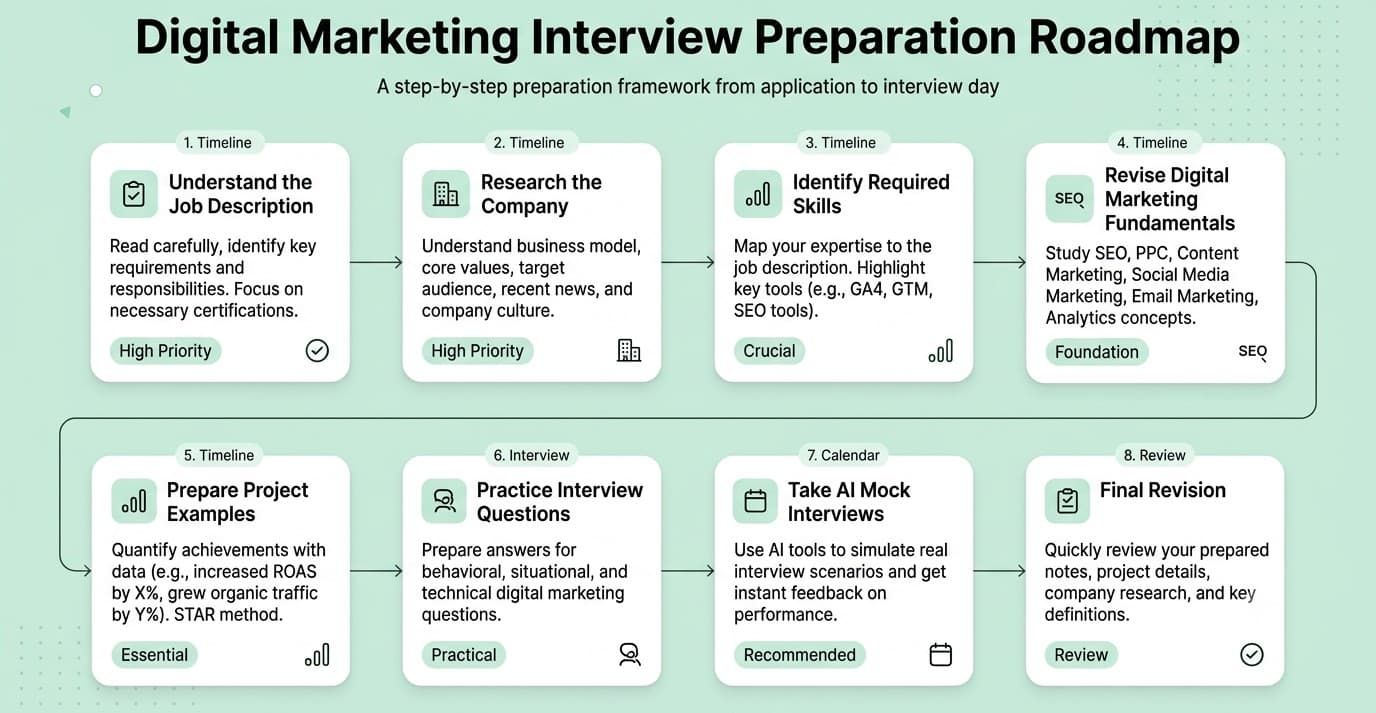
Preparing for a digital marketing interview involves seven steps: understanding the job description, researching the company, identifying required skills, revising fundamentals, preparing project examples, practicing common questions, and taking a mock interview before the real one.
1. Understand the Job Description
Every job description is a checklist in disguise. If it mentions "GA4 reporting" or "Meta Ads management," that's a near guarantee those topics come up in the interview. Read it line by line and match your experience to each requirement.
2. Research the Company
Know what the company sells, who its customers are, and what marketing channels it currently uses. If possible, look at their website, social presence, and recent campaigns, you'll sound prepared the moment you reference something specific.
3. Identify Required Skills
Separate "must have" skills (explicitly listed, likely tested directly) from "nice to have" skills (mentioned briefly, may come up as bonus questions). Prioritize your revision accordingly.
4. Revise Digital Marketing Fundamentals
Even for a specialized role, interviewers often start broad SEO basics, PPC basics, key metrics before narrowing into your specialty. Don't skip fundamentals assuming they're "too basic" to review.
5. Prepare Project Examples
Have two or three real examples ready from work, internships, freelancing, or personal projects with actual numbers attached. "I improved organic traffic" is forgettable. "I improved organic traffic by 34% in three months by fixing indexing issues" is not.
6. Practice Interview Questions
Go through common questions in your specialization out loud, not just in your head. Saying an answer and thinking an answer feel very different under interview pressure.
Read More: Top 75+Digital Marketing interview questions
7. Take Mock Interviews
Simulate the real thing ideally with unpredictable follow up questions so the actual interview feels like round two, not round one.
FREE TO USE
25K+ INTERVIEWS4.8★ RATING68% IMPROVEMENT
Crack Your Dream Job
Real Interviews. Real Pressure. Practice until it feels easy.
- Seamless Interview Experience
- Resume & JD Questions
- Instant Personalized Feedback
Preparation Checklist
Job description reviewed line by line
- Company researched (products, audience, channels)
- Required skills identified and prioritized
- Fundamentals revised (SEO, PPC, analytics)
- 2–3 project examples prepared with numbers
- Common questions practiced out loud
- At least one mock interview completed
What to Study Before a Digital Marketing Interview
Before a digital marketing interview, study SEO (on page, technical, keyword research, link building), PPC (Google Ads, Quality Score, ROAS, CPC), social media marketing, email marketing, content marketing, and GA4 analytics along with core marketing metrics. Focus depth on whatever the role specifically emphasizes.
SEO
- On page SEO: title tags, headings, keyword placement, content structure
- Technical SEO: crawlability, indexing, Core Web Vitals, site speed
- Keyword research: search volume, intent, competition analysis
- Link building: backlink strategies, authority signals, outreach basics
PPC
- Google Ads: campaign types, ad groups, bidding strategies
- Quality Score: how it's calculated and why it affects CPC
- ROAS: how to calculate and interpret it for campaign decisions
- CPC: what drives it up or down in an auction
Social Media
Platform specific ad managers (Meta, LinkedIn), organic vs. paid strategy, and engagement metrics that matter for each platform.
Email Marketing
Segmentation, automation flows, deliverability basics, and how open rate and CTR are calculated.
Content Marketing
Content strategy fundamentals, topic clusters, and how SEO and content work together rather than as separate disciplines.
GA4 & Analytics
Event based tracking, how conversions are defined, attribution models, and how to read a basic performance dashboard.
Marketing Metrics
CTR, conversion rate, CPA, ROAS, CAC, and LTV know not just the formulas but what a "good" number looks like in context.
Revision Checklist Table
| Topic | Priority | Revised? |
|---|---|---|
| On page & Technical SEO | High | ☐ |
| Keyword Research | High | ☐ |
| PPC & Google Ads Basics | High | ☐ |
| GA4 & Analytics | High | ☐ |
| Social Media Marketing | Medium | ☐ |
| Email Marketing | Medium | ☐ |
| Content Marketing | Medium | ☐ |
| Core Marketing Metrics | High | ☐ |
Understand the Job Description Like a Recruiter
Recruiters write job descriptions around the exact skills they intend to test. Reading a JD like a recruiter means identifying repeated keywords, required tools, and listed responsibilities, then preparing specific examples that map directly to each one.
What Recruiters Actually Look For
Recruiters aren't just checking boxes, they're looking for evidence that you can do the job on day one. Every bullet point in a JD usually maps to a real interview question.
How to Identify Important Skills
Skills mentioned in the first few lines or repeated more than once are usually the highest priority. Tools named explicitly (GA4, SEMrush, Google Ads) are almost always tested directly.
How to Prepare Answers Based on the JD
For each requirement listed, prepare one specific example or explanation. If a JD asks for "experience with performance reporting," don't wait to be asked, have a dashboard or reporting example ready to describe.
Example: Digital Marketing Executive Job Description
"We're looking for a Digital Marketing Executive to manage SEO and paid campaigns, report on GA4 performance, and collaborate with the content team on a monthly content calendar. Experience with Google Ads and basic HTML is a plus."
Breaking this down:
- SEO + paid campaigns → expect both SEO and PPC questions
- GA4 performance reporting → expect analytics and dashboard reading questions
- Content calendar collaboration → expect content strategy questions
- Google Ads + HTML "a plus" → possible bonus questions, lower priority than core skills
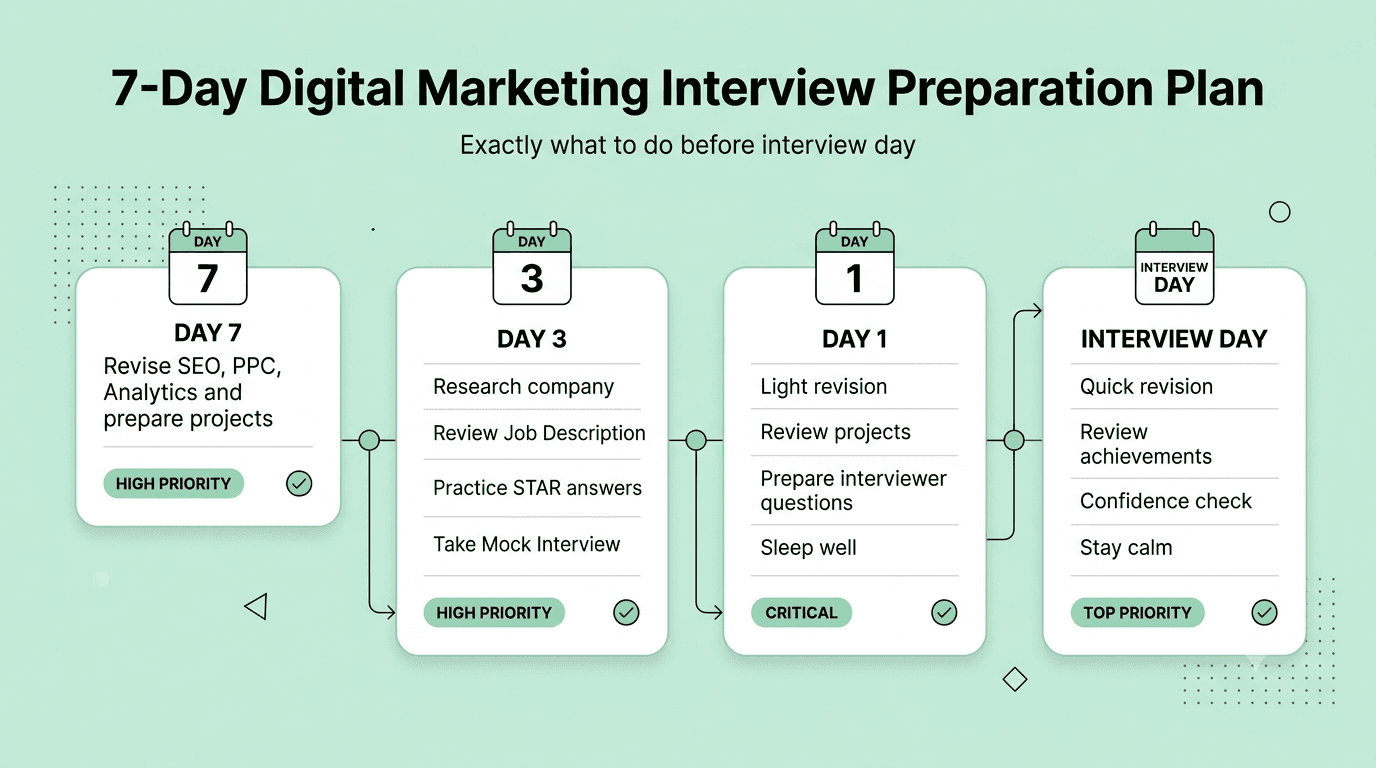
Build Your Digital Marketing Interview Roadmap
A digital marketing interview roadmap breaks preparation into a timeline: deep revision and project prep 7 days before, mock interviews and JD analysis 3 days before, light review and STAR answers 1 day before, and calm, quick recall on interview morning.
7 Days Before
Revise fundamentals across SEO, PPC, analytics, and your specialization. Gather and organize project examples with real metrics. Update your resume and LinkedIn profile to match the role you're applying for.
3 Days Before
Study the specific company and re read the job description closely. Practice STAR method answers for behavioral questions. Take your first full mock interview.
1 Day Before
Do a light review only — no new topics. Re read your project examples and STAR answers. Prepare questions to ask the interviewer. Get a full night's sleep instead of cramming.
Interview Morning
Skim your notes once, not extensively. Review your 2–3 strongest project examples. Do a short breathing or warm up exercise to settle nerves before the call or walk in.
FREE TO USE
8k+ SESSIONS92% FLUENCY4.9★ RATING
Speak With Confidence
Real Conversations. Real Scenarios. Speak until it feels natural.
- Real-Time Speaking Practice
- Guided Conversation Flows
- Instant AI Feedback
How to Prepare Answers Using the STAR Method
The STAR method structures behavioral answers into four parts — Situation, Task, Action, Result — giving interviewers a clear, complete story instead of a vague summary. It's especially effective for digital marketing questions about campaigns, problem solving, and achievements.
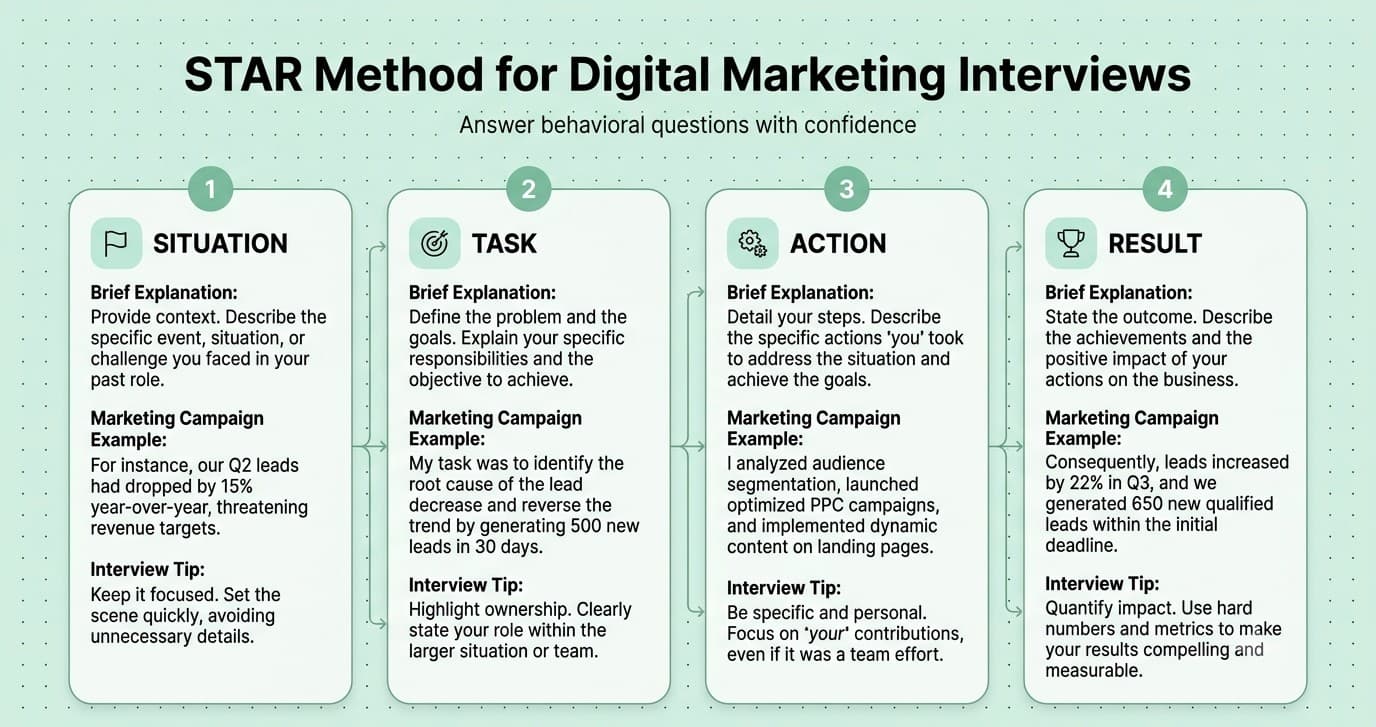
- Situation: Set the context — what was happening, what was the challenge?
- Task: What were you specifically responsible for?
- Action: What did you actually do, step by step?
- Result: What was the measurable outcome?
Example: Digital Marketing STAR Answer
Situation: "Organic traffic on a client's site had been flat for two months despite regular content publishing."
Task: "I was responsible for identifying the cause and improving rankings within the quarter."
Action: "I ran a full technical audit, found that key pages weren't being indexed due to a robots.txt misconfiguration, fixed it, and restructured internal linking around our highest priority pages."
Result: "Organic traffic grew 42% over the following two months, and three target keywords moved into the top 5 positions."
Practice the Most Common Interview Questions
Recruiters typically pull questions from five categories: SEO, PPC, analytics, content marketing, and social media. Practicing across all five even outside your specialization prepares you for the cross channel questions most interviews include.
Rather than repeating every possible question here, it's more useful to know the categories recruiters draw from:
- SEO: on page, technical, keyword research, ranking factors
- PPC: Google Ads mechanics, Quality Score, bidding, ROAS
- Analytics: GA4, conversions, attribution, reporting
- Content Marketing: strategy, topic clusters, SEO content
- Social Media: organic vs. paid, engagement, platform specific ad tools
For the full question bank with detailed, recruiter ready answers across all of these categories, see Top 75+ Digital Marketing Interview Questions and Answers (2026).
Digital Marketing Interview Tips
The strongest digital marketing interview tips are: speak in numbers, explain business impact rather than just tactics, showcase real campaigns, use marketing terminology correctly, think aloud during problem solving questions, and confidently admit knowledge gaps instead of guessing.
- Speak with numbers. "I improved CTR" is weaker than "I improved CTR from 2.1% to 3.4% over six weeks."
- Explain business impact. Connect every metric back to revenue, leads, or cost savings — that's what interviewers are actually listening for.
- Showcase real campaigns. Bring specific, named examples rather than generic descriptions of "a campaign I worked on."
- Use marketing terminology correctly. Misusing terms like CPA versus CPC signals gaps faster than not knowing an answer at all.
- Think aloud during problem solving questions. Interviewers want to see your reasoning process, not just a final answer.
- Admit knowledge gaps confidently. "I haven't used that specific tool, but I've worked with a similar one and could pick it up quickly" lands far better than bluffing.
How to Crack a Digital Marketing Interview
Cracking a digital marketing interview means understanding recruiter psychology they're evaluating technical knowledge, communication, problem solving, confidence, business understanding, and data driven thinking simultaneously, not just checking if you know definitions.
Recruiters are rarely testing a single skill at a time. A question like "how would you improve a underperforming campaign?" is quietly evaluating:
- Technical knowledge — do you understand the mechanics involved?
- Communication — can you explain it clearly and concisely?
- Problem solving — do you have a logical diagnostic process?
- Confidence — do you commit to an answer instead of hedging endlessly?
- Business understanding — do you connect the fix to actual business outcomes?
- Data driven thinking — do you reference metrics rather than opinions?
The candidates who "crack" interviews consistently aren't necessarily the most technically advanced, they're the ones who demonstrate all six of these at once, even in a short answer.
Read more about digital marketing skills recruiters look for in 2026
Digital Marketing Interview Preparation for Freshers
Digital marketing interview preparation for freshers should lean on internships, certifications, personal or college projects, freelance work, and a well optimized LinkedIn profile to compensate for limited full time experience recruiters expect this and evaluate freshers accordingly.
No Experience? Here's What Still Counts
Freshers often assume they have "nothing to show," but interviewers evaluating entry level candidates aren't expecting agency scale case studies.
- Internships: Even short or unpaid internships count describe specific tasks and any measurable contribution.
- Certifications: Google Ads, Google Analytics, HubSpot Academy, and similar certifications signal initiative and baseline knowledge.
- Personal projects: A self run blog, Instagram page, or small business page you've grown organically is a legitimate, discussable project.
- College projects: Marketing plans, case study assignments, or competition entries are valid examples — frame them like real campaigns.
- Freelancing: Even one paid or unpaid freelance client is worth describing in detail, including what you'd do differently now.
- LinkedIn profile: Make sure it's fully optimized a strong headline, summary, and any project links, since recruiters usually check it before or during the interview process.
Digital Marketing Interview Preparation for Experienced Professionals
Experienced professionals should prepare a portfolio of case studies with measurable campaign results, be ready to discuss team and budget management in detail, and have specific leadership examples ready interviews at this level focus on strategic ownership, not just execution.
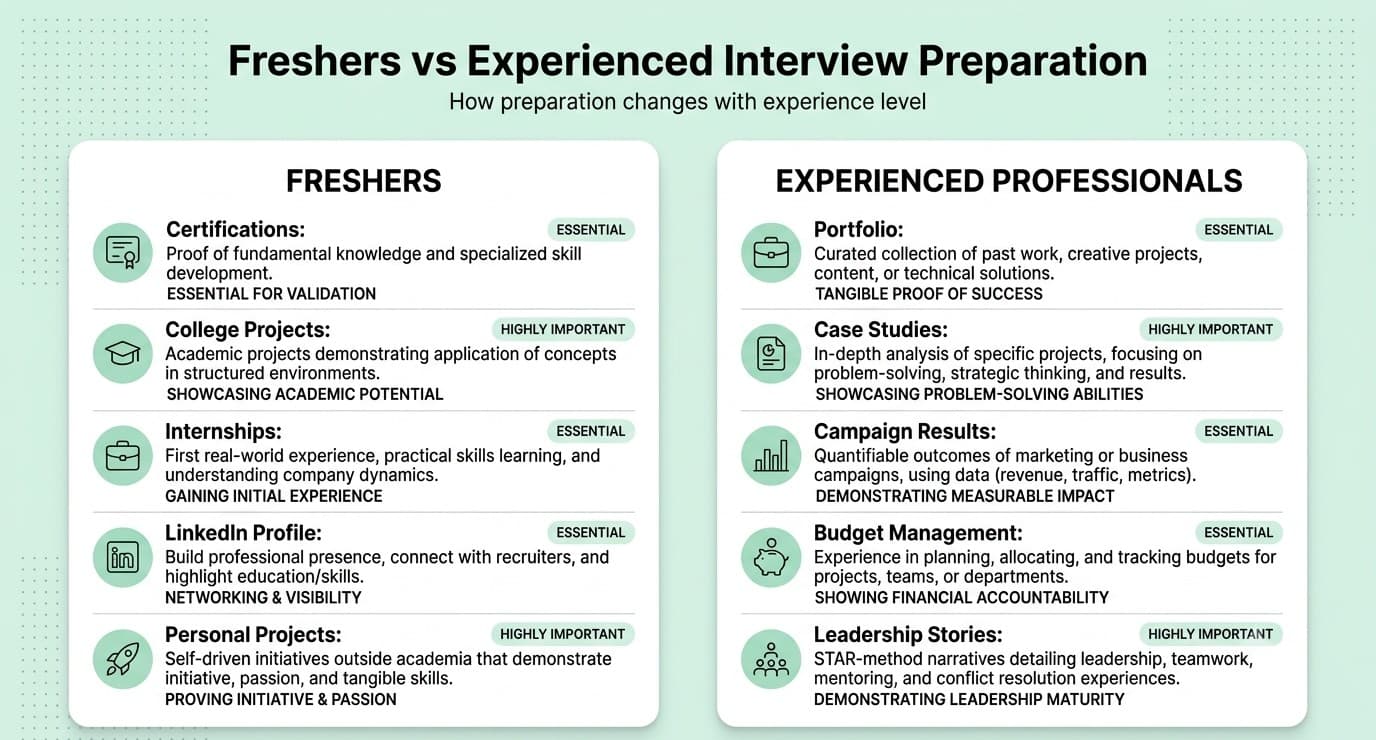
- Portfolio: Have a concise, organized portfolio of your best campaigns ready to walk through, ideally with before/after metrics.
- Case studies: Prepare 2–3 deep case studies you can explain in detail if asked to go deeper, not just summarize.
- Campaign results: Know your numbers precisely approximate figures ("around 30%, I think") undercut credibility at senior levels.
- Team handling: Be ready to discuss how you've managed, mentored, or resolved conflict within a team.
- Budget management: Prepare examples of how you've allocated, reallocated, or defended budget decisions.
- Leadership examples: Have at least one story showing initiative beyond your assigned role leading a project, mentoring, or driving a strategic change.
Common Mistakes During Digital Marketing Interviews
The most common digital marketing interview mistakes are memorizing answers word for word, skipping company research, ignoring metrics in favor of vague descriptions, weak self introductions, an unorganized portfolio, and not asking the interviewer any questions at the end.
- Memorizing answers. Rehearsed, robotic answers are easy to spot and can fall apart the moment a follow up question deviates from the script.
- Not researching the company. Generic answers that could apply to any company signal a lack of genuine interest.
- Ignoring metrics. Vague claims without numbers reduce credibility, especially for data driven roles.
- Weak introductions. A rambling or unfocused opening sets a poor tone for the rest of the interview.
- Poor portfolio presentation. Disorganized or outdated work samples undercut otherwise strong answers.
- No questions for the interviewer. Not asking anything at the end can read as disinterest, even if that's not the intent.
How to Practice Before Your Interview
Effective digital marketing interview practice includes speaking answers aloud, recording and reviewing yourself, running mock interviews with peers, and using AI mock interview tools that simulate real interview pressure with unpredictable follow up questions.
- Practice aloud. Reading an answer silently and speaking it fluently under pressure are different skills, always rehearse out loud.
- Record yourself. Watching your own answer back reveals filler words, pacing issues, and unclear explanations you won't notice in the moment.
- Mock interviews. Ask a friend, mentor, or peer to run through common questions with you in a realistic format.
- Peer interviews. Practicing with another job seeker preparing for similar roles adds useful, two way feedback.
- AI mock interviews. Tools that generate personalized follow up questions add a layer of unpredictability closer to a real interview than a scripted practice session.
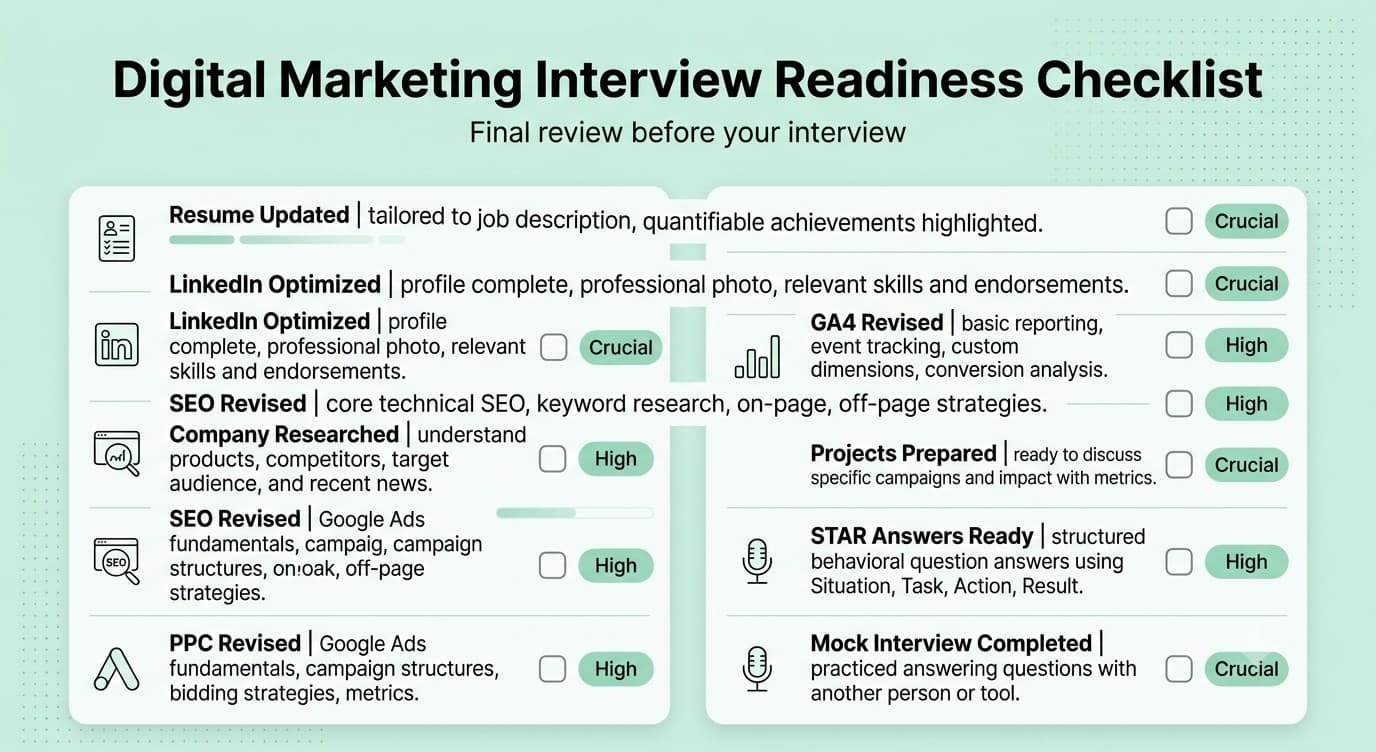
Digital Marketing Interview Checklist
A complete digital marketing interview checklist covers resume and LinkedIn readiness, topic revision across SEO, PPC, and analytics, prepared project examples, STAR method answers, and at least one completed mock interview before the real one.
| Task | Completed |
|---|---|
| Resume updated | ☐ |
| LinkedIn optimized | ☐ |
| Company researched | ☐ |
| SEO revised | ☐ |
| PPC revised | ☐ |
| Analytics revised | ☐ |
| Projects prepared | ☐ |
| STAR answers ready | ☐ |
| Mock interview completed | ☐ |
Practice Your Digital Marketing Interview with AI
Reading through frameworks, checklists, and example answers builds the foundation, but interviews are ultimately a live, unpredictable conversation. That's the gap Mocklingo's AI Mock Interview is designed to close.
With Mocklingo, you get:
- Real interview simulation that mirrors the pacing and pressure of an actual interview
- Personalized follow up questions based on how you actually respond, not a fixed script
- Instant AI feedback on clarity, structure, and confidence after every session
- HR + Technical round simulation so you're prepared for both behavioral and role specific questions
- Performance analytics to track your improvement across practice sessions
If communication clarity is part of what you're working on alongside interview prep, pairing mock interviews with Mocklingo's English communication practice helps you sound as confident as your preparation actually is.
Start Your Free AI Mock Interview →
FAQs
More Blogs

Oct 22, 2026
UI/UX Designer Interview Preparation Guide: A Complete Roadmap for 2026
38 min read

