Loading...
Contents
Top Digital Marketing Skills Recruiters Look for in 2026
Jul 24, 202626 min readUpdated Oct 22, 2026
In 2026, recruiters look for digital marketers who combine technical expertise (SEO, PPC, GA4, AI tools) with strong soft skills like communication and analytical thinking. Certifications alone no longer impress hiring managers. What matters now is proof that you can apply these skills to solve real business problems.
Digital marketing roles have changed shape over the past few years. Where a resume full of tool names and certifications used to be enough, employers today are looking for something deeper: can you actually use these skills to move a business metric? A candidate who understands SEO in theory but has never diagnosed a real ranking drop is a very different hire than one who has.
This guide breaks down the exact skills recruiters are screening for in 2026, split into technical skills, soft skills, and role specific expectations. You will also learn how recruiters actually test these skills in interviews, how to close common skill gaps, and how to present your skills clearly on a resume.
If you want to test how these skills come across in a real interview setting, you can practice with the Mocklingo AI Mock Interview, which simulates role specific questions and gives instant feedback on your answers.
FREE TO USE
25K+ INTERVIEWS4.8★ RATING68% IMPROVEMENT
Crack Your Dream Job
Real Interviews. Real Pressure. Practice until it feels easy.
- Seamless Interview Experience
- Resume & JD Questions
- Instant Personalized Feedback
What Skills Do Recruiters Look for in Digital Marketers?
Recruiters look for digital marketers who can apply skills to real business outcomes, not just list tools and certifications. During interviews, they evaluate how you think through problems, interpret data, and explain the impact of your work, alongside your technical knowledge of channels like SEO, PPC, and analytics.
Why Skills Matter More Than Certifications
A certification proves you completed a course. It does not prove you can apply what you learned when a campaign underperforms or a client asks why traffic dropped. Recruiters increasingly treat certifications as a baseline, not a differentiator.
The Difference Between Knowing a Tool and Solving a Business Problem
Knowing how to navigate Google Ads is a tool skill. Knowing why a campaign's CPA doubled and what to do about it is a business skill. Interviews are increasingly built around the second type of question because it reveals whether you understand the reasoning behind the process.
What Recruiters Evaluate During Interviews
Most interviews are quietly testing four things at once: technical accuracy, analytical reasoning, communication clarity, and awareness of business impact. A candidate who nails the technical definition but cannot connect it to a result usually loses out to one who can do both, even with slightly less polish.
Summary Box: Recruiters in 2026 prioritize applied skill over memorized knowledge. Certifications help you get noticed, but interview performance depends on how clearly you can connect your skills to measurable outcomes.
Essential Technical Digital Marketing Skills
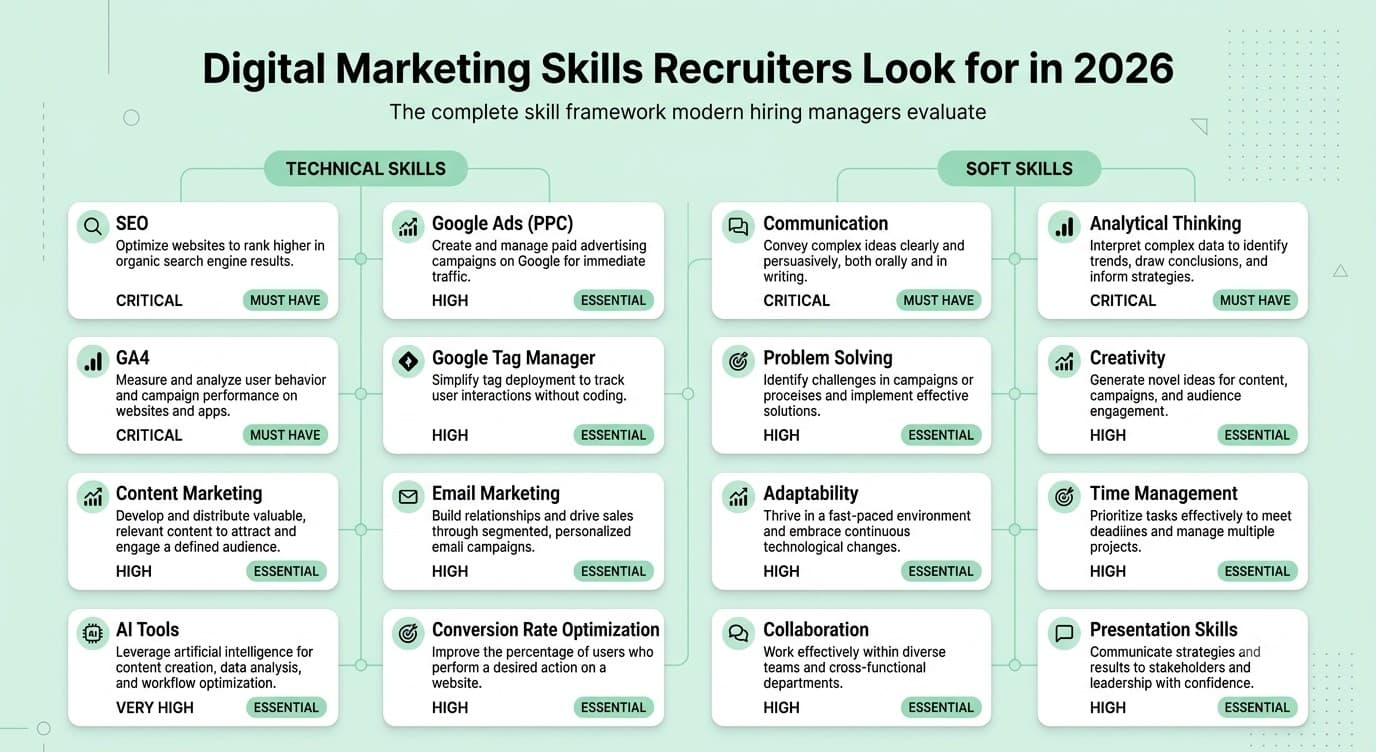
The core technical digital marketing skills recruiters expect include SEO, Google Ads and PPC, social media marketing, content marketing, email marketing, GA4, Google Tag Manager, conversion rate optimization, marketing automation, and working knowledge of AI tools used across these functions.
Search Engine Optimization (SEO)
Why it matters: SEO drives long term, compounding traffic that does not disappear the moment a budget is paused, making it one of the most valued skills across nearly every marketing role.
What recruiters expect: A working understanding of on page optimization, technical SEO, keyword research, and how search intent shapes content decisions.
How to demonstrate it in an interview: Walk through a real example where you diagnosed a ranking issue or content gap and describe the specific fix and the resulting change in traffic or rankings.
Read More: How keyword research is changing in 2026
Google Ads and PPC
Why it matters: Paid search remains one of the fastest ways to generate measurable, budget accountable results, and most marketing teams need at least one person who can manage it confidently.
What recruiters expect: Familiarity with campaign structure, bidding strategies, Quality Score, and how to read performance data to make budget decisions.
How to demonstrate it in an interview: Explain how you have optimized a real or practice campaign, including what metric you were trying to improve and what specific change you made.
Social Media Marketing
Why it matters: Social platforms are often the first touchpoint in a customer's journey, and recruiters want marketers who understand both organic strategy and paid amplification.
What recruiters expect: Comfort with platform specific ad managers, an understanding of engagement metrics, and the ability to tailor content to each platform's audience.
How to demonstrate it in an interview: Describe a content or campaign strategy you built, including how you chose the platform, format, and how you measured success.
Content Marketing
Why it matters: Content fuels SEO, social, and email simultaneously, making it one of the highest leverage skills in a marketer's toolkit.
What recruiters expect: An understanding of content strategy, topic planning, and how to write content that serves both search engines and real readers.
How to demonstrate it in an interview: Share an example of content you created that achieved a specific result, whether that is traffic, engagement, or conversions.
Email Marketing
Why it matters: Email remains one of the highest return channels in digital marketing, particularly for retention and nurturing existing leads.
What recruiters expect: Knowledge of segmentation, automation flows, and how to interpret open rate and click through rate to improve campaigns.
How to demonstrate it in an interview: Describe an email sequence or campaign you built or improved, and what change in performance resulted.
Google Analytics 4 (GA4)
Why it matters: Nearly every marketing decision today is expected to be backed by data, and GA4 is the standard tool most companies use to track it.
What recruiters expect: Comfort navigating GA4's event based model, setting up conversions, and pulling insights from a dashboard without guidance.
How to demonstrate it in an interview: Walk through how you have used GA4 data to make or support a real marketing decision.
Google Tag Manager (GTM)
Why it matters: GTM sits behind accurate tracking, and marketers who understand it can troubleshoot data issues instead of depending entirely on a developer.
What recruiters expect: Basic familiarity with tags, triggers, and variables, even if you have not built complex tracking setups from scratch.
How to demonstrate it in an interview: Mention any experience setting up or troubleshooting event tracking, even for a simple form submission or button click.
Conversion Rate Optimization (CRO)
Why it matters: Driving traffic is only half the job. Recruiters value marketers who also know how to turn that traffic into actual conversions.
What recruiters expect: Understanding of A/B testing, landing page best practices, and how to identify friction points in a conversion funnel.
How to demonstrate it in an interview: Describe a landing page or funnel change you made and the resulting lift in conversion rate.
Marketing Automation
Why it matters: Automation allows marketing teams to scale personalized communication without manually managing every touchpoint.
What recruiters expect: Familiarity with tools like HubSpot or Mailchimp, and an understanding of how automated workflows are triggered and optimized.
How to demonstrate it in an interview: Explain an automated workflow you set up or improved, such as a welcome series or lead nurture sequence.
AI Tools for Digital Marketing
Why it matters: AI tools are now embedded across research, content creation, and campaign optimization, and recruiters expect candidates to use them efficiently rather than avoid them.
What recruiters expect: Practical, responsible use of AI tools for tasks like research or drafting, paired with the judgment to verify and refine AI generated output.
How to demonstrate it in an interview: Give a specific example of how you have used an AI tool to speed up a task while still applying your own expertise to the final result.
Soft Skills Every Digital Marketer Needs
The soft skills recruiters value most in digital marketing include communication, analytical thinking, creativity, problem solving, adaptability, time management, collaboration, and presentation skills. These are often assessed indirectly through how candidates explain their technical answers.
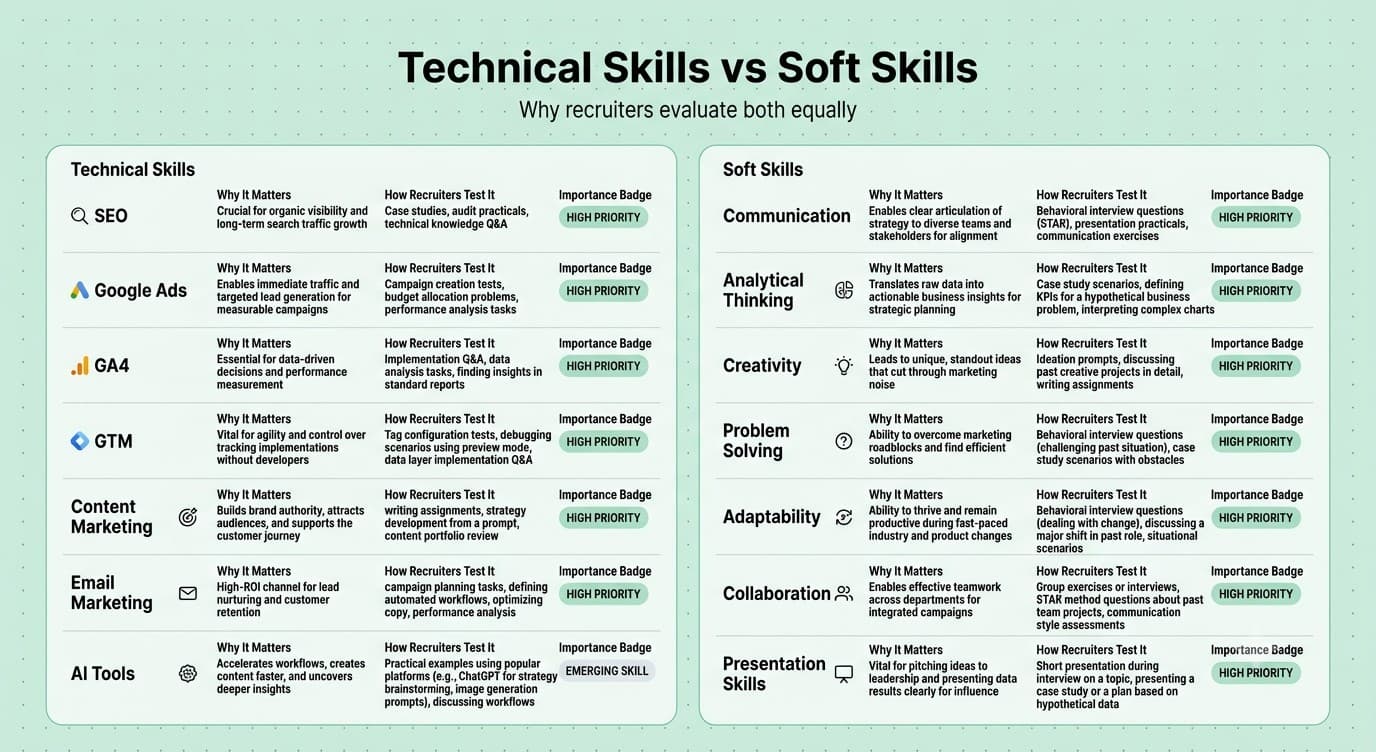
Communication
Why it matters: Marketers constantly translate data and strategy into language that non marketing stakeholders can understand and act on. Sample interview question: "How would you explain a drop in campaign performance to a non technical manager?"
Analytical Thinking
Why it matters: Every channel produces data, and the ability to interpret it correctly separates strategic marketers from purely tactical ones.
Sample interview question: "Walk me through how you would investigate a sudden change in conversion rate."
Creativity
Why it matters: Standing out in crowded feeds and inboxes requires original thinking, not just correct execution.
Sample interview question: "Describe a campaign idea you came up with that felt different from what competitors were doing."
Problem Solving
Why it matters: Campaigns rarely go exactly as planned, and recruiters want to see a logical process for diagnosing and fixing issues.
Sample interview question: "A campaign you launched isn't converting. How do you approach fixing it?"
Adaptability
Why it matters: Algorithms, platforms, and best practices shift constantly, and marketers need to adjust without losing momentum. Sample interview question: "Tell me about a time a platform or algorithm change forced you to rethink your strategy."
Time Management
Why it matters: Marketers often juggle multiple campaigns and deadlines simultaneously, and recruiters want evidence you can prioritize effectively.
Sample interview question: "How do you prioritize when you have three campaigns due at the same time?"
Collaboration
Why it matters: Marketing rarely operates in isolation, and most roles require close coordination with design, sales, or product teams. Sample interview question: "Describe a time you had to work closely with another team to launch a campaign."
Presentation Skills
Why it matters: Reporting results clearly to stakeholders is often just as important as achieving the results in the first place.
Sample interview question: "How would you present a quarter of underwhelming results to leadership?"
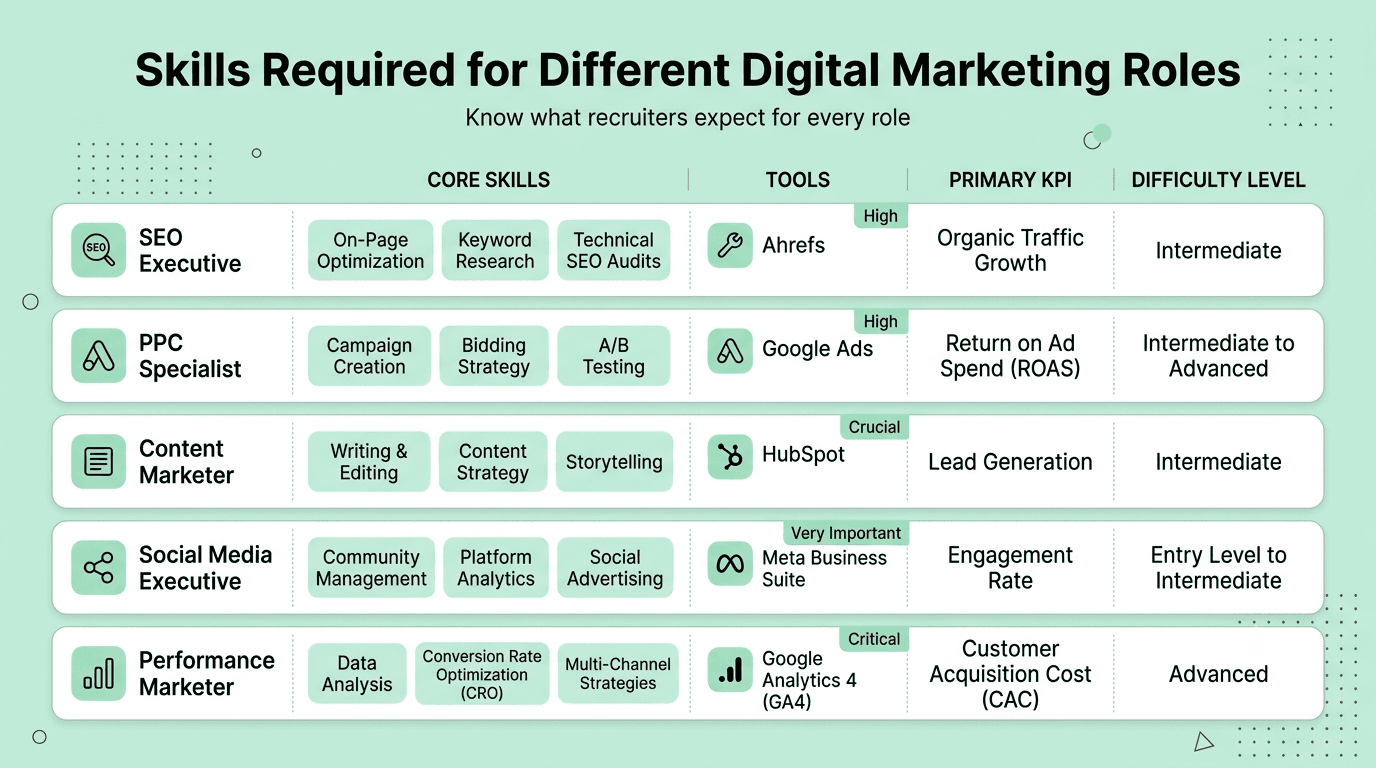
Skills Required for Different Digital Marketing Roles
FREE TO USE
8k+ SESSIONS92% FLUENCY4.9★ RATING
Speak With Confidence
Real Conversations. Real Scenarios. Speak until it feels natural.
- Real-Time Speaking Practice
- Guided Conversation Flows
- Instant AI Feedback
Digital Marketing Skills for Freshers
Recruiters do not expect freshers to have deep, hands on experience, but they do expect a baseline understanding of core concepts, relevant certifications, and some form of applied learning such as personal projects, freelance work, or academic assignments that show initiative.
Skills Recruiters Expect From Entry Level Candidates
Freshers are typically evaluated on fundamentals, curiosity, and communication rather than deep specialization. Recruiters know your practical experience will be limited, so they focus on how well you understand the basics and how eager you are to learn.
Certifications That Add Value
Google Ads certification, Google Analytics certification, and HubSpot Academy courses are widely recognized and signal that you have taken initiative beyond a college syllabus.
Personal Projects
A self managed blog, a small social media page you have grown, or an SEO experiment on your own website all count as legitimate, discussable experience.
Freelancing
Even a single freelance client, paid or unpaid, gives you a real example to discuss in detail, including what results you achieved and what you would improve.
Building a Portfolio
Compile your best work, whether it is a mock campaign, a content sample, or a small case study, into a simple portfolio you can share during interviews.
Continuous Learning
Recruiters notice candidates who stay current with platform updates and industry trends, since digital marketing changes faster than most other fields.
How Recruiters Evaluate Digital Marketing Skills in Interviews
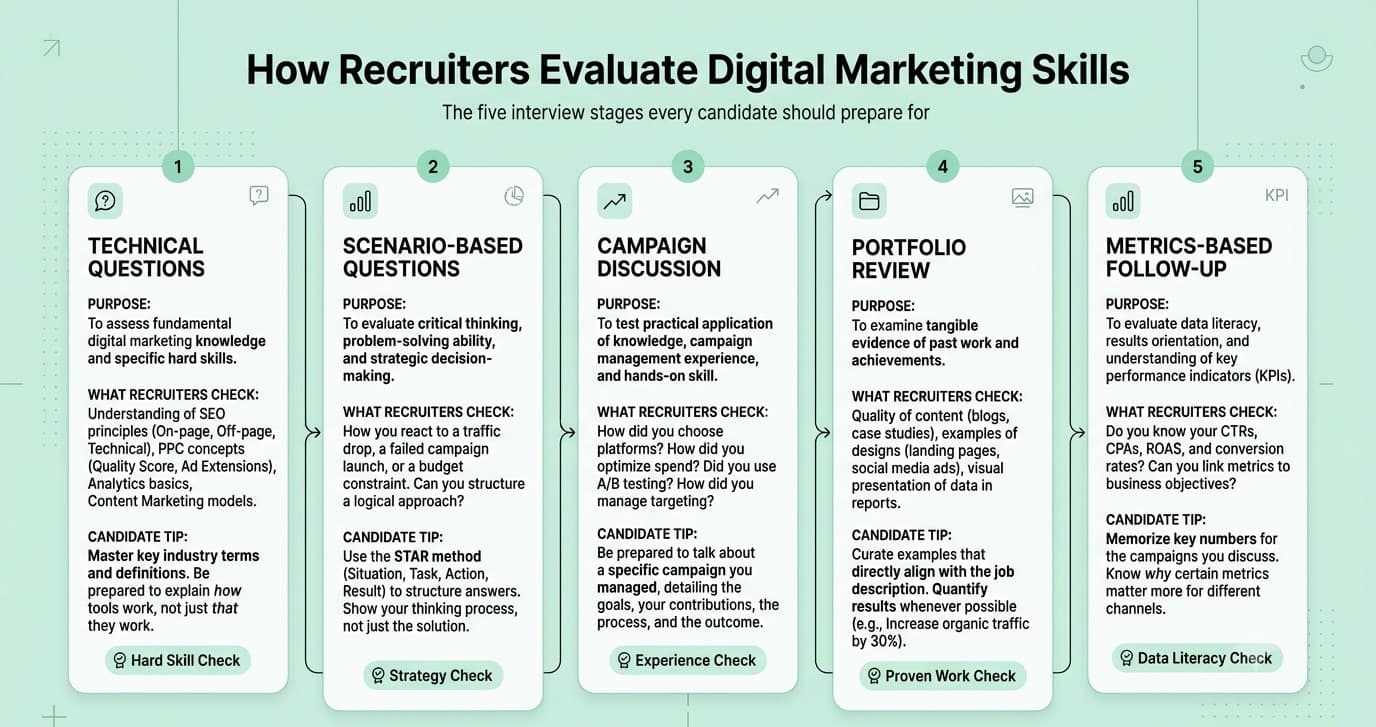
Recruiters evaluate digital marketing skills through a mix of technical questions, scenario based problem solving, campaign discussions, portfolio reviews, and metrics focused follow up questions designed to see whether you truly understand the numbers behind your work
Technical Questions
Direct questions about definitions, tools, and processes test baseline knowledge, usually early in the interview.
Scenario Based Questions
Questions like "traffic suddenly drops, what do you do" test how you think under pressure and whether you have a logical diagnostic process.
Campaign Discussions
Interviewers often ask you to walk through a real campaign in detail, probing deeper with follow up questions to see how well you actually understand what happened.
Portfolio Reviews
For content, design, or campaign heavy roles, recruiters may review your portfolio directly, so organization and clarity matter as much as the work itself.
Metrics Focused Questions
Expect to be asked not just what a metric is, but how you used it to make a decision, which is where many candidates struggle despite knowing the definitions.
For a complete breakdown of the exact questions recruiters ask across each of these categories, see Digital Marketing Interview Questions and Answers (2026).
Digital Marketing Skills Checklist
A digital marketing skills checklist helps you self assess where you stand across core skills such as SEO, Google Ads, GA4, content marketing, social media, email marketing, AI tools, and communication, so you know exactly where to focus your preparation.
How to Improve Your Digital Marketing Skills
You can improve your digital marketing skills by building personal projects, earning Google certifications, practicing with free tools, analyzing real world campaigns, creating a portfolio, staying updated with industry trends, and practicing mock interviews to apply what you have learned under realistic pressure.
- Build personal projects. Start a blog, run a small social page, or experiment with SEO on a personal website to gain hands on experience.
- Get Google certifications. Google Ads, Google Analytics, and similar certifications build credible, verifiable knowledge.
- Practice with free tools. Google Search Console, Google Trends, and Canva let you practice real skills without any budget.
- Analyze real campaigns. Study campaigns from brands you admire and think through why they worked, as if you were reporting on them yourself.
- Create a portfolio. Document your projects, even small ones, in a simple, organized format you can share in interviews.
- Stay updated with industry trends. Follow reliable marketing publications and platform updates so your knowledge does not go stale.
- Practice mock interviews. Applying your skills out loud, under time pressure, reveals gaps that quiet studying never will.
Read More: Digital marketing interview preparation 2026
Digital Marketing Skills for Your Resume
On a digital marketing resume, highlight technical skills tied to measurable achievements rather than listing tools alone. Separate the tools you have used from the skills those tools helped you apply, and quantify results wherever possible to show real impact.
Which Technical Skills to Highlight
Prioritize the skills most relevant to the role you are applying for, drawn directly from the job description, rather than listing every skill you have ever touched.
How to Quantify Achievements
Attach a number to every achievement possible. "Managed SEO content" is weak. "Grew organic traffic 38 percent through content and technical SEO improvements" is strong.
Skills vs Tools
A skill is what you can do, such as keyword research or campaign optimization. A tool is what you used to do it, such as Ahrefs or Google Ads. Resumes are strongest when both are present together.
Sample Skills Section
Skills: SEO (Technical, On Page, Keyword Research), Google Ads and PPC Campaign Management, GA4 and Google Tag Manager, Content Strategy and SEO Writing, Email Marketing Automation (Mailchimp, HubSpot), Social Media Advertising (Meta Ads), AI Assisted Research and Content Workflows
Common Skill Gaps That Cost Candidates Interviews
The most common skill gaps that cost candidates interviews include knowing theory without practical experience, weak analytical reasoning, poor communication, a shaky understanding of KPIs, difficulty explaining campaign results clearly, and not knowing how to use AI tools effectively.
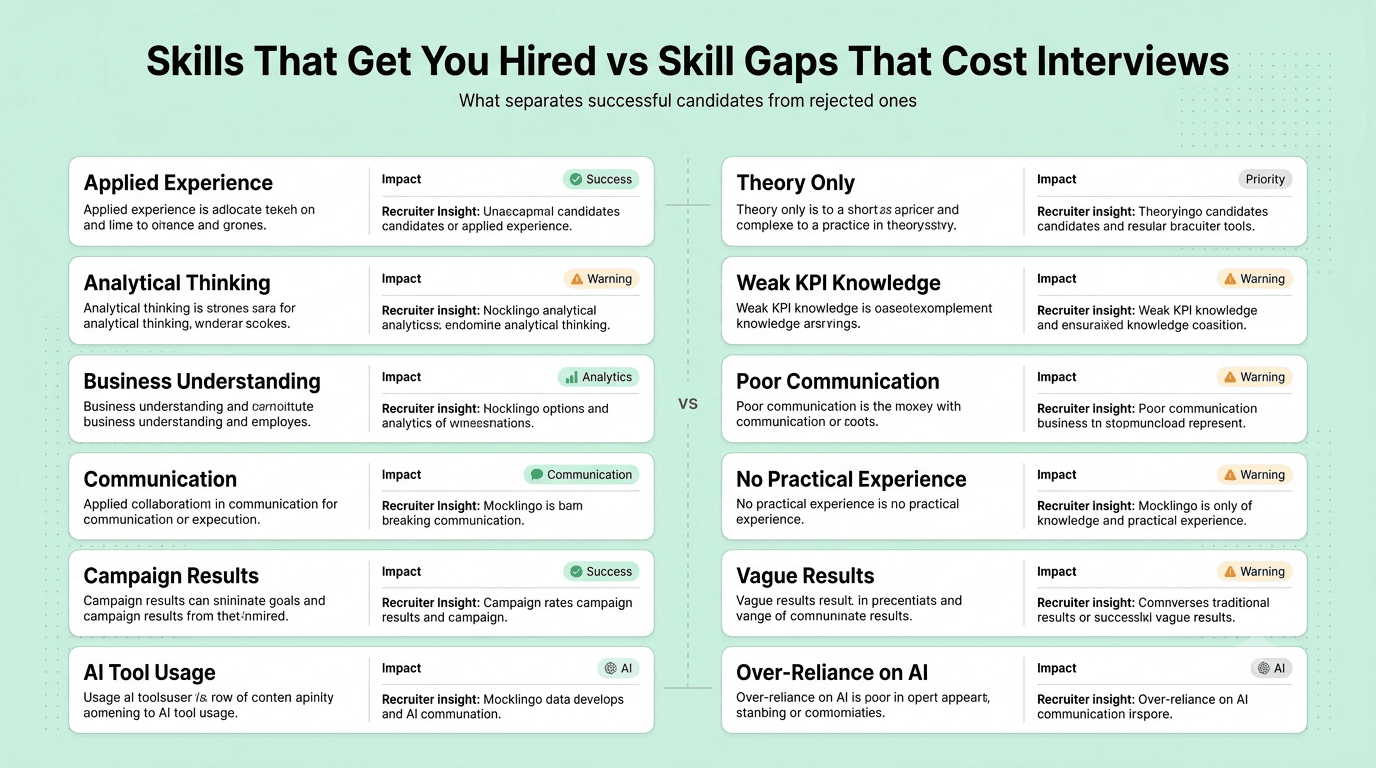
- Knowing theory but lacking practical experience. Candidates who can define a concept but cannot describe applying it often lose out to less polished but more hands on candidates.
- Weak analytical skills. Struggling to interpret data in real time is one of the fastest ways to lose credibility in an interview.
- Poor communication. Even strong technical knowledge falls flat if it cannot be explained clearly and concisely.
- No understanding of KPIs. Confusing metrics or misunderstanding what a "good" number looks like signals a gap recruiters notice quickly.
- Inability to explain campaign results. Vague answers about outcomes, without specifics, suggest limited ownership of the work described.
- Not using AI tools effectively. Either avoiding AI entirely or over relying on it without judgment both raise concerns for recruiters evaluating current, real world skill.
Practice Your Digital Marketing Skills Before the Interview
Knowing your skills on paper is different from demonstrating them clearly under interview pressure. That gap is exactly what Mocklingo Ai Mock Interview is built to close.
With Mocklingo, you get:
- AI powered interview simulation that mirrors the pacing and pressure of a real interview
- Role specific questions tailored to the digital marketing skills relevant to your target role
- Follow up questions that adapt based on how you actually respond, not a fixed script
- Instant feedback on clarity, structure, and confidence after every session
- Confidence building through repeated, realistic practice instead of one shot preparation
If communication is one of the skills you are working to strengthen, pairing mock interviews with Mocklingo's English communication practice can help your answers land as clearly as your knowledge deserves.
Practice Your Digital Marketing Interview with AI →
FAQs
More Blogs

Oct 22, 2026
UI/UX Designer Interview Preparation Guide: A Complete Roadmap for 2026
38 min read

