Loading...
Contents
Top 75+ Digital Marketing Interview Questions and Answers (2026)
Jul 24, 202630 min readUpdated Oct 24, 2026
The most common digital marketing interview questions cover core concepts (SEO, SEM, CTR, ROAS), channel specific skills (SEO, PPC, social, email, content), analytics tools like GA4, and scenario based problems such as sudden traffic drops or budget cuts. Recruiters test both technical knowledge and how you think under pressure not just definitions.
Digital marketing interviews rarely follow a script. One recruiter might open with "what is CTR?" and the next might ask how you'd handle a client whose organic traffic grew but leads didn't. Both are testing the same thing: do you actually understand how marketing performance works, or have you just memorized buzzwords?
This guide pulls together 75+ real interview questions, organized by role and skill area with direct, recruiter ready answers. It's built for freshers preparing for their first digital marketing role, SEO specialists prepping for a technical round, and experienced marketers gearing up for a leadership level conversation.
FREE TO USE
25K+ INTERVIEWS4.8★ RATING68% IMPROVEMENT
Crack Your Dream Job
Real Interviews. Real Pressure. Practice until it feels easy.
- Seamless Interview Experience
- Resume & JD Questions
- Instant Personalized Feedback
Why Recruiters Ask These Questions
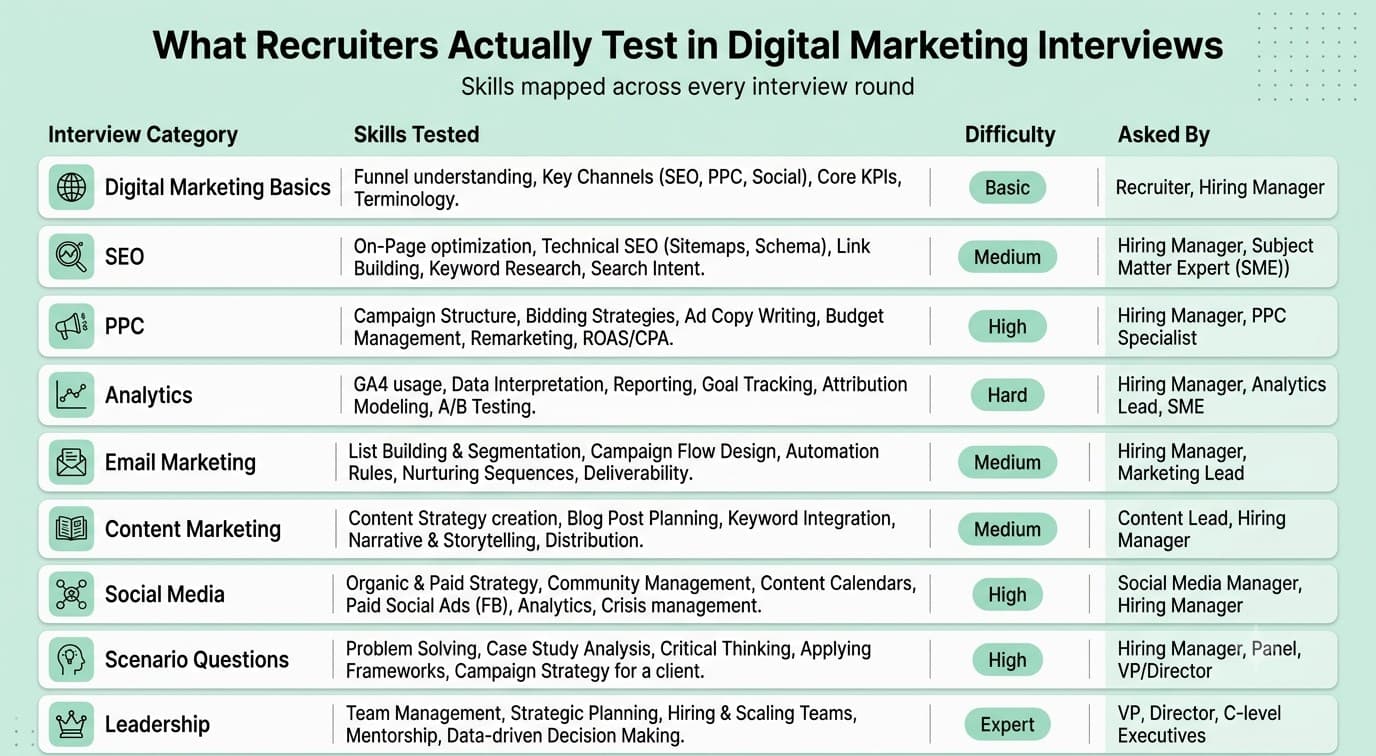
Digital marketing roles sit at the intersection of creativity, data, and strategy. A recruiter asking "what's your CPA?" isn't just checking vocabulary, they're checking whether you can connect a metric to a business outcome. Scenario questions like "traffic suddenly drops" exist because real campaigns break in real time, and hiring managers want to know how you diagnose and fix problems, not just how you define them.
What This Guide Covers
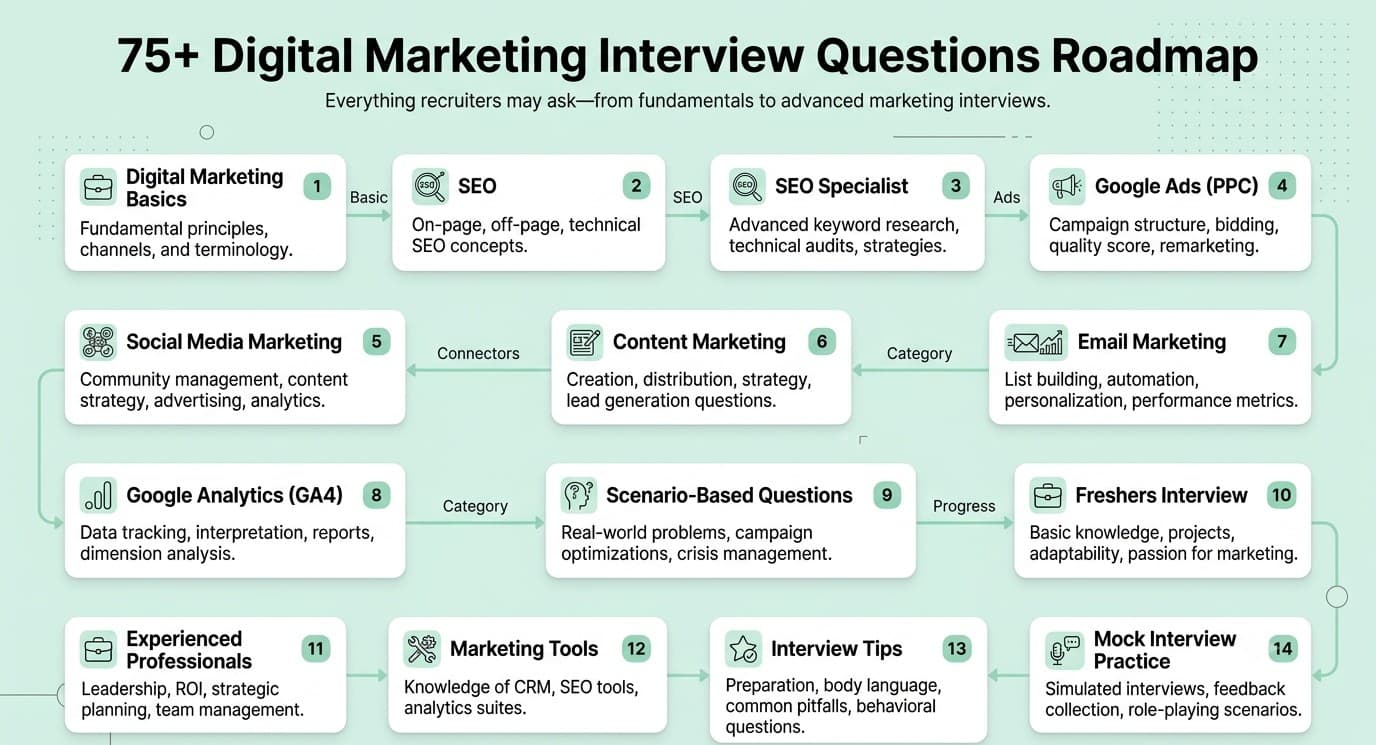
This is a complete question bank spanning 14 sections: fundamentals, SEO, SEO specialist deep-dives, PPC, social media, content marketing, email marketing, analytics, scenario-based questions, fresher-specific questions, experienced-professional questions, essential tools, and interview tips. Each answer is written the way you'd actually say it out loud in an interview clear, specific, and free of filler.
If you want to go beyond reading answers and actually rehearse them out loud, you can practice these exact questions with Mocklingo's AI mock interview tool, which asks personalized follow-ups and scores your responses in real time.
Basic Digital Marketing Interview Questions
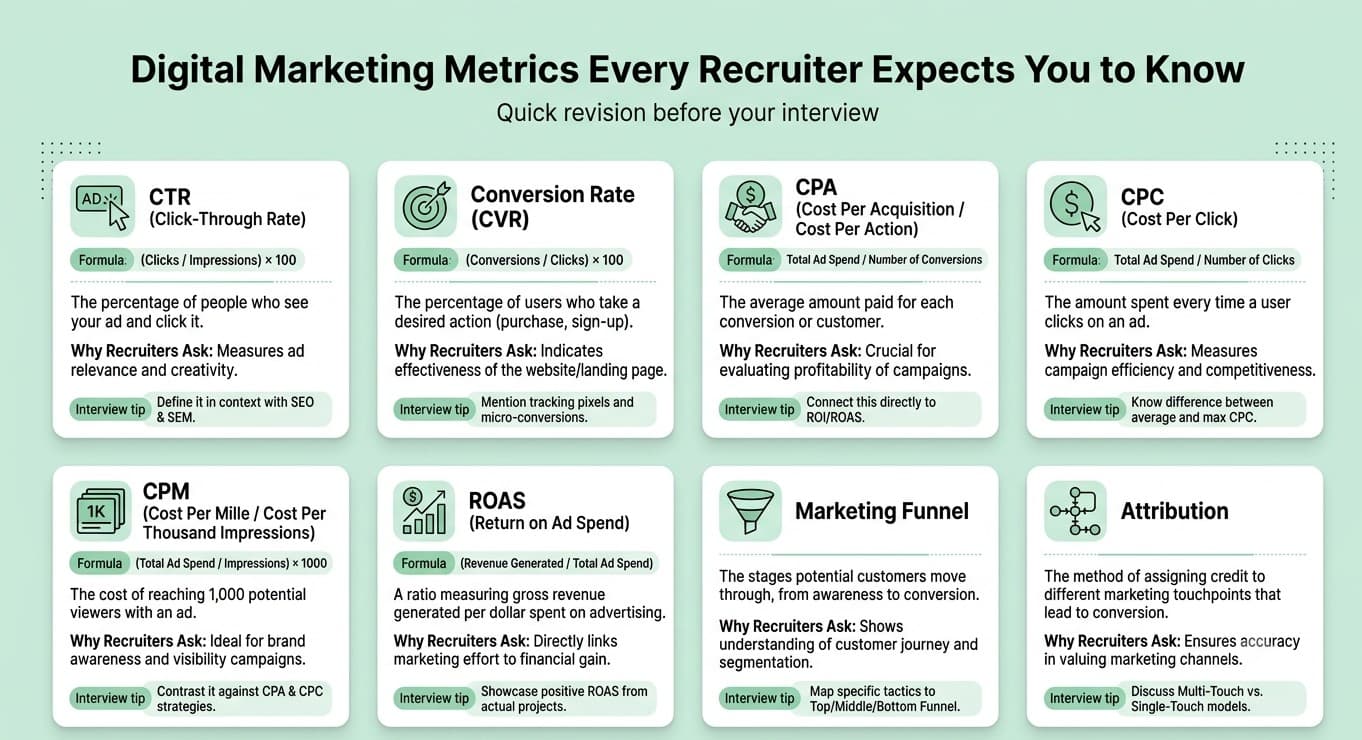
These digital marketing interview questions show up in almost every first round screening, regardless of the specific role.
1. What is digital marketing?
Digital marketing is the practice of promoting products or services through digital channels, search engines, social media, email, and paid ads to reach and convert a target audience. Unlike traditional marketing, it allows real time tracking and optimization.
2. What are the different digital marketing channels?
The main channels are SEO, SEM/PPC, social media marketing, content marketing, email marketing, affiliate marketing, and influencer marketing. Most companies run a mix of these, weighted by audience and budget.
3. What is the difference between SEO and SEM?
SEO (Search Engine Optimization) focuses on earning organic, unpaid rankings through content and technical optimization. SEM (Search Engine Marketing) includes paid search ads, where visibility is bought rather than earned. SEO is slower but compounding; SEM is faster but stops the moment budget stops.
4. What is inbound marketing?
Inbound marketing attracts customers by creating valuable content and experiences tailored to them, rather than interrupting them with outbound ads. Blogging, SEO, and social content are classic inbound tactics.
5. What is CTR (Click Through Rate)?
CTR is the percentage of people who click a link or ad after seeing it, calculated as (clicks ÷ impressions) × 100. It's a key indicator of how compelling your headline, ad copy, or meta description is.
6. What is Conversion Rate?
Conversion rate is the percentage of visitors who complete a desired action, a purchase, signup, or download out of total visitors. It's calculated as (conversions ÷ total visitors) × 100.
7. What is CPA (Cost Per Acquisition)?
CPA measures how much it costs, on average, to acquire one paying customer or lead. It's calculated by dividing total campaign spend by the number of conversions.
8. What is ROAS (Return on Ad Spend)?
ROAS measures revenue generated for every dollar spent on advertising. A ROAS of 4:1 means $4 in revenue for every $1 spent a core metric for judging paid campaign profitability.
9. What is a Marketing Funnel?
A marketing funnel maps the customer journey from awareness to purchase, typically broken into stages: Awareness, Interest, Consideration, Intent, and Conversion. Each stage needs different content and messaging.
10. What is Attribution in marketing?
Attribution is the process of identifying which marketing touchpoints get credit for a conversion. Common models include first touch, last touch, linear, and data driven attribution each telling a different story about what actually drove the sale.
SEO Interview Questions
Foundational seo interview questions test whether you understand how search engines find, rank, and serve content.
11. What is SEO?
SEO is the practice of optimizing a website's content and structure to rank higher in organic search results. It combines technical fixes, content quality, and authority building (links) to earn visibility without paying for ads.
12. What are the types of SEO?
SEO is generally split into three categories: technical SEO, on page SEO, and off page SEO. Together they cover how a site is built, what's on the page, and how the wider web vouches for it.
13. What is Technical SEO?
Technical SEO focuses on the backend health of a site crawlability, site speed, mobile friendliness, structured data, and indexing so search engines can access and understand content properly.
14. What is On Page SEO?
On page SEO covers optimizations made directly on a webpage: title tags, headings, keyword placement, internal links, and content quality. It's about making a specific page relevant and useful for a target query.
15. What is Off Page SEO?
Off page SEO refers to actions taken outside your own website to build authority primarily backlinks, but also brand mentions, PR, and social signals.
16. What is a canonical tag?
A canonical tag tells search engines which version of a duplicate or near duplicate page is the "master" version to index. It prevents duplicate content issues from splitting ranking signals.
17. What is robots.txt?
Robots.txt is a file at the root of a domain that tells search engine crawlers which pages or sections they're allowed or disallowed from crawling.
18. What is a sitemap?
A sitemap is an XML file listing all important URLs on a site, helping search engines discover and crawl pages more efficiently especially useful for large or newly launched sites.
19. What is keyword cannibalization?
Keyword cannibalization happens when multiple pages on the same site target the same keyword, causing them to compete against each other and diluting ranking potential instead of one page winning clearly.
20. What is E-E-A-T?
E-E-A-T stands for Experience, Expertise, Authoritativeness, and Trustworthiness, a framework Google's quality raters use to judge content credibility, especially for YMYL (Your Money, Your Life) topics.
21. What are Core Web Vitals?
Core Web Vitals are Google's page experience metrics: Largest Contentful Paint (loading), Interaction to Next Paint (responsiveness), and Cumulative Layout Shift (visual stability). They're part of Google's ranking signals.
22. What is internal linking?
Internal linking connects pages within the same website, helping distribute authority, guide users to relevant content, and help search engines understand site structure and page importance.
23. What is schema markup?
Schema markup is structured data code added to a page that helps search engines understand its content more precisely, often enabling rich results like FAQ dropdowns, star ratings, or recipe cards.
24. What is search intent?
Search intent is the underlying goal behind a query informational, navigational, commercial, or transactional. Ranking well requires matching content format to intent, not just matching keywords.
25. What are featured snippets?
Featured snippets are highlighted answer boxes shown at the top of Google's search results, pulled directly from a ranking page's content. Structuring content with clear, concise answers increases the chance of winning one.
FREE TO USE
8k+ SESSIONS92% FLUENCY4.9★ RATING
Speak With Confidence
Real Conversations. Real Scenarios. Speak until it feels natural.
- Real-Time Speaking Practice
- Guided Conversation Flows
- Instant AI Feedback
SEO Specialist Interview Questions
These seo specialist interview questions go deeper they're designed to test hands on execution, not just definitions.
26. How do you perform keyword research?
I start by identifying seed topics relevant to the business, then expand using tools like Ahrefs, SEMrush, or Google Keyword Planner to find search volume, difficulty, and intent. I prioritize keywords by a mix of volume, competition, and relevance to conversion potential not just traffic size.
Read More: How keyword research is changing in 2026
27. Which SEO tools have you used?
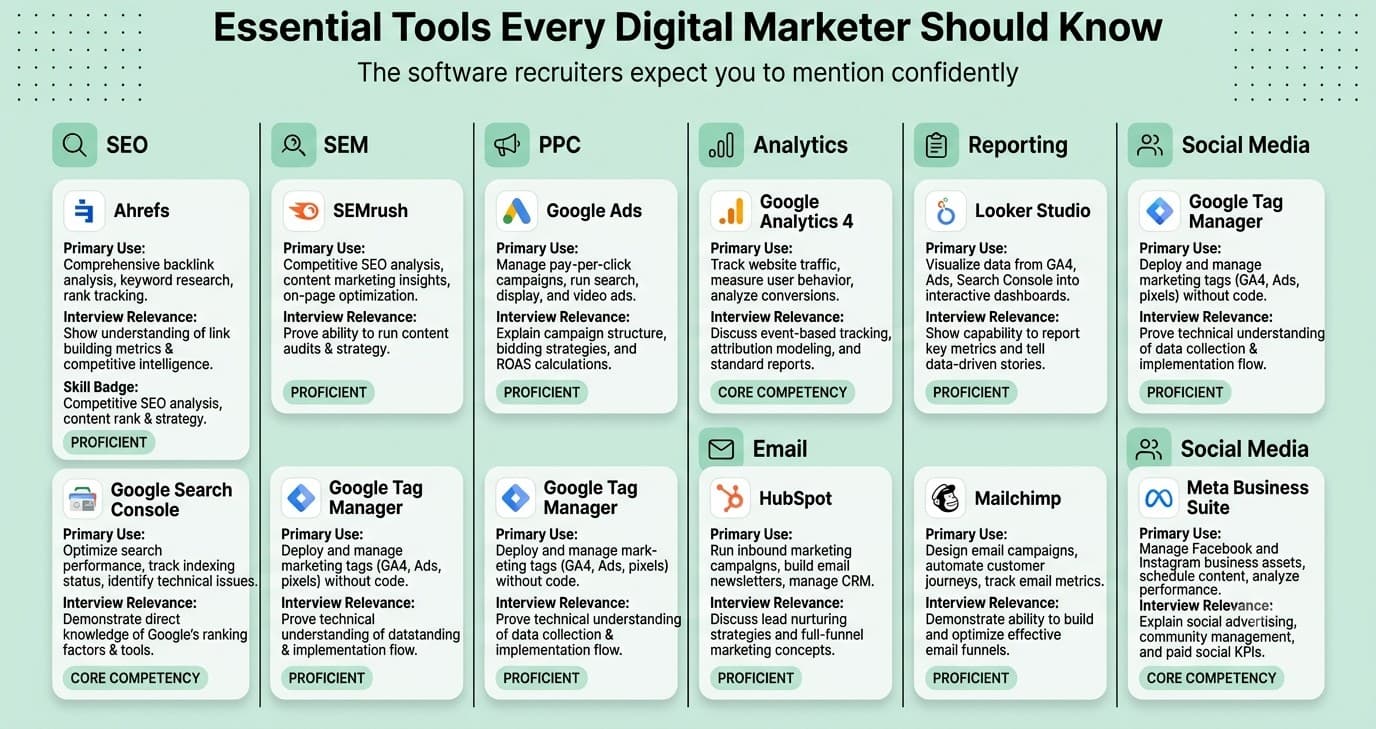
Common answer framework: mention tools across categories Ahrefs or SEMrush for keyword and backlink research, Google Search Console for indexing and performance, Screaming Frog for technical audits, and Looker Studio for reporting.
28. Explain how you'd perform an SEO audit.
An SEO audit typically covers four layers: technical health (crawlability, speed, indexing), on page quality (content, metadata, keyword targeting), off page authority (backlink profile), and competitive gaps. I document findings by priority quick wins first, structural fixes next.
29. How do you improve rankings for a page that's stuck?
I check search intent alignment first is the content answering what users actually want? Then I look at content depth versus top ranking competitors, internal linking, and whether technical issues like slow load times or thin content are holding it back.
30. How do you measure SEO success?
Beyond rankings, I track organic traffic growth, keyword visibility across a target set, conversion rate from organic sessions, and indexed page count. Rankings alone don't pay bills — traffic that converts does.
31. How do you optimize CTR for organic listings?
I rewrite title tags and meta descriptions to be specific and benefit driven rather than generic, and I test structured data like FAQ or review schema to make listings visually stand out in search results.
32. How do you fix indexing issues?
I check Google Search Console's Coverage report for errors, verify robots.txt isn't blocking key pages, confirm canonical tags are correct, and check for "noindex" tags left in accidentally, a common cause on JavaScript heavy sites.
33. Tell us about an SEO project you're proud of.
This is a storytelling question structure your answer as: the problem you found, the specific actions you took, and the measurable result (traffic %, ranking positions, or conversions gained).
Read Here: How to become an SEO specialist
PPC Interview Questions
PPC interview questions test your understanding of paid search mechanics and budget accountability.
34. What is Google Ads?
Google Ads is Google's advertising platform that lets businesses bid on keywords to display ads across Search, Display, YouTube, and Shopping- paying per click, impression, or conversion depending on campaign type.
35. What is the difference between CPC and CPM?
CPC (Cost Per Click) charges advertisers each time someone clicks an ad. CPM (Cost Per Mille) charges per 1,000 impressions, regardless of clicks. CPC suits performance goals; CPM suits brand awareness.
36. What is Quality Score?
Quality Score is Google's rating (1–10) of ad relevance, expected CTR, and landing page experience. A higher Quality Score typically lowers cost per click and improves ad position.
37. What is Ad Rank?
Ad Rank determines an ad's position in search results, calculated using bid amount, Quality Score, and expected impact of ad extensions. It's why a lower bid can sometimes outrank a higher one.
38. What are keyword match types?
Match types control how closely a search query must match your keyword: broad match (widest reach), phrase match (must include the phrase meaning), and exact match (tightest control, closest match to intent).
39. What are negative keywords?
Negative keywords prevent ads from showing for irrelevant searches, filtering out unqualified traffic and protecting budget from wasted clicks.
40. What is conversion tracking?
Conversion tracking measures specific actions users take after clicking an ad purchases, signups, calls allowing advertisers to tie ad spend directly to business results.
41. What is Performance Max?
Performance Max is a Google Ads campaign type that uses automation and machine learning to serve ads across all Google inventory (Search, Display, YouTube, Shopping, Discover) from a single campaign.
42. What is Smart Bidding?
Smart Bidding uses machine learning to automatically set bids for each auction based on the likelihood of conversion, optimizing for goals like target CPA or target ROAS.
43. How is ROAS used in PPC decision making?
ROAS tells you which campaigns, ad groups, or keywords are actually profitable, guiding budget reallocation toward what's working and away from what's draining spend without return.
44. What is A/B testing in PPC?
A/B testing compares two versions of an ad, landing page, or bidding strategy against each other to determine which performs better, using statistically significant data rather than guesswork.
45. What is landing page optimization?
Landing page optimization improves a page's design, copy, and load speed to increase the percentage of ad clicks that convert since even a great ad fails if the landing page doesn't deliver.
Social Media Marketing Questions
46. What's the difference between organic and paid social?
Organic social relies on unpaid content and community engagement, while paid social uses advertising budgets to boost reach and target specific audiences. Most brands need both working together.
47. What is engagement rate?
Engagement rate measures interactions (likes, comments, shares) relative to reach or followers, indicating how compelling content is beyond just view counts.
48. What are the best KPIs for social media?
Depending on goals: reach and impressions for awareness, engagement rate for content quality, click through rate for traffic, and conversion rate for revenue driven campaigns.
49. How do you build a social media strategy?
Start with clear goals, define the target audience per platform, set a content mix and posting cadence, and build in a measurement framework to iterate based on what performs.
50. What is influencer marketing?
Influencer marketing partners with individuals who have engaged audiences to promote a product or brand, leveraging their credibility and reach instead of traditional advertising.
51. What are Meta Ads?
Meta Ads is the advertising platform for Facebook and Instagram, allowing highly targeted campaigns based on demographics, interests, and behavior across both apps.
52. What is LinkedIn Marketing?
LinkedIn Marketing focuses on B2B audiences through organic content, sponsored posts, and InMail campaigns, targeting users by job title, industry, or company size.
Content Marketing Questions
53. What is content strategy?
Content strategy is the planning process behind what content to create, for whom, and why aligning topics with business goals and audience needs across the funnel.
54. What is a content calendar?
A content calendar is a scheduling tool that organizes what content gets published, where, and when keeping publishing consistent and aligned with campaigns or seasonal trends.
55. What is SEO content?
SEO content is written specifically to rank for target search queries while genuinely answering user intent balancing optimization with real usefulness.
56. What are topic clusters?
Topic clusters organize content around a core "pillar" page linked to related "cluster" pages, signaling topical authority to search engines and improving internal linking structure.
57. How is AI used in content marketing?
AI tools assist with research, drafting, and optimization but the strongest content strategies still rely on human judgment for accuracy, originality, and brand voice.
58. What are common content KPIs?
Organic traffic, time on page, scroll depth, backlinks earned, and conversion rate from content pages are typical KPIs used to measure content performance.
Email Marketing Questions
59. What is open rate?
Open rate is the percentage of recipients who open an email, calculated as (opens ÷ delivered emails) × 100 — heavily influenced by subject line quality and sender reputation.
60. What is CTR in email marketing?
Email CTR measures the percentage of recipients who clicked a link inside the email, indicating how compelling the content and call to action were.
61. What is segmentation?
Segmentation divides an email list into smaller groups based on behavior, demographics, or engagement level, allowing more relevant, targeted messaging instead of one size fits all blasts.
62. What is email automation?
Email automation triggers pre built email sequences based on user actions like a welcome series after signup or a cart abandonment reminder without manual sending.
63. How do you A/B test emails?
Test one variable at a time subject line, send time, or CTA against a control group, then measure which version drives higher opens or clicks before rolling out to the full list.
64. What affects email deliverability?
Sender reputation, authentication protocols (SPF, DKIM, DMARC), list hygiene, and spam trigger language all affect whether emails land in the inbox or the spam folder.
Analytics Questions
65. What is Google Analytics 4 (GA4)?
GA4 is Google's current analytics platform, built on an event based data model rather than the old session based model, giving more flexibility to track custom user interactions across web and app.
66. What are events in GA4?
Events are individual user interactions tracked in GA4 clicks, video plays, form submissions replacing the older pageview centric model with more granular behavioral data.
67. What are conversions in GA4?
Conversions are specific events marked as meaningful business outcomes, like a purchase or signup, allowing GA4 to report on what actually drives value, not just traffic.
68. How does attribution work in GA4?
GA4 defaults to data driven attribution, using machine learning to assign conversion credit across multiple touchpoints based on actual contribution, rather than a fixed rule like last click.
69. What are UTM parameters?
UTM parameters are tags added to URLs that track the source, medium, and campaign driving traffic, allowing precise attribution in analytics tools.
70. What is Looker Studio used for?
Looker Studio (formerly Google Data Studio) is a free reporting tool that turns raw data from GA4, Google Ads, and other sources into visual, shareable dashboards.
71. What KPIs matter most in analytics reporting?
It depends on the goal, but common KPIs include sessions, conversion rate, bounce rate, average engagement time, and cost per conversion always tied back to what the business actually cares about.
Scenario based questions
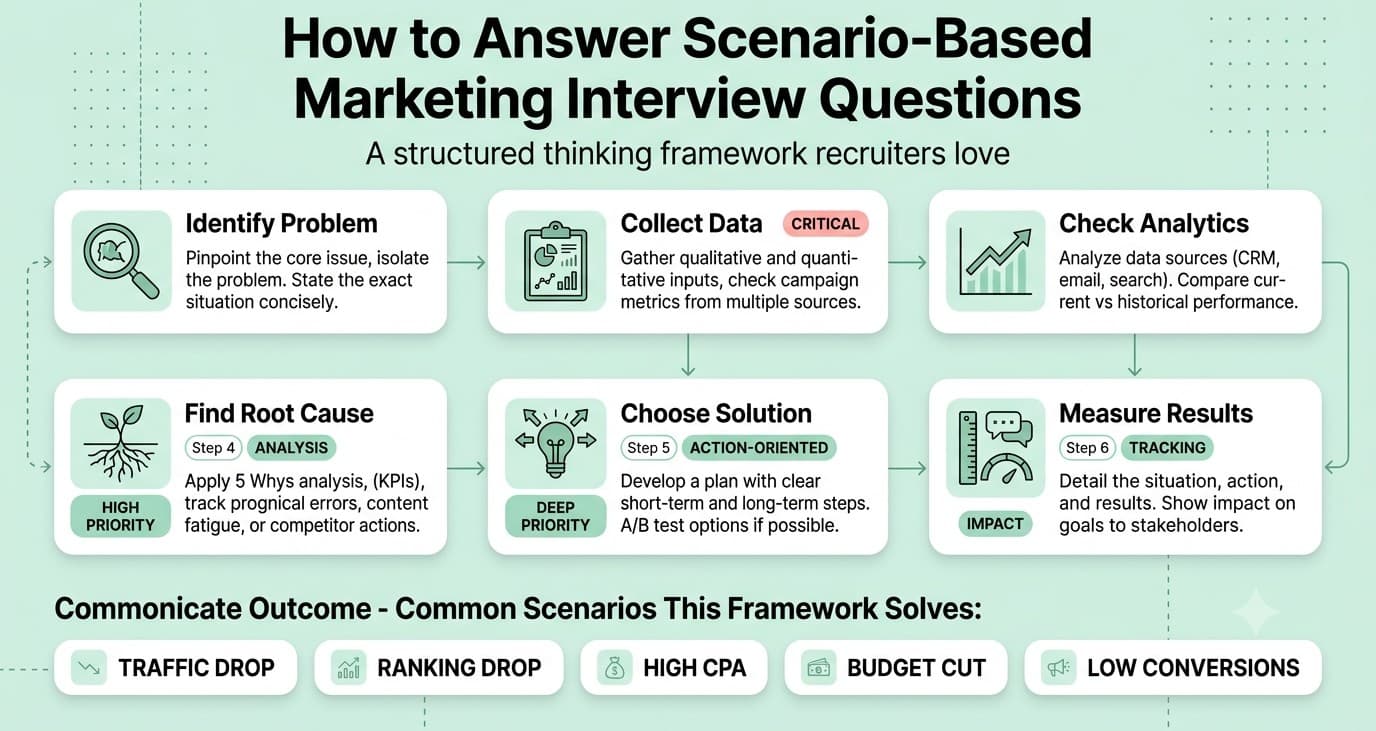
Scenario questions reveal how you actually think, not just what you know.
72. "Traffic suddenly drops — what do you do?"
First, check for a tracking issue (has GA4 or the tag actually broken?). If tracking is fine, check Search Console for manual actions or indexing drops, review recent site changes, and check for algorithm updates around the drop date.
73. "A campaign isn't converting — how do you fix it?"
I'd break the funnel into stages: is the issue traffic quality (wrong audience), landing page (weak offer or slow load), or tracking (conversions not firing correctly)? I'd isolate the stage before changing anything.
74. "Website ranking suddenly declines — what's your process?"
Check for technical issues first (indexing, site errors), then check if a competitor outranked you with better content, and finally check for algorithm updates. I'd avoid panic changing content before diagnosing the actual cause.
75. "Budget gets cut by 40% — how do you respond?"
I'd reallocate spend toward the highest ROAS channels and pause underperforming campaigns, while communicating clearly to stakeholders what trade offs — like reduced reach or slower growth — come with the cut.
76. "A client wants quick SEO results — how do you manage expectations?"
I'd explain that SEO is a compounding channel, not an instant one, and offer a hybrid approach: quick technical fixes and CTR improvements for near term gains, paired with a longer term content and authority plan.
77. "PPC CPA doubles overnight — what do you check?"
I'd check for auction changes (new competitors bidding up), landing page issues, tracking errors, or a shift in traffic quality from an automated bidding strategy, before assuming the market itself changed.
78. "Organic traffic grows but leads don't — what's happening?"
This usually points to a mismatch between the keywords ranking and actual buyer intent, or a weak conversion path on the pages gaining traffic. I'd check if new traffic is top of funnel content that isn't yet nurtured toward conversion.
Digital Marketing Interview Questions for Freshers
Digital marketing interview questions for freshers focus less on deep technical skill and more on mindset, curiosity, and communication.
79. Introduce yourself.
Keep it structured: background, relevant coursework or projects, and why you're drawn to digital marketing specifically in under 90 seconds.
80. Why digital marketing?
Give a genuine, specific reason a project, internship, or personal experience that pulled you toward the field rather than a generic "I love creativity" answer.
81. What's your favorite campaign and why?
Pick a real campaign, explain what made it effective from a strategic standpoint (targeting, messaging, channel choice), not just that you liked the visuals.
82. What are your strengths?
Choose strengths relevant to the role analytical thinking, writing, adaptability and back each with a brief, specific example.
83. What are your weaknesses?
Be honest but show self awareness and active improvement for example, learning a tool you weren't familiar with rather than a vague, safe answer.
84. Do you have any certifications?
Mention relevant ones if you have them (Google Ads, Google Analytics, HubSpot). If not, mention what you're currently studying toward.
85. Where do you see yourself in a few years?
Show ambition tied to growth within the field moving from execution toward strategy or specialization without sounding like you'll leave the company immediately.
Questions for Experienced Professionals
86. What's your biggest professional achievement?
Use a specific, metric backed story a campaign, a strategy shift, or a process improvement and clearly connect your actions to the outcome.
87. How have you managed a team?
Talk about your actual management approach how you delegate, review performance, and develop team members with a real example of a challenge you navigated.
88. How do you manage budgets?
Explain how you allocate spend across channels based on performance data, and how you've handled reallocating budget mid campaign when results shifted.
89. How do you approach reporting to stakeholders?
Focus on translating metrics into business impact stakeholders care about revenue and growth, not just CTR or impressions and how often you report and to whom.
90. How do you create a marketing strategy from scratch?
Outline your process: audience research, competitive analysis, channel selection, goal setting, and how you build in measurement from day one rather than as an afterthought.
91. Describe your leadership style.
Be specific and back it with an example collaborative, data driven, hands on rather than a buzzword with no evidence behind it.
92. How do you manage stakeholder expectations?
Talk about proactive communication setting realistic timelines upfront, flagging risks early, and translating marketing complexity into business language stakeholders can act on.
Tools Every Digital Marketer Should Know
Digital Marketing Interview Tips
- Research the company. Know their products, target audience, and recent campaigns before walking in.
- Know your marketing metrics cold. CTR, CPA, ROAS, and conversion rate should be second nature, not something you calculate mid interview.
- Prepare 2–3 campaign examples. Have real numbers ready, even from academic projects or internships.
- Revise GA4. It's the current standard, and most analytics questions will assume familiarity with it.
- Revise SEO fundamentals even if you're interviewing for a PPC or content role — cross channel knowledge stands out.
- Practice scenario questions out loud. Reading an answer and saying it fluently under pressure are two different skills.
- Practice with AI mock interviews. Simulating the real pressure of an interview with follow up questions you can't fully predict builds the kind of confidence that reading alone doesn't.
Read here full guide on digital marketing interview preparation
Practice These Questions with AI
Reading through 75+ questions is a good start, but interviews test how you sound saying the answers out loud, under time pressure, with follow up questions you didn't prepare for. That's the gap Mocklingo's AI mock interview practice is built to close.
With Mocklingo, you get:
- Personalized follow up questions based on how you actually answer — not a fixed script
- Instant AI feedback on clarity, structure, and confidence
- HR + Technical interview simulation covering both behavioral and role specific rounds
- Unlimited practice so you can rehearse until answers feel natural, not memorized
- Performance analysis that tracks your improvement across sessions
If English fluency or communication clarity is part of what you're working on alongside interview prep, Mocklingo's English communication practice module pairs well with mock interviews to help you sound as confident as you actually are.
Start Your Free Digital Marketing Mock Interview →
FAQs
More Blogs

Oct 22, 2026
UI/UX Designer Interview Preparation Guide: A Complete Roadmap for 2026
38 min read

