Loading...
Contents
Top Full Stack Developer Skills Recruiters Look for in 2026
Aug 12, 202640 min readUpdated Sep 23, 2026
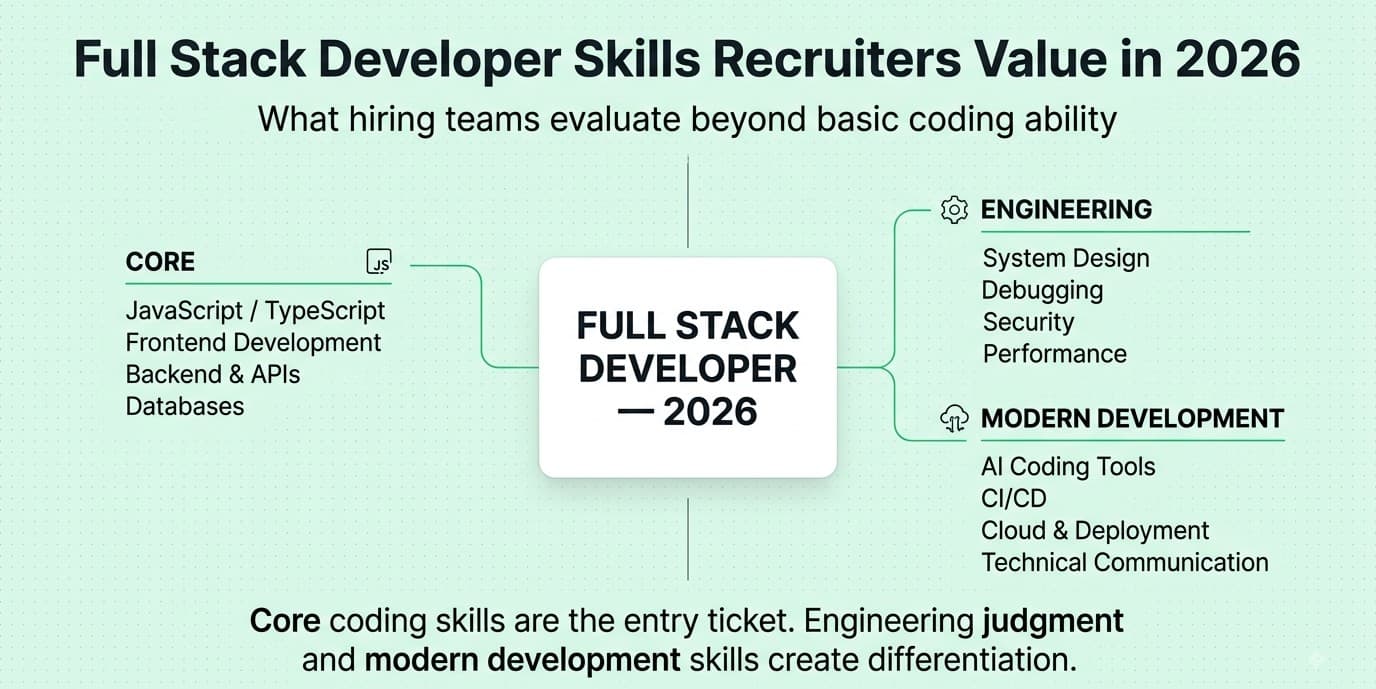
In 2026, recruiters hiring full stack developers prioritize strong fundamentals in JavaScript and one modern frontend framework, backend and API design judgment, database schema thinking, Git and deployment fluency, and the ability to work effectively with AI coding assistants without losing ownership of the code. Certifications matter far less than a deployed project you can explain end to end. Fresher expectations center on building complete, working features. Senior expectations center on system design tradeoffs and technical leadership across the stack.
Job descriptions for full stack developers have become almost interchangeable. React. Node. A database. "Strong problem-solving skills." What that list will not tell you is which of those skills a recruiter actually tests for, which ones get you past the resume screen, and which ones decide whether you get an offer or a rejection after a technically clean interview.
I have hired and interviewed full stack developers for over two decades, across startups shipping their first product and enterprises maintaining systems with millions of users. The pattern I see repeatedly is this: most rejected candidates were not lacking in raw coding ability. They were rejected because they could not demonstrate judgment, could not explain tradeoffs, or optimized their prep around the wrong signals entirely. This guide is built to close that exact gap.
We are going deep on what actually matters in 2026, not what mattered when bootcamps first standardized the MERN stack curriculum. AI coding assistants have changed a meaningful part of this job, and hiring has adjusted accordingly, even where job postings have not caught up yet.
FREE TO USE
25K+ INTERVIEWS4.8★ RATING68% IMPROVEMENT
Crack Your Dream Job
Real Interviews. Real Pressure. Practice until it feels easy.
- Seamless Interview Experience
- Resume & JD Questions
- Instant Personalized Feedback
How Hiring for Full Stack Developers Has Changed Going Into 2026
The biggest shift is that AI tools now generate boilerplate code, basic CRUD endpoints, and simple UI components in seconds, so recruiters spend less time testing raw syntax recall and more time testing architectural judgment, code review instincts, and the ability to reason about tradeoffs an AI tool cannot make for you.
A few forces are shaping hiring decisions this year:
- AI copilots have absorbed the boilerplate. Scaffolding a component, writing a basic REST endpoint, or generating a first-pass form with validation takes minutes with tools like Copilot, Cursor, or Claude. Recruiters know candidates use these tools, so live coding rounds increasingly test whether you understand what the generated code does, not whether you can type it fast.
- System design questions have moved earlier in the pipeline. Companies used to reserve system design for senior interviews. Many now ask a lightweight version even at the mid-level, because the mechanical coding bar has dropped in relative importance while architectural reasoning has not.
- Full stack has come to mean "can own a feature end to end," not "knows a long list of technologies." Hiring managers increasingly favor candidates who can take a feature from a database table to a deployed, monitored production endpoint over candidates who list ten frameworks but have shallow depth in each.
- Security and performance awareness are tested earlier in the process. With more code being AI generated, companies are more worried about developers who ship vulnerable or inefficient code without noticing, so basic security and performance literacy now shows up in mid-level interviews, not just senior ones.
None of this means core coding ability stopped mattering. It means core coding ability is now the entry ticket, and the skills layered on top of it decide who actually gets hired.
Read More :- How to prepare for Full stack developer interview in 2026
Core Fundamentals
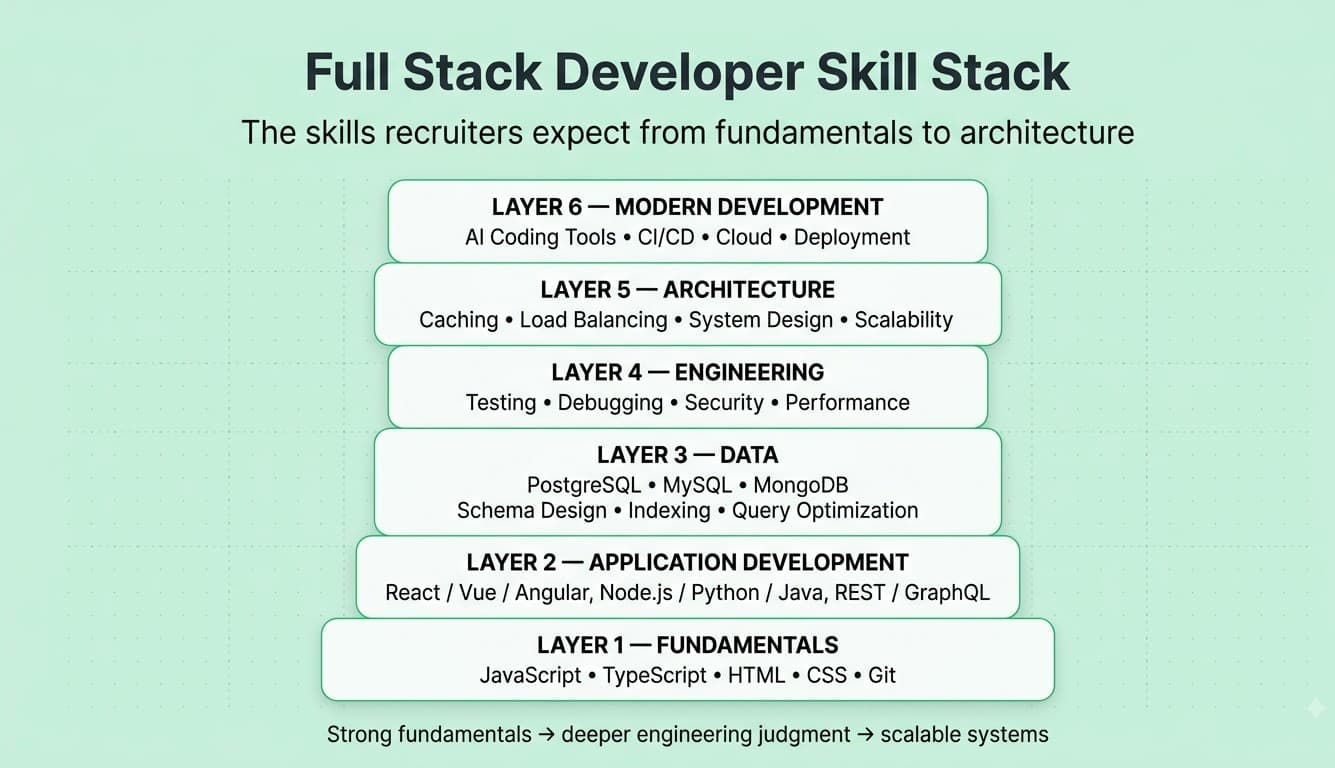
JavaScript and TypeScript Fundamentals
Why Recruiters Prioritize This Skill
Nearly every modern full stack role touches JavaScript somewhere in the pipeline, whether on the frontend, the backend through Node, or both. Recruiters treat weak fundamentals here as a serious red flag because frameworks change every few years, but the underlying language does not, and candidates who only know a framework's patterns without the language beneath them struggle the moment something breaks outside the framework's happy path.
What Recruiters Actually Expect in 2026
Deep comfort with closures, asynchronous behavior including promises and async/await, and the event loop is assumed for anyone beyond entry level. TypeScript fluency has shifted from a nice-to-have to a default expectation at most companies with any real codebase, because it is now the industry standard for anything beyond a small prototype.
Interview Evaluation
- Resume screening: recruiters look for TypeScript explicitly mentioned rather than JavaScript alone, especially past entry level.
- Technical interviews: questions about closures, this-binding, and asynchronous execution order that expose whether a candidate understands the language or has memorized framework patterns.
- Practical rounds: debugging a snippet with a subtle async bug, such as a race condition in a loop of API calls.
Real Workplace Example
A dashboard needs to fetch data from three different endpoints and combine the results before rendering. A developer without solid async fundamentals writes code that renders a partial or incorrect state because they did not properly await all three calls, a bug that only shows up intermittently in production under real network latency.
Fresher Expectations
Understands variable scope, closures at a working level, and can explain the difference between synchronous and asynchronous code with a simple example.
Mid-Level Expectations
Comfortable debugging race conditions, understands TypeScript generics and interfaces well enough to design reusable types, not just annotate existing code.
Senior-Level Expectations
Makes team-wide decisions about type strictness, shared type definitions across frontend and backend, and mentors others on why a particular async pattern is safer than another.
Common Mistakes
Candidates often can use async/await correctly in simple cases but cannot explain what happens if you forget to await a promise inside a loop, which reveals memorized syntax rather than real understanding.
How to Build This Skill
Deliberately write and break asynchronous code: build a small script that fetches from multiple APIs, then introduce bugs on purpose, like removing an await, and observe exactly what breaks and why.
Example Interview Questions
"What will this code log, and why?" followed by a snippet with a closure inside a loop. "Explain the difference between Promise.all and running awaits sequentially, and when you would choose each."
Strong Sample Answer Direction
A strong answer explains the underlying mechanism, the event loop and microtask queue, in plain language, rather than just stating the correct output without reasoning.
Git and Version Control Discipline
Why Recruiters Prioritize This Skill
Every team codebase depends on clean, reviewable git history. Recruiters have learned that poor git habits, like giant unreviewable commits or force pushes over shared branches, cause real friction and slow down entire teams, so this gets evaluated even though it rarely appears as a dedicated interview question.
What Recruiters Actually Expect in 2026
Comfort with branching strategies, writing atomic commits with clear messages, resolving merge conflicts confidently, and using pull requests as a collaboration tool, not just a formality to click through.
Interview Evaluation
Portfolio and GitHub reviews where recruiters look at commit history quality, not just the final code, and sometimes a live exercise involving resolving a merge conflict.
Real Workplace Example
Two developers modify the same file for unrelated features. A developer comfortable with git resolves the conflict cleanly and confirms nothing broke. An uncomfortable developer either avoids the conflict by working around it awkwardly or accidentally overwrites a teammate's change.
Fresher Expectations
Can commit in logical, small chunks, write clear commit messages, and open a basic pull request.
Mid-Level Expectations
Resolves merge conflicts independently, understands rebasing versus merging tradeoffs, and writes commits that make a future code review easy.
Senior-Level Expectations
Sets branching and release strategy for a team, and uses git history as a debugging tool, tracing when and why a bug was introduced using bisect or blame.
Common Mistakes
Committing large, unrelated changes together, which makes code review and rollback far harder than necessary, and writing commit messages like "fix" or "update" that carry no information.
How to Build This Skill
Go back through your own GitHub history and rewrite three old commit messages to be clear and specific, then practice this discipline going forward on every project, including personal ones.
Example Interview Questions
"Walk me through how you would resolve a merge conflict in a shared branch." "How do you decide what belongs in one commit versus multiple commits?"
Strong Sample Answer Direction
Strong answers describe a clear personal system, not just theoretical knowledge of git commands, since recruiters are testing habits, not command memorization.
Technical Skills
Frontend Framework Depth (React, Vue, or Similar)
Why Recruiters Prioritize This Skill
Frontend frameworks are how most user-facing product work actually gets built. Recruiters test this skill heavily because shallow framework knowledge, copied from tutorials, tends to produce components that work in isolation but break under real state complexity or scale.
What Recruiters Actually Expect in 2026
Beyond basic component and hook usage, recruiters expect state management judgment: knowing when local state is enough versus when a global store is warranted, and performance awareness around unnecessary re-renders. AI generated component scaffolding is assumed, so the differentiator is knowing when the generated approach is wrong for the situation.
Interview Evaluation
Live coding rounds building a small feature, often followed by a deliberate follow up asking the candidate to optimize or refactor their own solution, testing depth beyond the first working version.
Real Workplace Example
A form with several interdependent fields keeps causing the entire page to re-render on every keystroke. A developer with real framework depth identifies the cause, unnecessary prop drilling or a poorly scoped context, and fixes the actual architectural issue rather than patching it with a memoization band-aid that hides the symptom.
Fresher Expectations
Builds functional components with hooks correctly, understands props versus state, and can explain why a component re-renders.
Mid-Level Expectations
Makes deliberate state management architecture decisions, understands performance implications of context and prop drilling, and writes reusable, well-composed components.
Senior-Level Expectations
Sets frontend architecture standards for a team, decides when a heavier state management library is worth its complexity cost, and mentors others on component design patterns.
Common Mistakes
Reaching for a heavy state management solution before it is needed, and not understanding why a component re-renders, leading to scattered, ineffective performance fixes.
How to Build This Skill
Build one moderately complex application, like a multi-step form with shared state or a dashboard with filters, and deliberately try two different state management approaches to feel the tradeoffs firsthand rather than reading about them.
Example Interview Questions
"Why is this component re-rendering more than expected, and how would you fix it?" "When would you reach for a global state library instead of context or local state?"
Strong Sample Answer Direction
Strong answers discuss tradeoffs specific to the scenario given, rather than reciting a general opinion about state management tools, since the "right" answer depends heavily on context.
Backend and API Design
Why Recruiters Prioritize This Skill
An API is a contract other developers, including frontend teammates and external partners, depend on for years. Recruiters treat API design as a strong signal of overall engineering maturity because a poorly designed API creates ongoing pain long after the original developer has moved on.
What Recruiters Actually Expect in 2026
Beyond writing working endpoints, recruiters expect thoughtful decisions around REST resource naming, proper status code usage, validation and error handling, and increasingly, comfort discussing when GraphQL or another approach fits better than REST for a given use case.
Interview Evaluation
System design style questions asking candidates to design an API for a given feature, followed by probing questions about edge cases like pagination, rate limiting, and versioning.
Real Workplace Example
A mobile team consuming an API needs to paginate through thousands of records efficiently. A developer without real API design experience returns everything in one response or implements pagination inconsistently across endpoints, creating performance problems and confusing client-side code.
Fresher Expectations
Builds working CRUD endpoints with correct status codes and basic input validation.
Mid-Level Expectations
Designs consistent, well-documented APIs across a feature area, handles pagination, filtering, and error responses thoughtfully, and considers backward compatibility when making changes.
Senior-Level Expectations
Sets API design standards across the organization, makes build versus buy decisions for infrastructure like authentication or rate limiting, and reviews API designs from other teams for long-term maintainability.
Common Mistakes
Inconsistent naming and status code usage across endpoints, and designing an API around the current frontend's exact needs instead of a stable, general-purpose resource model.
How to Build This Skill
Design and build a small API for a real project, then intentionally add a new client, like a second frontend or a script, and notice where your original design choices cause friction.
Example Interview Questions
"Design an API for a bookmarking feature. Walk me through your resource structure and why." "How would you handle versioning an API that external partners depend on?"
Strong Sample Answer Direction
Strong answers ask clarifying questions about consumers and scale before designing, rather than jumping straight to endpoint names.
Database Design and Query Optimization
Why Recruiters Prioritize This Skill
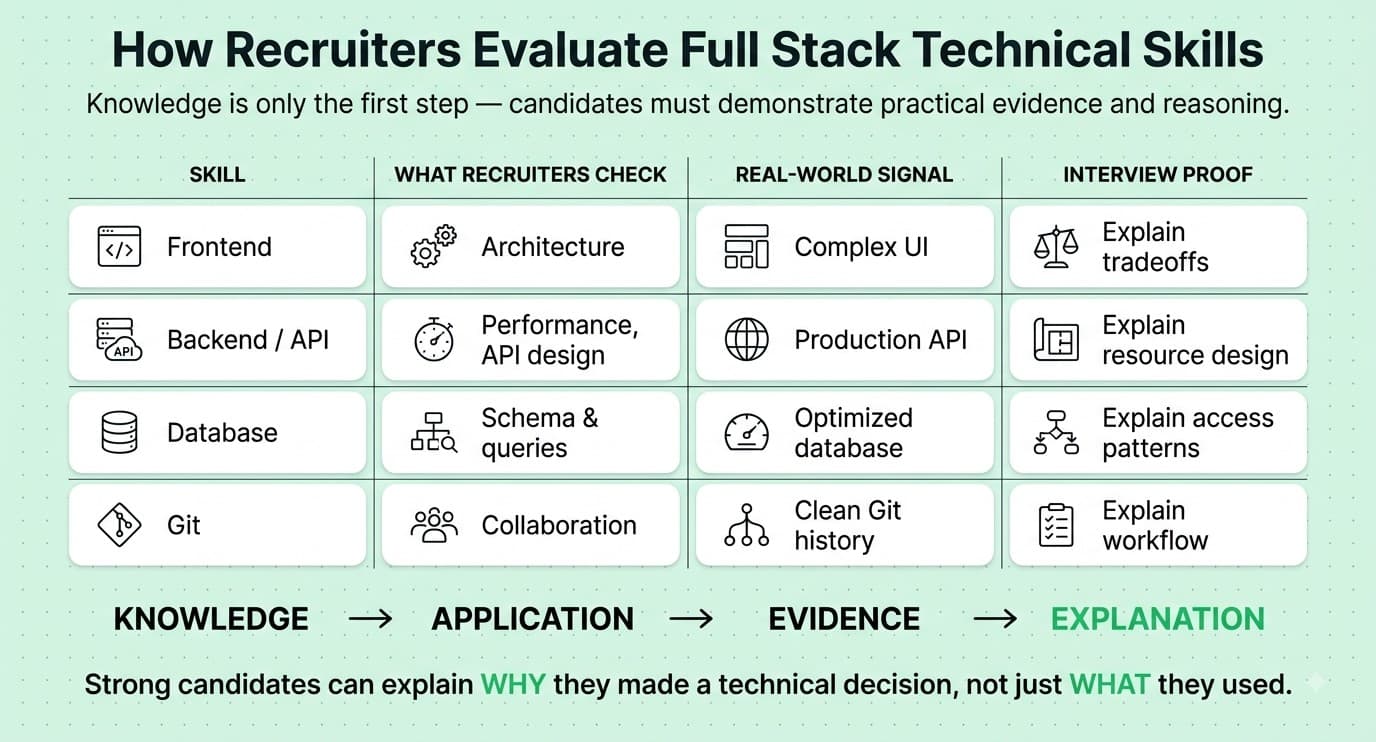
A poorly designed schema creates problems that compound for years and are expensive to fix once real data and dependent code exist. Recruiters test this because it reveals whether a candidate thinks ahead about data integrity and scale, or just makes it work for the demo.
What Recruiters Actually Expect in 2026
Comfort with normalization tradeoffs, indexing strategy, and understanding when a relational database is the right choice versus a document store. Basic query performance literacy, knowing why a query is slow and how to fix it, is now expected earlier in careers than it used to be.
Interview Evaluation
Schema design exercises given a feature description, and sometimes a query optimization exercise given a slow query and an explain plan.
Real Workplace Example
A social feed feature works fine with a hundred test users but grinds to a crawl in production with real traffic because the query joins several large tables without proper indexing. A developer with real database depth catches this during design, not after a production incident.
Fresher Expectations
Designs a normalized schema for a simple feature and writes basic queries with joins correctly.
Mid-Level Expectations
Understands indexing strategy, can read a query execution plan at a basic level, and makes reasonable normalization versus denormalization tradeoffs for performance.
Senior-Level Expectations
Makes database technology selection decisions for new systems, designs for scale from the start on high-traffic features, and leads migration strategy for schema changes on live systems.
Common Mistakes
Over-normalizing a schema to the point of hurting query performance for the most common access patterns, and not considering indexing until a query is already slow in production.
How to Build This Skill
Take a project you have already built and deliberately load it with a large volume of realistic sample data, then find and fix the slowest queries using an execution plan, since performance problems rarely show up with small test datasets.
Example Interview Questions
"Design a schema for a simple e-commerce order system." "This query is slow on a large table, how would you investigate and fix it?"
Strong Sample Answer Direction
Strong answers explain the access patterns the schema needs to support well before proposing table structures, since good schema design starts from how data will actually be read and written.
Business and Problem-Solving Skills
Debugging and Root Cause Analysis
Why Recruiters Prioritize This Skill
Writing new code is a small fraction of a real developer's time. Most of the job is understanding, fixing, and extending existing systems, often under production pressure. Recruiters test debugging specifically because it reveals how a candidate thinks under pressure with incomplete information, which is close to impossible to fake.
What Recruiters Actually Expect in 2026
A systematic approach: reproducing the issue, narrowing down where it originates, and forming and testing hypotheses, rather than randomly changing code until something works. Comfort using AI tools to help investigate is expected, but blind trust in AI generated diagnoses without verification is a clear red flag.
Interview Evaluation
Live debugging exercises with an intentionally broken codebase, evaluated on process and communication, not just whether the bug gets fixed.
Real Workplace Example
A production error only happens for a small subset of users. A developer with strong debugging instincts narrows it down methodically, checking what those users have in common, rather than guessing at random causes, and eventually traces it to a timezone edge case affecting users in one specific region.
Fresher Expectations
Can reproduce a bug reliably and use basic tools like console logs or a debugger to narrow down the cause.
Mid-Level Expectations
Debugs confidently across the full stack, from frontend behavior to backend logs to database state, and forms hypotheses methodically instead of guessing.
Senior-Level Expectations
Debugs complex, intermittent production issues involving multiple systems, and builds tooling or monitoring that makes future debugging faster for the whole team.
Common Mistakes
Making random changes hoping something fixes the issue, and fixing the visible symptom without identifying or documenting the actual root cause, which often lets the bug resurface elsewhere.
How to Build This Skill
Practice narrating your debugging process out loud while working through real bugs, even alone, since building the habit of explaining your reasoning as you go is exactly what interviewers are evaluating.
Example Interview Questions
"Walk me through how you would investigate a bug that only happens in production, never locally." "Tell me about a hard bug you fixed. How did you find the root cause?"
Strong Sample Answer Direction
Strong answers show a clear method, not just a lucky guess that happened to work, and explain what was ruled out along the way.
System Design and Architecture Thinking
Why Recruiters Prioritize This Skill
As AI tools handle more of the line-by-line coding, the ability to design a system that scales, stays maintainable, and makes sensible tradeoffs has become a sharper differentiator, and it now gets tested earlier in careers than it used to.
What Recruiters Actually Expect in 2026
At the mid-level, a working understanding of how to structure a moderately complex feature, including basic caching, load handling, and separation of concerns. At the senior level, full system design covering scalability, reliability, and cost tradeoffs across an entire architecture.
Interview Evaluation
Dedicated system design interviews, increasingly appearing even at mid-level for candidates with three or more years of experience, evaluated on the clarity of tradeoff reasoning, not a single "correct" diagram.
Real Workplace Example
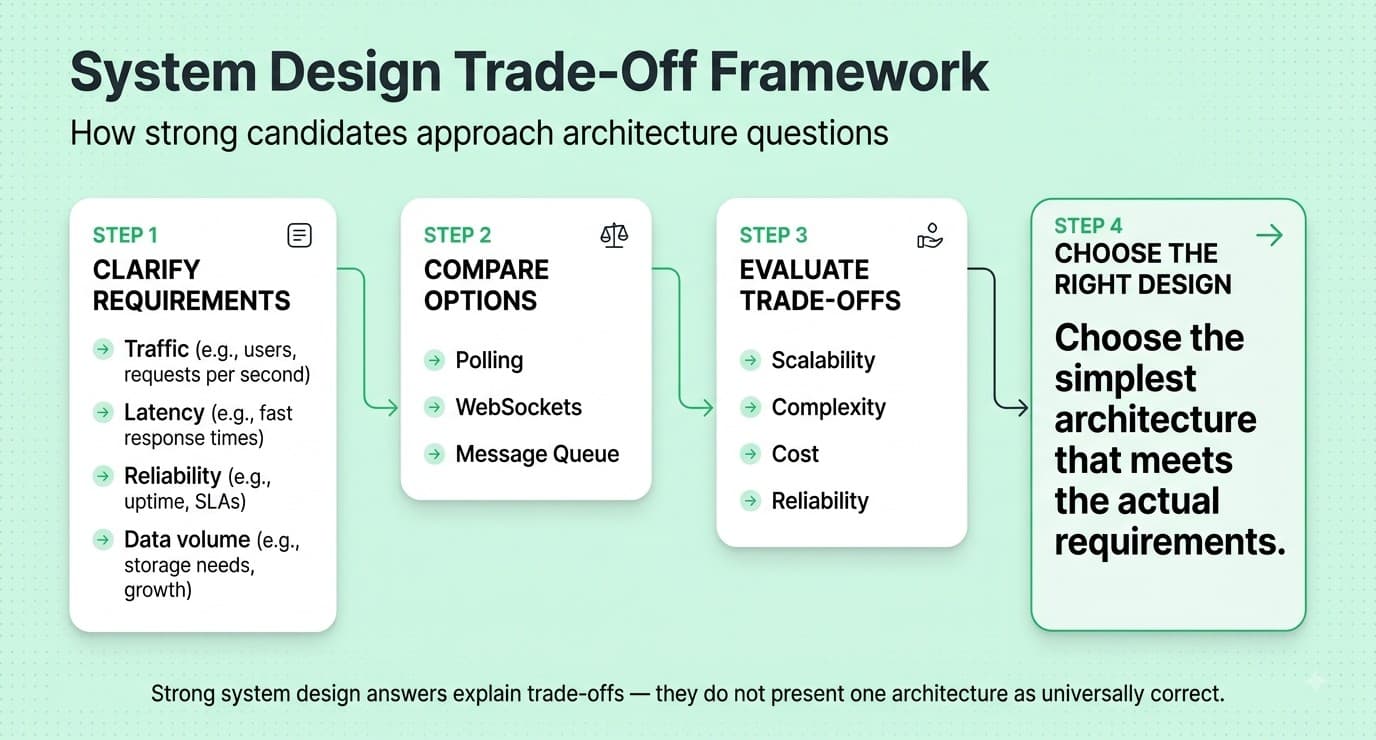
A feature needs to notify users in near real time. A developer with system design maturity considers polling versus websockets versus a message queue, weighs the operational complexity of each against actual requirements, and picks the simplest approach that meets the real need instead of the most technically impressive one.
Fresher Expectations
Can reason about the basic structure of a single feature, like separating a data layer from business logic from presentation.
Mid-Level Expectations
Designs a moderately complex feature considering scale, caching, and failure handling, and can explain the reasoning behind each choice.
Senior-Level Expectations
Designs systems for scale and reliability across an entire product, makes build versus buy and technology selection decisions, and communicates architecture tradeoffs clearly to both engineers and non-technical stakeholders.
Common Mistakes
Over-engineering a solution for a scale the product will never reach, and under-engineering a system that has an obvious near-term scaling need, both of which reveal a lack of grounded tradeoff thinking.
How to Build This Skill
Take a feature from a personal project and explicitly write out three different ways to architect it, along with the tradeoffs of each, even if you only build one, since the practice of comparing options builds the reasoning muscle recruiters are testing for.
Example Interview Questions
"Design a URL shortening service. Walk me through your approach and tradeoffs." "How would you design a notification system that needs to handle sudden spikes in traffic?"
Strong Sample Answer Direction
Strong answers start by clarifying scale and requirements before proposing a design, and explicitly name the tradeoffs of their chosen approach rather than presenting it as the only correct answer.
FREE TO USE
8k+ SESSIONS92% FLUENCY4.9★ RATING
Speak With Confidence
Real Conversations. Real Scenarios. Speak until it feels natural.
- Real-Time Speaking Practice
- Guided Conversation Flows
- Instant AI Feedback
Communication and Collaboration Skills
Code Review and Technical Communication
Why Recruiters Prioritize This Skill
Code review is where most real technical communication happens on a team, far more often than formal presentations. Recruiters test this because a developer who cannot give or receive feedback constructively creates friction that slows down an entire team over time.
What Recruiters Actually Expect in 2026
The ability to explain a technical decision clearly in writing, and to give feedback on someone else's code that is specific and actionable rather than vague or purely stylistic nitpicking.
Interview Evaluation
Some companies now include a mock code review round, showing candidates a pull request and asking them to leave comments, evaluated on the quality and tone of the feedback given.
Real Workplace Example
A teammate submits a pull request with a subtle bug in error handling. Strong technical communication looks like a comment explaining exactly what input would break it and why, with a suggested fix, rather than a vague "this looks off" that leaves the author guessing.
Fresher Expectations
Writes clear pull request descriptions explaining what changed and why, and responds constructively to feedback without becoming defensive.
Mid-Level Expectations
Gives specific, actionable code review feedback to teammates, and can explain technical tradeoffs in writing clearly enough that a less technical stakeholder can follow the gist.
Senior-Level Expectations
Sets code review culture and standards for a team, and uses code review as a mentoring opportunity rather than just a gatekeeping step.
Common Mistakes
Leaving vague feedback like "this could be better" without specifics, and treating code review purely as a bug hunt instead of also an opportunity to share context and reasoning.
How to Build This Skill
Practice reviewing open-source pull requests and writing feedback as if you were the reviewer, even if you never submit it, purely to build the habit of specific, constructive technical writing.
Example Interview Questions
"Here is a pull request, what feedback would you leave?" "Tell me about a time you disagreed with a code review comment. How did you handle it?"
Strong Sample Answer Direction
Strong answers show curiosity and specificity, asking why a choice was made before assuming it was wrong, rather than issuing a flat correction.
AI and Automation Skills
Working Effectively With AI Coding Assistants
Why Recruiters Prioritize This Skill
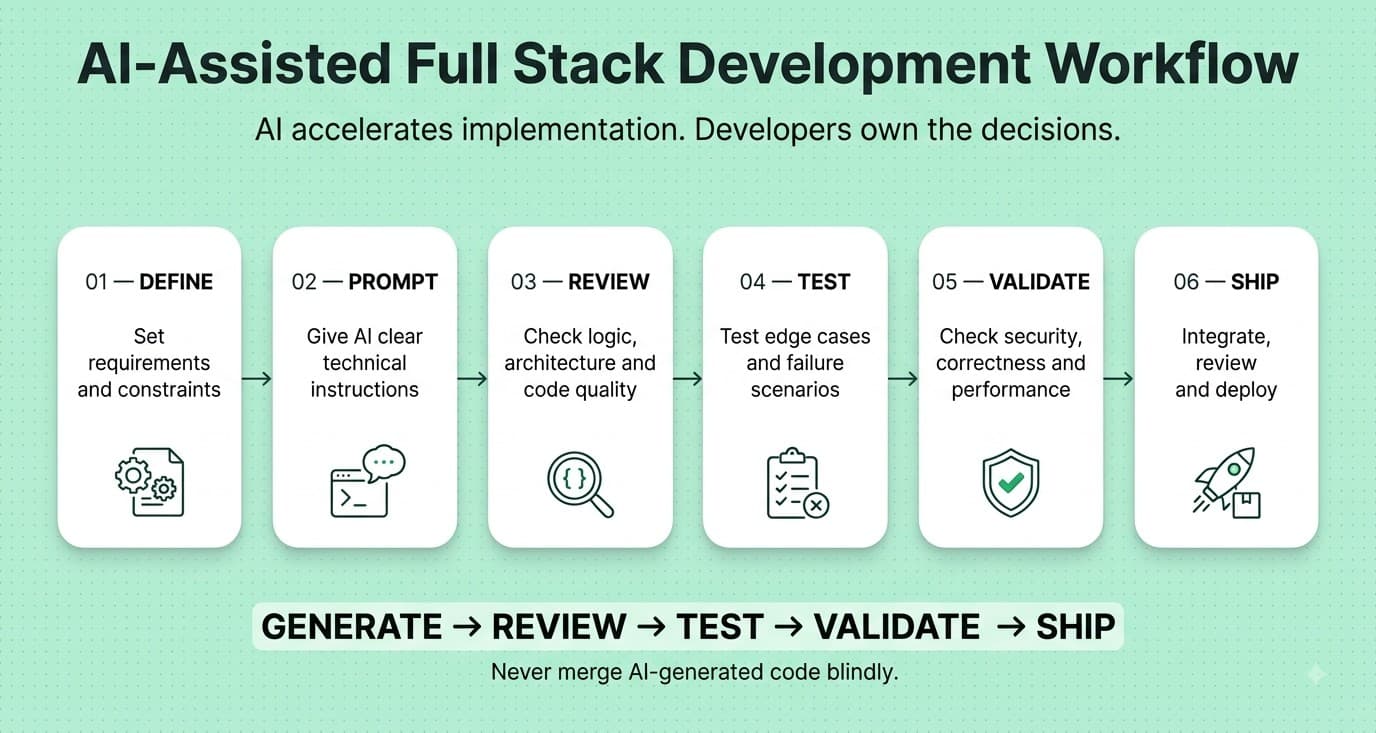
By 2026, most engineering teams assume candidates already use AI coding tools daily. What recruiters actually test is whether a candidate directs these tools well and catches their mistakes, rather than shipping unreviewed AI output.
What Recruiters Actually Expect in 2026
Ability to prompt an AI tool precisely for a coding task, and just as importantly, to review the generated code critically for correctness, security issues, and fit with the existing codebase before merging it.
Interview Evaluation
Some interviews now include a round where candidates are shown AI generated code and asked to find bugs, security issues, or design problems in it, testing review instincts directly.
Real Workplace Example
An AI assistant generates a working login endpoint, but stores a password comparison using a method vulnerable to timing attacks. A developer who reviews AI output critically catches this before it ships; one who does not, does not.
Fresher Expectations
Uses AI tools to speed up boilerplate and routine code, but reviews and tests the output rather than merging it directly.
Mid-Level Expectations
Knows which tasks are safe to delegate heavily to AI and which require careful human design first, and consistently catches subtle bugs or security issues in AI generated code.
Senior-Level Expectations
Sets team norms for responsible AI tool usage, balancing velocity gains against code quality and security risk, and trains others on effective review habits for AI assisted code.
Common Mistakes
Merging AI generated code without testing it against edge cases, and at the other extreme, refusing to use AI tools at all, which recruiters increasingly view as a productivity and adaptability concern rather than a principled stance.
How to Build This Skill
Deliberately ask an AI tool to generate a moderately complex function, then spend as much time reviewing and testing it as it would have taken to write from scratch, specifically looking for edge cases and security issues it may have missed.
Example Interview Questions
"How do you decide when to trust AI generated code versus writing something critical by hand?" "Here's some AI generated code, what security or correctness issues do you see?"
Strong Sample Answer Direction
Strong answers demonstrate specific review habits and named examples of catching a real issue, not general statements about being "careful" with AI tools.
Read More: Top 100 Full stack developer interview questions
Skills Recruiters Value More Than Certifications
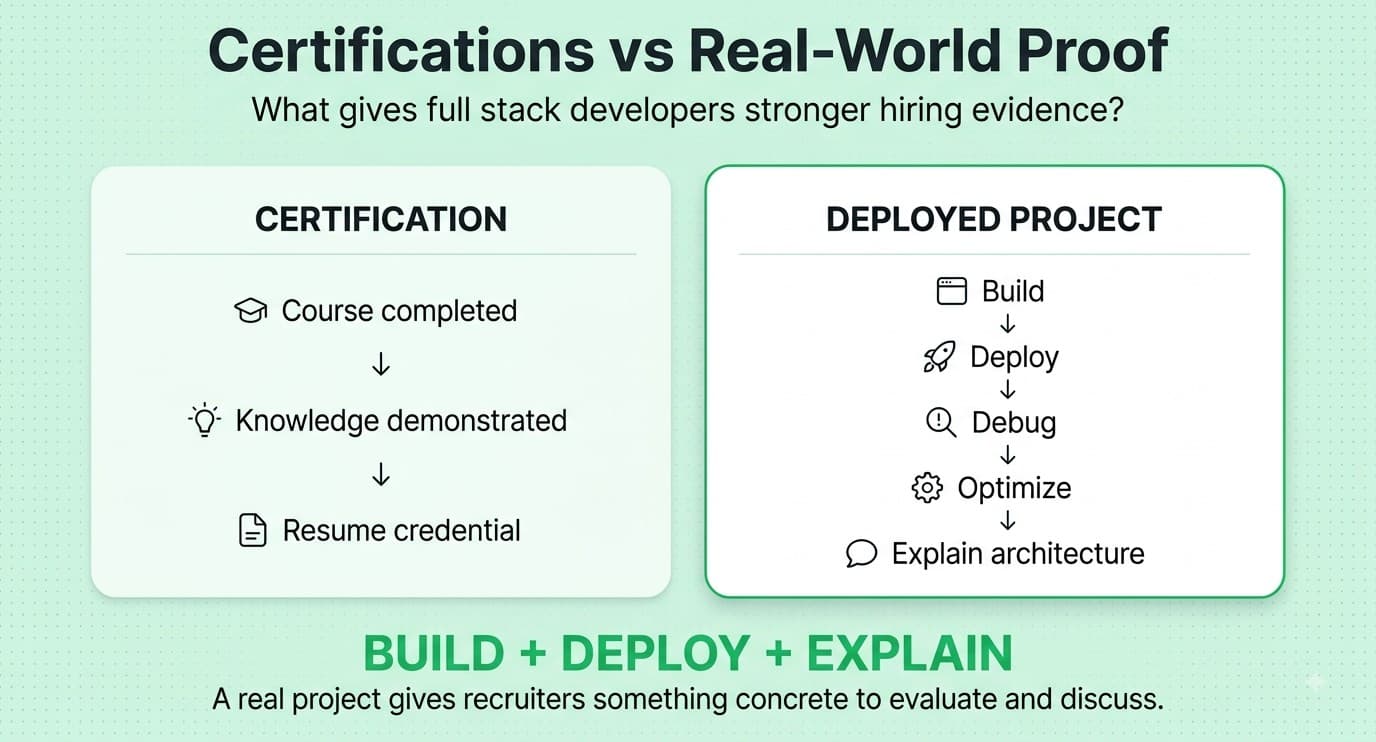
Certifications prove you completed a course. A deployed, working project you can explain end to end proves you can actually do the job. Most hiring managers weight a real project, even a modest one hosted on a free tier, well above a certification badge, because deploying and maintaining something real surfaces problems a course never forces you to solve, like handling a production error, managing environment variables securely, or dealing with a dependency update that breaks your build.
Certifications still hold value in specific situations, mainly for career switchers with no other proof of technical ability, or as a minor tiebreaker between two similarly strong candidates. But recruiters consistently report seeing candidates with a wall of certificates and no project they can speak about with real depth for more than a couple of minutes. If you are deciding where to invest your next twenty hours, building and deploying something real will outperform another certificate almost every time.
Skills That Are Becoming Less Important
- Memorizing syntax and boilerplate patterns. AI tools generate this instantly, so reciting a common pattern from memory carries far less weight than understanding when and why to use it.
- Deep specialization in a single framework's minor API details. Recruiters increasingly value transferable architectural judgment over memorized specifics of one framework's latest version.
- Manual, repetitive testing of basic CRUD flows. Automated testing and AI assisted test generation have reduced the value of manually clicking through basic flows as a core skill.
- Jquery and legacy DOM manipulation patterns, outside of maintaining specific legacy codebases, are rarely tested or expected anymore in modern hiring.
None of these skills are worthless. They are simply no longer meaningful differentiators on their own.
AI Is Changing Full Stack Development
Which skills AI is replacing: Boilerplate generation, basic CRUD scaffolding, simple component creation, and routine test writing are increasingly automated. Developers who define their value primarily by typing speed or memorized syntax face real pressure.
Which skills AI is enhancing: Developers who already have strong architectural judgment can now explore and prototype multiple approaches in the time it used to take to build one, because AI accelerates the mechanical implementation between decision and working code.
Which human skills are becoming more valuable: System design judgment, security awareness, debugging complex or ambiguous issues, and code review instincts are becoming sharper differentiators, because these require context and judgment that AI tools do not reliably have.
How professionals should adapt: Treat AI as a fast, occasionally wrong junior engineer working alongside you. Direct it clearly, review its output critically, and reinvest the time saved on the parts of the job that genuinely require your judgment: architecture, debugging, security, and mentoring.
This is a real shift, not a threat, for developers willing to adapt. Full stack developers who embrace this shift typically become more valuable, since they can now cover significantly more ground per week than before.
Skills That Instantly Differentiate Candidates
Common Skill Gaps Recruiters Notice
- Candidates who can build a feature with a framework but cannot explain what is happening underneath it when something breaks outside the typical pattern.
- Candidates who write working code but cannot explain the tradeoffs of their own architectural choices when asked.
- Candidates who treat every AI suggestion as correct without independently testing it for edge cases or security issues.
- Candidates who can debug in a familiar environment but freeze when a bug spans multiple systems, like frontend, backend, and database, at once.
- Candidates who cannot describe a real production issue they caused or found, and how they resolved it.
Learning Roadmap
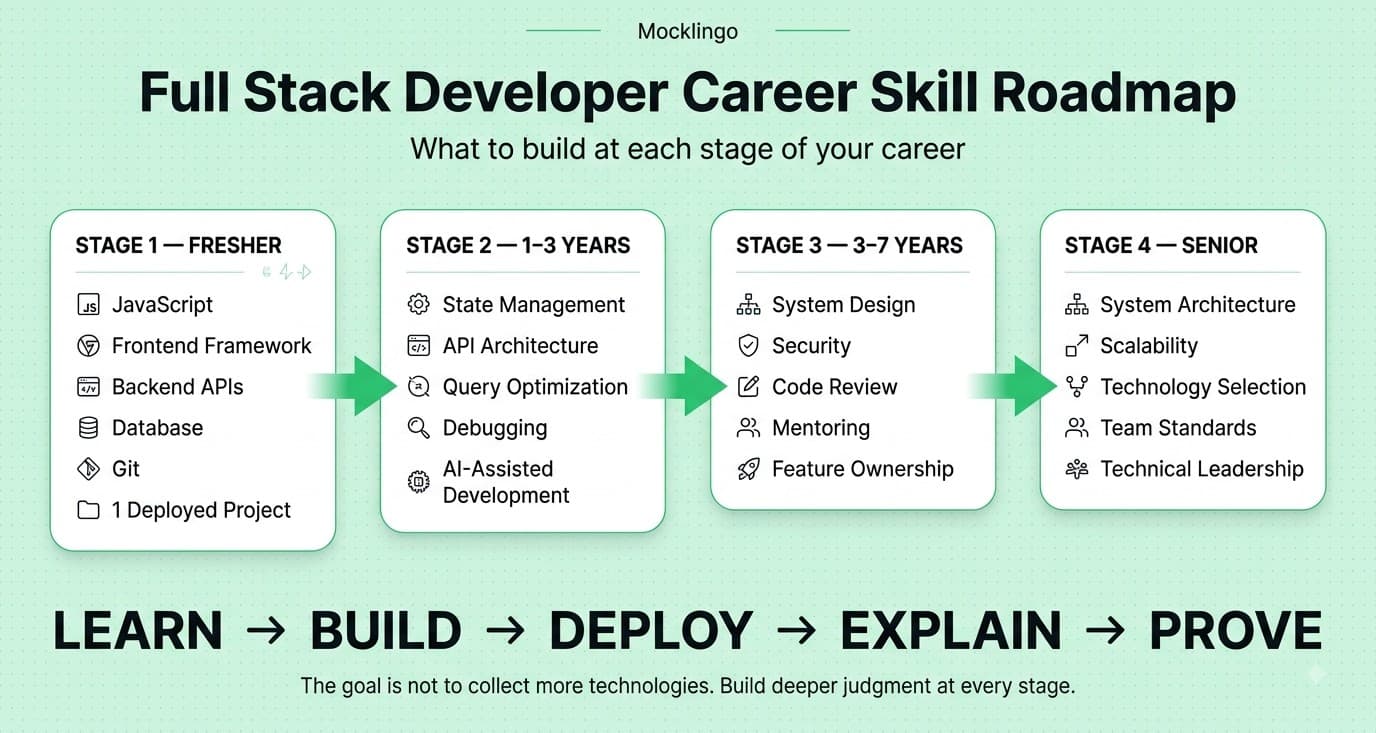
For Freshers
- JavaScript fundamentals, including closures and asynchronous behavior, before deep framework specialization.
- One frontend framework built to real depth, not surface familiarity.
- Basic backend API design and one relational database, including simple normalized schema design.
- Git discipline: atomic commits, clear messages, and comfort with pull requests.
- One deployed, end-to-end personal project you can explain in detail from database to UI.
For Professionals With 1 to 3 Years of Experience
- State management architecture judgment on the frontend, not just hook usage.
- API design standards: consistent naming, pagination, error handling, and versioning awareness.
- Query optimization basics and reading a database execution plan.
- Structured debugging habits across the full stack, not just the layer you are most comfortable in.
- Verified, hands-on use of AI coding assistants with a consistent review process.
For Professionals With 3 to 7 Years of Experience
- System design for moderately complex features, including caching and failure handling.
- Leading code review culture and mentoring junior developers.
- Security literacy: common vulnerabilities and how to catch them in review, including in AI generated code.
- Cross-functional communication, translating technical tradeoffs for non-technical stakeholders.
- Ownership of a feature area end to end, including monitoring and incident response.
For Senior Professionals
- Full system architecture design for scale, reliability, and cost tradeoffs.
- Technology selection and build versus buy decisions at the organizational level.
- Setting team-wide standards for code quality, AI tool usage, and technical practices.
- Hiring and evaluating other engineers using the same judgment-based standards outlined in this guide.
Self-Assessment Checklist
- I can explain what happens under the hood in an async/await function without looking anything up.
- I can explain why a specific component in my code re-renders and how I would fix unnecessary re-renders.
- I can design a normalized database schema for a moderately complex feature and explain my reasoning.
- I can read a query execution plan and identify why a query is slow.
- I have a deployed project I can walk through end to end, from database to UI, without notes.
- I can describe a real bug I debugged using a clear, methodical process, not a lucky guess.
- I can name at least two architectural approaches to a feature and explain the tradeoffs between them.
- I can catch and correct a security or correctness issue in AI generated code.
- I write pull request descriptions and code review comments that are specific and actionable, not vague.
If you checked fewer than six of these, prioritize the learning roadmap section above before applying widely.
Portfolio or Resume Proof
| Skill | Resume | Portfolio or GitHub | Interview Talking Point | |
|---|---|---|---|---|
| JavaScript/TypeScript fundamentals | Mention specific concepts applied (async patterns, type-safe APIs) instead of just "JavaScript" | Share a short post explaining a tricky async bug you solved | Publish a small utility library with clear TypeScript types | Explain the underlying mechanism, not just the fix |
| Frontend framework depth | Name the framework and the specific complexity handled (state management, performance) | Share a before/after performance improvement | Publish a moderately complex app, not a tutorial clone | Explain one architectural decision and its tradeoffs |
| Backend and API design | Quantify scale or consumers of an API you built | Share a post on an API design decision and why | Publish API documentation alongside your project code | Walk through your resource design reasoning |
| Database design | Mention schema decisions and their impact on performance | Share a query optimization story | Publish schema diagrams with your project | Explain access patterns that drove your design |
| Debugging and system design | Frame past work around problems solved, not just features shipped | Share a detailed debugging story | Include a README section on architecture decisions and tradeoffs | Walk through your investigation process step by step |
| AI collaboration | Mention specific AI-assisted workflows and your review process | Share a lesson learned catching an AI-introduced bug | Note in project READMEs where AI was used and how it was verified | Describe your verification and testing process |
Conclusion
The full stack developer role in 2026 rewards a specific combination: fundamentals solid enough to debug beneath any framework, architectural judgment that shows up before the first line of code is written, and the discipline to review AI generated work as critically as your own. None of these skills require rare talent. They require deliberate practice and honest feedback on where your reasoning has gaps, not just whether your code runs.
If explaining your architectural tradeoffs clearly under interview pressure is the part that feels shaky, that is a rehearsable skill, not a fixed trait. Structured, realistic mock interview practice, the kind that pushes you with real follow-up questions the way tools like Mocklingo's AI mock interview practice do, is exactly the space to build that fluency before it counts in an interview that decides your offer.
Practice Full stack developer interview with Mocklingo